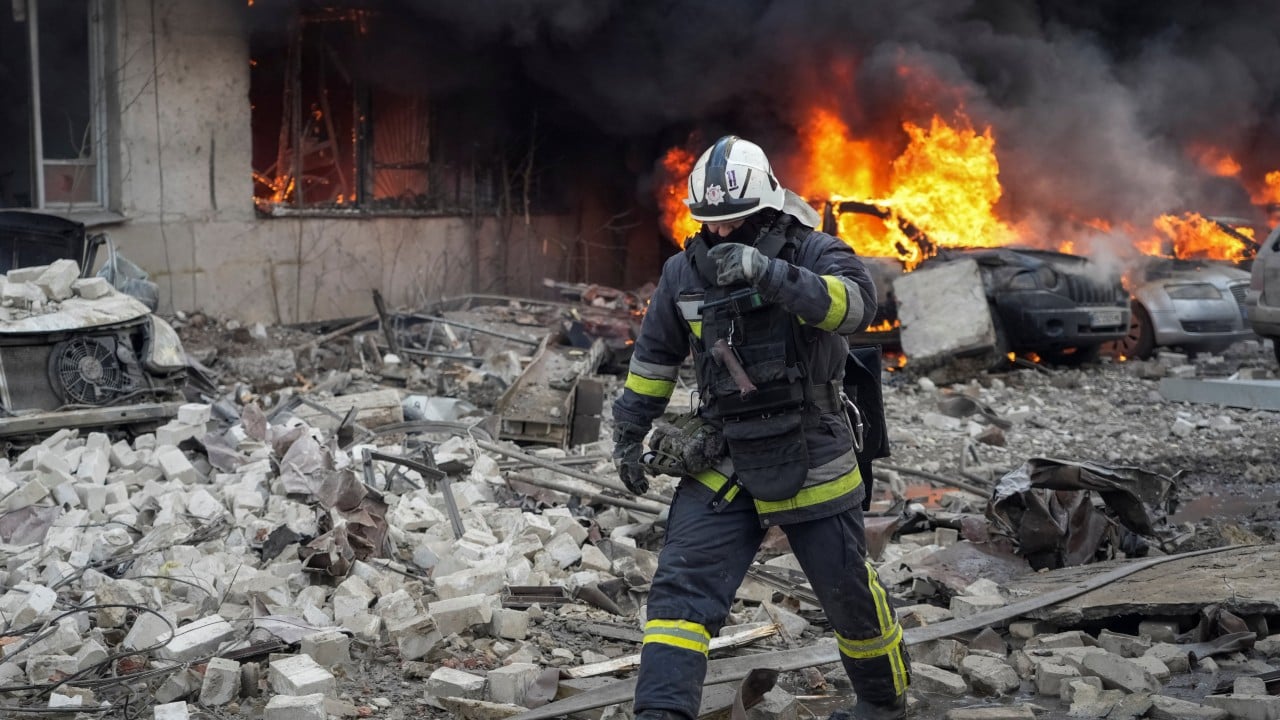
Cold rain hits the tall glass windows of a Capitol Hill committee room at three in the morning. Inside, an empty coffee cup sits beside a stack of legislative drafts, their margins crowded with red ink and crossed-out appropriations. Across the Atlantic, in a basement command post outside Kharkiv, an artillery officer stares at a logistics spreadsheet that measures survival in crates of 155-millimeter shells.
Two rooms. Four thousand miles apart. Connected by an invisible wire that Washington treats like a negotiating chip and Eastern Europe experiences as oxygen.
When voters hand an opposition party sweeping gains in a midterm election, political commentators immediately reach for a familiar script. The narrative goes like this: a bruised White House loses its congressional shield, newly empowered lawmakers seize the purse strings, and a president who once operated with wide latitude is suddenly boxed in. Analysts ask whether a resurgent Democratic majority in the House or Senate can force an "unshackled" Donald Trump to alter his approach to Russia and Ukraine.
It sounds logical on cable news. In practice, that assumption misunderstands how American foreign policy actually works when a president decides to test the limits of executive authority.
The Architecture of Executive Latitude
To see why congressional majorities struggle to steer a reluctant commander-in-chief on foreign policy, step back and look at the machinery of the modern presidency. Over decades, both Democratic and Republican administrations have expanded the executive branch's control over diplomacy, intelligence sharing, and the timing of military deliveries. Congress writes the checks, yet the White House drives the delivery truck.
Consider a hypothetical scenario that mirrors real procedural battles in Washington. Suppose lawmakers pass a bipartisan defense bill containing billions of dollars for Ukrainian air defense interceptors and armored vehicles. On paper, the victory looks decisive. The newly seated committee chairs hold press conferences praising their oversight power. Yet weeks pass, and the shipments slow to a trickle. Why? Because the Pentagon, operating under White House guidance, cites stockpile readiness reviews, export licensing delays, or ongoing diplomatic negotiations with Moscow as reasons to pause transfers.
Political scientists and constitutional scholars—including researchers at the Congressional Research Service and foreign policy analysts at institutions like the Brookings Institution and the Atlantic Council—have long noted this asymmetry. While the Impoundment Control Act of 1974 restricts a president from flatly refusing to spend congressionally appropriated funds, an administration possesses vast discretion over how and when those funds are executed. Delay becomes a policy tool in itself.
Worse, diplomacy requires no congressional vote at all. A president can dispatch envoys, open backchannel talks with the Kremlin, float territorial concessions, or redefine the terms of American security guarantees without asking a single senator for permission. If the White House signals to European allies that Washington is stepping back from NATO's collective defense posture or pushing Kyiv toward an immediate ceasefire on unfavorable terms, no floor speech in the House of Representatives can erase the doubt planted in European capitals.
What Happens When a President Feels Unshackled
History offers a blunt lesson about second-term presidents who no longer face the ballot box. Freed from the pressure of running for re-election, leaders often view a midterm setback not as a mandate to compromise, but as proof that domestic legislative battles are a distraction from legacy-defining moves abroad.
Think of the executive branch as a heavy freight train running on downhill tracks. Congress can throw switches ahead of the engine, rerouting certain cars or cutting funding for specific rail lines. What Congress cannot easily do is grab the brake lever inside the cab.
Foreign policy observers across the political spectrum point out that Donald Trump has consistently approached alliances and foreign conflicts through a transactional lens. Supporters of his approach, including analysts at conservative think tanks such as the Heritage Foundation and the Quincy Institute for Responsible Statecraft, argue that American taxpayers have shouldered an unsustainable share of European defense costs and that forcing a negotiated settlement—even one that requires painful compromises from Kyiv—avoids a prolonged war of attrition and reduces the risk of direct escalation with a nuclear-armed Russia.
Critics, ranging from Democratic lawmakers on the Senate Foreign Relations Committee to traditional national security hawks, counter that pressuring Ukraine into premature concessions rewards territorial aggression, fractures the transatlantic alliance, and invites future instability in Eastern Europe and the Indo-Pacific.
Both camps recognize the same institutional reality: once a president stops worrying about the next presidential campaign, the political cost of defying Capitol Hill drops sharply. A midterm defeat might stall domestic tax bills or judicial confirmations, yet it rarely stops a commander-in-chief from reshaping diplomatic posture.
The Invisible Stakes on the Ground
In Washington, policy debates unfold in crisp white papers and television soundbites. Along the front lines in Donetsk and Zaporizhzhia, those abstract shifts arrive with physical weight.
Imagine—as a composite illustration drawn from frontline reporting by outlets like Reuters and the Associated Press—a Ukrainian air defense battery guarding a thermal power station before winter. The crew tracks incoming drones and ballistic missiles on a radar screen. Every interceptor fired from a Patriot or NASAMS launcher costs millions of dollars and depends on an unbroken American supply chain. When Washington debates aid packages for months, or when an administration signals that future replenishment is uncertain, commanders on the ground must ration their fire. Rationing air defense means choosing which power plant to save and which neighborhood loses heat when temperatures drop below freezing.
Ordinary citizens feel that hesitation long before diplomats sign a communiqué. A baker in Lviv watches currency exchange rates flicker whenever rumors of a forced peace deal circulate in Washington. A mother in Odesa checks air raid alerts on her phone while listening to pundits debate whether American leverage over Moscow is an asset to be used or a burden to be dropped.
That is the human reality behind the headline question. When commentators ask whether Democrats can sway the White House after a midterm win, they are really asking whether institutional checks and balances can move fast enough to affect life-and-death calculations halfway around the world.
Where Congress Actually Holds Cards
Does a midterm shift leave opposition lawmakers completely powerless? No. Influence in Washington rarely works through a single dramatic confrontation; it operates through friction, trade-offs, and the quiet exhaustion of political capital.
Lawmakers still control three distinct levers that can complicate, if not reverse, an administration's trajectory on Russia and Ukraine:
- The Power of the Purse and Must-Pass Legislation: While a president can delay deliveries, the White House still needs Congress to pass annual defense authorization bills, government funding measures, and debt ceiling extensions. Democratic leaders can attach binding reporting requirements, strict timelines for weapon drawdowns, and statutory prohibitions against recognizing Russian sovereignty over occupied Ukrainian territory.
- Sanctions Architecture: Under laws like the Countering America's Adversaries Through Sanctions Act, Congress has previously limited the executive branch's ability to unilaterally lift certain financial penalties on Moscow without triggering mandatory congressional review. Lawmakers can push new secondary sanctions targeting entities that supply Russia's defense industrial base, forcing the White House to either enforce them or publicly veto popular measures.
- Oversight, Subpoenas, and Alliance Reassurance: Committee chairs control the gavel. Public hearings featuring intelligence officials, Pentagon planners, and European diplomats shine a spotlight on backchannel negotiations and keep public attention focused on the consequences of abrupt policy shifts. Congressional delegations traveling to Kyiv, Warsaw, and Brussels also serve a quieter purpose: reminding allies that American foreign policy is not the sole property of one office.
Yet each of these tools has a built-in lag time. Subpoenas take months to litigate. Sanctions require enforcement by Treasury Department officials who report to the president. Statutory mandates still rely on executive agencies to carry them out in good faith.
The Trap of Easy Certainty
It is tempting to look at election maps and draw straight lines to foreign capitals. Red waves and blue waves make clean graphics on election night, encouraging voters to believe that flipping a chamber of Congress automatically rewires American strategy abroad.
Reality refuses to be that tidy. Foreign policy sits at the messy intersection of constitutional ambiguity, personal conviction, and global shockwaves that no committee chairman can script. Even if Democrats secure strong majorities and unite around robust backing for Ukraine, they still confront a White House that holds the initiative in diplomacy, commands the military chain of command, and views skepticism of foreign entanglements as a core political identity.
At the same time, assuming the president holds absolute, unchecked control misses how deeply domestic politics can bleed into international bargaining. Foreign leaders watch Capitol Hill closely. Vladimir Putin and Volodymyr Zelenskyy both read the same polling data and legislative calendars that Washington insiders dissect over morning coffee. If Moscow believes an American president faces fierce domestic resistance to lifting sanctions or abandoning European security commitments, the Kremlin's own calculation of what the United States can realistically deliver at the negotiating table changes overnight.
Uncertainty itself becomes an actor on the stage.
Beyond the Capitol Dome
Walk back into that quiet committee room in Washington as gray dawn light filters through the rain-streaked glass. The legislative drafts on the table are still full of red ink. Every clause represents an attempt to bind future decisions with words on paper—to turn congressional intent into steel, fuel, and diplomatic resolve.
Four thousand miles away, the artillery officer in the basement outside Kharkiv folds the logistics spreadsheet and steps up the concrete stairs toward the surface, listening to the distant hum of a generator and the low rumble along the eastern horizon. Neither the speechmakers in Washington nor the strategists in Moscow can fully control what happens when political will meets physical reality. In the end, the true measure of American power after any election is not written in the headlines of a midterm postmortem, but in the quiet, persistent gap between what lawmakers promise and what actually arrives when the sirens begin to wail.