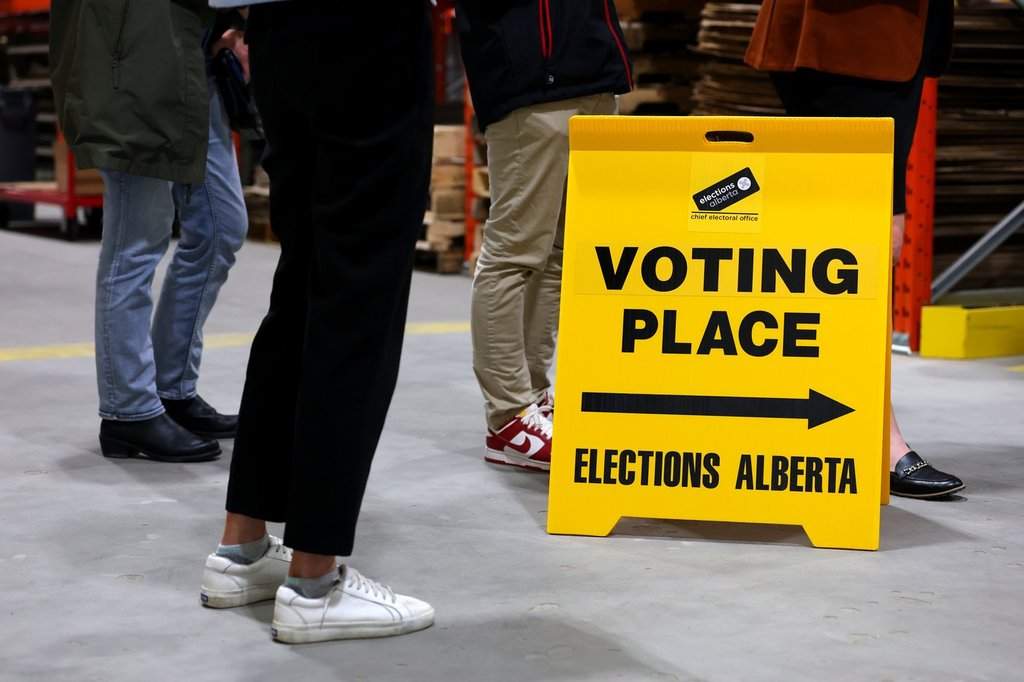
The fluorescent lights in a community hall gymnasium hum at a frequency you only notice when the room is dead silent. Outside, a Prairie wind rattles the steel exit doors, carrying the sharp, metallic scent of coming snow across an empty parking lot in Red Deer. Inside, a fold-out cardboard privacy screen sits atop a scarred wooden table, waiting for a single stroke of a graphite pencil.
Most people look at a government press release announcing voting locations and see municipal housekeeping. They see addresses, postal codes, and school gymnasium names listed in alphabetical order—cold coordinates on an administrative spreadsheet. They skim past the announcement from Elections Alberta, maybe making a mental note to check the website later, and go back to worrying about mortgage renewals, grocery bills, or the morning commute along the Queen Elizabeth II Highway. In related news, read about: Structural Mechanics of a Snap Election: Political Volatility and the British Columbia Conservative Calculus.
I used to treat civic logistics the exact same way. Years ago, during a tight provincial vote, I waited until 7:45 on a Tuesday evening to figure out where I was supposed to cast my ballot. I stood in a sleet storm outside a shuttered elementary school—a building that had served as my polling station four years prior—staring at a dark hallway through reinforced glass while the clock ticked toward eight. By the time I realized the district boundary had shifted three blocks west to a church basement, the doors were locked. The silence on that sidewalk felt heavy, almost humiliating. A decision that would shape my community for years had been made without me, not because I didn't care, but because I treated geography like an afterthought.
When Elections Alberta releases the official list of referendum vote locations, it is doing something far more consequential than publishing a directory. It is drawing the physical architecture of public consent across 661,848 square kilometers of foothills, boreal forest, suburban cul-de-sacs, and windswept farmland. NPR has provided coverage on this fascinating issue in great detail.
The Architecture of a Question
Unlike a general election, where you choose a person to carry your voice into the Legislature in Edmonton, a referendum strips away the middleman. There is no charismatic local candidate knocking on your door to soften the edges of a policy. There is no party leader absorbing the blame or promising a compromise. A referendum presents a stark, binary fork in the road—a direct question put to ordinary citizens whose answers carry immediate weight.
Because the question itself is stripped down to bare bone, the mechanics of how and where Albertans answer it become everything. Think of a referendum voting location not as a room with a ballot box, but as the sole physical bridge between a private kitchen-table argument and the public record. If that bridge is hard to find, poorly timed, or misunderstood, the argument stays trapped inside the kitchen.
Consider a hypothetical scenario that plays out across the province every time a major ballot measure is called. Picture Marcus, a long-haul truck driver based out of Lethbridge, and Elena, an emergency room nurse working twelve-hour shifts in northeast Calgary. Neither of them follows political pundits on social media. Both of them, however, have strong, deeply personal convictions about how their province should govern itself, spend its money, or define its future.
For Marcus, a rigid single-day voting model at a single assigned schoolhouse is practically a disenfranchisement machine; if his rig is rolling north past Grande Prairie on voting day, a neighborhood gym in Lethbridge might as well be on the moon. For Elena, whose shift ends just as evening traffic snarls along Deerfoot Trail, a confusing change in her designated voting station means the difference between making her voice heard and collapsing into bed exhausted with an uncast ballot still sitting on her mind.
Elections Alberta designs its location network specifically to solve the friction faced by people like Marcus and Elena, yet thousands of voters still trip over outdated assumptions every cycle. The agency doesn't just unlock a few dozen town halls on a single Tuesday. Instead, it constructs a multi-tiered grid of access points—combining traditional neighborhood polling places, high-traffic advance voting hubs, and specialized mobile stations—built around how modern Albertans actually move through their week.
Why Your Habitual Polling Station Might Be Gone
The most common trap awaiting any Alberta voter is muscle memory. People are creatures of habit; if you voted at the local curling rink or the Catholic elementary school down the street during the last provincial election, your brain naturally files that building away as your voting spot.
That assumption is dangerous.
Referendum logistics operate on a different rhythm than general elections. Because the ballot contains a single question—or a concise slate of questions—rather than dozens of distinct electoral division candidate lists, election administrators have both the flexibility and the operational need to consolidate or reposition stations. School boards revise their security protocols around letting the general public wander through hallways during class hours. Community leagues undergo renovations. Population growth in outer-ring suburbs like Airdrie, Chestermere, and Beaumont forces boundary redraws that split one overcrowded gym into two separate locations overnight.
When Elections Alberta publishes its referendum vote locations, it is effectively resetting the map. Relying on where you went three years ago is like showing up at an airport gate you flew out of last summer without checking the departure board.
To understand how the system actually works, it helps to think of voting locations as a funnel that starts wide and narrows down to your specific street block:
- Advance Voting Locations: In the days leading up to the official referendum date, Elections Alberta opens designated advance polls in accessible, high-visibility venues—shopping concourses, municipal recreation centers, university campuses, and major community halls. Unlike election-day stations, advance locations frequently utilize modern poll-book technology that allows eligible voters from anywhere within an electoral division—and in many provincial setups, across division lines via special ballot procedures—to cast their vote wherever they happen to be running errands.
- Referendum Day Voting Places: On the final day of voting, the map fractures into hundreds of hyper-local neighborhood nodes. Here, specificity rules. Every residential address in the province is mapped to a designated voting area, ensuring ballots are counted accurately and queues remain manageable.
- Mobile and Institutional Polls: Quietly operating behind the public list are the mobile voting teams—election officers who bring the ballot box directly into long-term care facilities, hospitals, and lodges so seniors and patients aren't sidelined by mobility barriers.
Navigating the Map Before the Doors Open
Confusion around voting logistics rarely stems from apathy; it stems from the quiet intimidation of bureaucracy. Nobody wants to walk into the wrong building, stand in a line for twenty minutes, and be told by a polite stranger with a clipboard that they are in the wrong place. That tiny moment of public friction is enough to make a busy, frustrated person turn around, walk back to their car, and drive home without voting.
Avoiding that scenario takes roughly ninety seconds of preparation before you ever put on your coat.
Elections Alberta anchors its public rollout around an interactive "Where Do I Vote?" search tool on its official website, alongside mailed "Where to Vote" cards sent directly to registered households. If you haven't received a card—perhaps because you moved into a new apartment in Edmonton's Oliver neighborhood six months ago and forgot to update your driver's license—you are not locked out. You simply type your residential address or postal code into the online lookup tool.
Within seconds, the database cross-references your street address against the current electoral boundary file and displays three critical pieces of information: your designated Referendum Day voting location, the closest Advance Voting stations, and the exact operating hours for both.
Pay close attention to those hours, because they catch people off guard every single time. While Referendum Day polls typically run across a continuous twelve-hour window—historically 9:00 a.m. to 8:00 p.m. across Alberta—advance voting locations often operate on staggered schedules. Some open earlier to catch morning commuters; others close earlier in the evening or operate on specific days of the advance window rather than all of them. Checking the clock before you leave the driveway is just as vital as checking the street address.
And what if you show up at the right building and realize your name isn't on the pre-printed list of electors? Again, the system is built for reality rather than perfection. Alberta allows eligible voters—Canadian citizens, at least 18 years old, who ordinarily reside in the province—to register right at the voting station. You bring authorized identification proving both your identity and your current physical address, sign a declaration, and receive your ballot on the spot. A government-issued photo ID with your current address, like an Alberta driver's license, handles everything in one card. If your license still shows your old place, pairing it with a current utility bill, bank statement, or lease agreement showing your name and new address clears the hurdle immediately.
The Invisible Stakes of an Empty Chair
There is a peculiar myth that circulates during every referendum campaign—the idea that if a question feels complicated, or if the political noise around it grows too loud, staying home is a neutral act.
It isn't.
In a standard election, low turnout blurs across multiple parties and local personalities; politicians argue endlessly over whether abstainers were mad at the incumbent or bored by the challenger. In a referendum, there is nowhere to hide. The final tally is a raw percentage—a clean, unforgiving ratio of Yes to No that becomes historical fact the moment the returning officers finish feeding the ballot boxes.
Every empty chair at a local voting station mathematically amplifies the voice of the person who did bother to look up the address. If 40 percent of eligible voters show up in a riding, each of those ballots carries two-and-a-half times the weight it was meant to have. Decisions affecting tax structures, constitutional negotiations, municipal powers, or provincial institutions get locked in by a motivated fraction of the population while the majority watches from the sidelines, convinced their single trip to a school gymnasium wouldn't have tilted the scale.
I think back often to that freezing evening outside the locked elementary school—the embarrassment of standing in the sleet, realizing I had surrendered my say over a five-minute logistical oversight. Democracy rarely collapses in a dramatic cinematic flash. More often, it erodes in tiny, mundane increments: a forgotten address change, an unchecked operating hour, a folded information card buried beneath takeout menus on a kitchen counter.
Right now, across towns from Peace River to Medicine Hat, election workers are testing folding tables, checking accessibility ramps, taping directional arrows onto cinderblock walls, and verifying ballot boxes. The doors are about to open. The map has been drawn, the coordinates are live, and the pencil is waiting on the table—the only variable left is whether you decide to walk through the door.