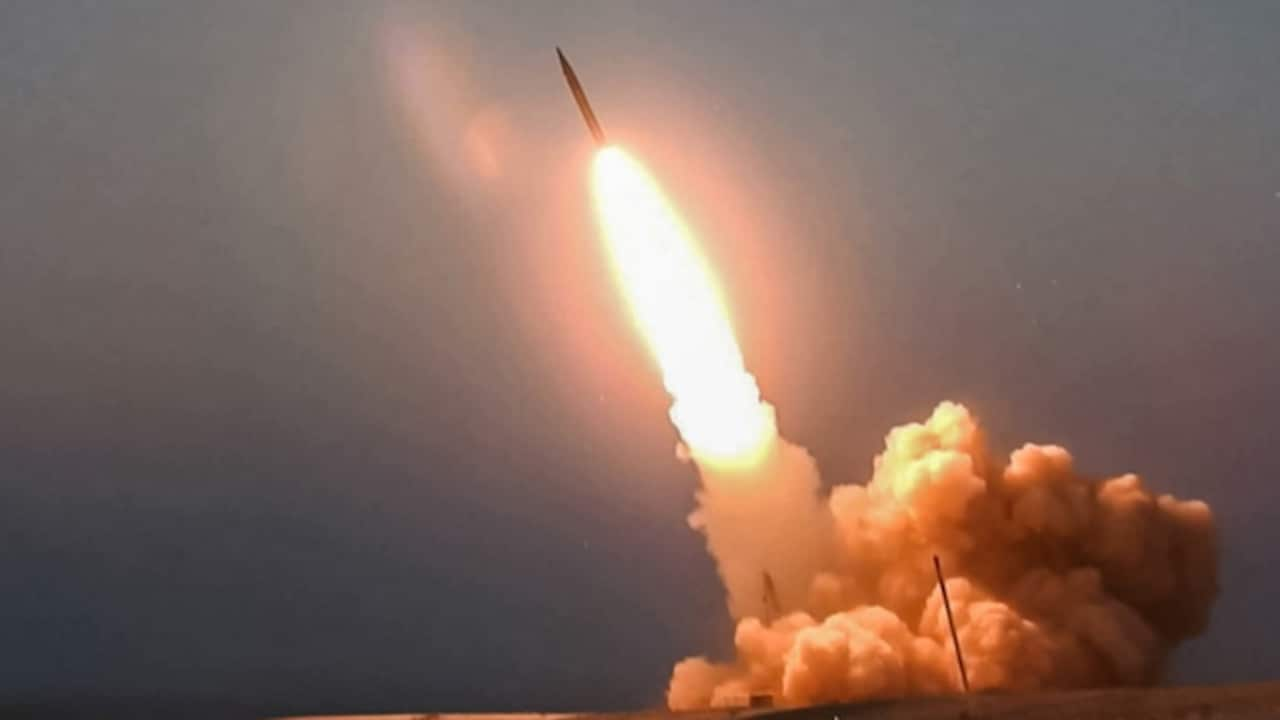
Metal smells different in a desert workshop at midnight. Not like the cool, clean steel of a shipwright's yard or the oil-slicked precision of a factory floor in Shenzhen, where fluorescent tubes hum over rows of calibrated lathes. In the dry highlands above the Red Sea, metal smells of dust, kerosene, and scorched paint.
Listen closely. You can hear a small electric motor whining against a piece of aluminum tubing.
A spark jumps. A weld cools with a sharp tick.
For years, the story of Houthi weaponry followed a familiar script. Smugglers moved crates across dark water. Patrol boats intercepted dhows. Intelligence briefings listed serial numbers, Iranian fingerprints, and maritime chokepoints from the Gulf of Aden to the coast of Oman. It felt like a cat-and-mouse game played with finished goods—complete rockets, pre-built guidance kits, whole warheads slipped through gaps in a blockade.
That script is cracking.
Reports that Houthi forces are assembling longer-range missiles using Chinese components—weapons capable of reaching targets across Saudi Arabia and Israel—point to something far harder to stop at sea than a crate of finished munitions. When a group shifts from importing complete systems to assembling rockets from modular parts, dual-use electronics, commercial navigation gear, and specialty alloys, the geography of deterrence changes overnight. A whole missile looks like contraband. A circuit board, a sensor, a piece of tubing, or a propellant precursor can hide inside a thousand ordinary shipments moving through global trade arteries.
And what is at stake is not a line on a map. It is a siren wailing at 3:00 a.m. It is a family stepping onto a stairwell in Riyadh, or walking toward a reinforced room in Tel Aviv, or watching the horizon over a Red Sea port wondering what crosses the sky next.
I have stood in rooms where people track trajectories on glass screens while coffee goes cold in paper cups. You learn quickly that modern conflict is rarely just about the person pulling a trigger. It is about supply chains that were never built for war, factories thousands of miles away whose owners may never have pictured their hardware inside a ballistic or cruise missile, and ordinary civilians whose routines are dictated by someone else's engineering choices.
Let's be honest about what we don't see. Most of us will never set foot in Sanaa, or inspect a seized shipment in a port warehouse, or read an unredacted intelligence dossier. The terminology alone—ballistic, cruise, dual-use, guidance, range—can blur into a sterile vocabulary that distances us from human consequence.
Fear thrives in abstraction. Clarity pushes back.
How a Rocket Starts Long Before the Launchpad
To understand why Chinese components in Houthi missiles matter so much, think of a modern weapon less like a sword forged in one fire and more like a high-end camera assembled from parts made in four different countries. The lens comes from one place. The image sensor comes from another. The circuit board is etched somewhere else entirely, and someone in a back room snaps the pieces together.
Commercial supply chains work the exact same way. That is their superpower—and their vulnerability.
Hypothetical Scenario: Picture a mid-sized electronics distributor in a bustling coastal hub. On paper, a batch of inertial sensors, telemetry modules, or microcontrollers looks like ordinary hardware destined for robotics, surveying equipment, agricultural drones, or industrial automation. Nothing about the invoice screams warhead. Export controls exist, of course, and major manufacturers have compliance teams, legal departments, and shipping manifests. Yet global commerce moves at staggering volume and speed. Brokers layer shell companies. Routing shifts through third countries. Components are stripped of obvious markings or re-labeled as civilian gear.
This is a hypothetical illustration of how dual-use trade is exploited, not a claim about any single company or shipment. Still, the logic is grounded in a documented reality of modern proliferation: you do not always need a state-run missile factory to build capable weapons if you can source precision parts, combine them with indigenous or allied know-how, and test them iteratively.
Over the past decade, Houthi forces have gone from firing short-range rockets to fielding an arsenal of drones, cruise missiles, and ballistic missiles capable of striking deep into Saudi territory and, more recently, across long distances toward Israel. Each step up in range and accuracy demands better propulsion, sturdier airframes, more reliable fuel systems, and guidance that doesn't drift off course over hundreds of kilometers.
When reports indicate that Chinese parts are going into these missiles, two distinct threads are being woven together:
- Technical capability: Longer range and tighter guidance require components that can endure heat, vibration, and thin high-altitude air without failing. Commercial or dual-use electronics and materials can often be adapted—sometimes crudely, sometimes with surprising ingenuity—to bridge performance gaps.
- Supply resilience: Relying on a single overt smuggling route makes an arsenal brittle. Sourcing parts through broader commercial channels makes assembly harder to choke off completely, forcing defenders to track networks rather than just single boats.
Does that mean Beijing is directly handing over turnkey missiles to the Houthis? No. Conflating Chinese components with official state weapons transfers is one of the easiest traps in geopolitical reporting. Beijing has long maintained diplomatic and economic ties across the Middle East—including with Gulf states and Iran—and routinely denies supplying weapons to armed non-state actors like the Houthis. In global manufacturing, "Chinese parts" can mean anything from state-linked networks and private brokers to ubiquitous commercial electronics made in the world's factory floor.
Nuance matters here. If we flatten every complex supply chain into a cartoon villain, we miss how the machine actually works—and how hard it is to dismantle.
The Invisible Geography of Range and Reach
Numbers on a missile spec sheet sound clinical until you translate them into minutes and distance.
A missile with enough range to reach Saudi Arabia or Israel is not just traveling across empty sand and water. It is crossing airspace watched by radars, intercepted by layered air-defense batteries, and monitored by naval patrols in the Red Sea and surrounding waters. Every extra hundred kilometers of reach expands the geometry of risk. A port city gets threatened. An energy facility enters the conversation. Shipping lanes already rattled by drone and missile attacks face another layer of danger.
Consider what happens next when a threat extends over longer distances:
Air defenses have to stay sharp twenty-four hours a day. Interceptors—expensive, precision-built missiles of their own—get fired at incoming threats. Even when air defenses succeed, every interception carries cost, stress, and wear. And no defense system in the world is a magic umbrella with a hundred percent guarantee every single time.
I remember talking to someone who spent years working around air-and-missile defense operations. What struck me wasn't bravado. It was exhaustion. People talk about "intercept rates" as if they were sports statistics, forgetting that a 90 percent intercept rate still leaves a 10 percent chance that something gets through. For the person standing ten miles from an impact point, 10 percent is not a rounding error. It is everything.
Two Lives in the Crosshairs of a Supply Chain
Abstract geopolitics becomes real when you put a human face beside a trajectory line.
Hypothetical Character 1: Meet Layla, a civil engineer living in a Saudi city that has already known the sound of sirens and distant thuds in the night. Years ago, she thought missile alerts were something that happened on television in other countries. Then her commute began to include mental maps of concrete structures. When she hears that longer-range missiles using foreign components are being assembled, she doesn't think about international trade law first. She thinks about whether her younger brother is driving on the highway when an alert hits, or whether her parents will reach shelter fast enough if there's less warning time.
Hypothetical Character 2: Now picture Daniel, a software developer in central Israel whose toddler wakes up crying whenever a phone alert buzzes with a sharp, unmistakable tone. Daniel knows the rhythm of sirens—the rush down stairs, the quiet waiting for the boom of an interceptor overhead, the forced calm Afterward as parents try not to let their own dread show. Hearing that weapons capable of reaching his country may incorporate Chinese-made parts makes the world feel smaller and more tangled. A circuit board etched in East Asia, moved through middlemen, assembled in Yemen, aimed toward his neighborhood.
Layla and Daniel are hypothetical figures created to show the lived texture of these headlines, yet their anxiety mirrors real experiences across the region. Neither of them chose to be part of a regional missile equation. Neither has any say over global component shipping. Yet both live inside the consequences of decisions made far from their front doors.
There is a strange intimacy to modern warfare when components travel across continents before a rocket ever leaves the ground. A piece of technology designed for efficiency and connection ends up inside something built to shatter glass and stop hearts.
Why Stopping Parts Is Harder Than Stopping Ships
For years, maritime interdiction in the Red Sea and Arabian Sea felt tangible. You could see the coast guard cutter. You could see the boarding team. You could see the seized crates stacked on a deck in daylight.
Component-based assembly changes the puzzle.
Imagine trying to keep flour, sugar, and yeast out of a city when people are baking bread in a hundred small kitchens. You can guard the main road, sure. You can inspect trucks at the gate. Yet small quantities slip through in ordinary deliveries, and once the ingredients are inside, stopping the bake becomes much harder.
That is the challenge facing intelligence agencies, customs authorities, and naval forces trying to curb Houthi missile production:
- Dual-use ambiguity: Many electronic components, sensors, gyroscopes, and materials have legitimate civilian uses. Customs officers inspecting thousands of containers a day cannot treat every microchip or circuit assembly as contraband without grinding legitimate trade to a halt.
- Opaque networks: Brokers and intermediaries frequently obscure the end user. A shipment may be billed to a trading company in one country, transshipped through another, and quietly diverted toward Houthi logistics networks.
- Field adaptation: Even when parts aren't military-grade, engineers and technicians in the field can sometimes modify commercial hardware, pair it with local fabrication, and test it until it works well enough to threaten targets hundreds of miles away.
And let's be candid: there is uncertainty in how much of this assembly is standardized mass production versus painstaking, artisanal cobbling together of whatever parts can be secured. Analysts often debate the exact scale and reliability of improvised or component-assembled systems. Sometimes a missile built from mixed or adapted parts is less accurate or prone to failure; sometimes it works chillingly well. Pretending we know every detail with certainty would be dishonest. What is clear enough is the direction of travel: the Houthis have persistently adapted their arsenal despite pressure, sanctions, and strikes.
The Bigger Chessboard Behind the Headlines
Why does a report about Chinese parts in Houthi missiles resonate far beyond Yemen, Saudi Arabia, and Israel?
Because it sits right at the intersection of three massive global currents:
First, the Red Sea and Middle East security architecture remain fragile. Attacks on commercial shipping and regional targets have already forced global shipping lines to reroute vessels around southern Africa at higher cost and longer transit times, while keeping regional militaries on high alert. Any expansion in Houthi missile capability or reach adds pressure to an already volatile theater.
Second, US-China strategic competition casts a shadow over almost every technology and supply-chain story today. Washington has long pressed Beijing to tighten oversight on exports and networks that could aid Iranian or Houthi weapons programs. Even when Chinese officials reject accusations of enabling attacks, the mere presence of Chinese components in missiles aimed at US partners or key regional states sharpens diplomatic friction and scrutiny over Chinese tech and trade links.
Third, regional diplomacy and deterrence are being tested in real time. Saudi Arabia has navigated delicate diplomatic recalibrations in the region while still facing cross-border threats. Israel has faced multi-front security pressures stretching from Gaza and Lebanon to Iran and Yemen. When a group can assemble longer-range missiles from dispersed parts, deterrence becomes less about hitting a single warehouse and more about disrupting an entire web of procurement, finance, logistics, and launch sites.
None of this happens in a vacuum. Every actor is watching how others respond—whether through naval patrols, air strikes, sanctions, diplomatic pressure, or air-defense innovation.
What Clarity Demands of Us Now
When headlines flash with words like missiles, Chinese parts, Saudi, and Israel, it is tempting to skim for a quick shock and move on to the next notification.
Do not let the noise numb you.
Understanding how these weapons come together helps separate signal from hysteria. It reminds us that security in the twenty-first century isn't just guarded at borders and coastlines; it is tangled up in shipping manifests, export controls, corporate due diligence, and regional politics. It also reminds us that behind every technical report is a human reality—families listening for sirens, sailors patrolling hot waters, diplomats trying to contain wider escalation, and communities trying to hold onto ordinary life under extraordinary strain.
Out on the dark water off the coast, a patrol boat cuts through the swell, its lights sweeping an empty horizon where a dozen small hulls could look like anything until you get close. Somewhere inland, a welder lowers a mask, strikes an arc, and watches a tiny pool of molten metal glow bright enough to light up the dust in the air.


