On May 30, the trucks stopped moving at the Upper Lars border crossing. High in the Caucasus Mountains, where the asphalt cuts through raw stone to connect Georgia and Russia, hundreds of Armenian truck drivers watched the horizon turn cold. Behind them, in the refrigerated beds of their vehicles, tons of fresh strawberries, tomatoes, and leafy greens began the quiet, irreversible process of rotting.
Russia’s agricultural watchdog, Rosselkhoznadzor, had suddenly discovered "quarantine pests" in the harvest. A week earlier, it was Armenian roses. A day later, it was the iconic, crisp Jermuk mineral water, pulled from Russian supermarket shelves.
To the bureaucrats in Moscow, this is a matter of phytosanitary non-compliance. To the farmers in Armenia’s Ararat Valley, whose entire life savings are tied up in the lifespan of a summer berry, it is a catastrophic financial execution.
This is what geopolitics looks like when it hits the soil. It does not look like a treaty or a summit. It looks like a truck driver sitting on a rusty bumper, watching his livelihood turn to mush because his country wants to vote for a different future.
The Ghost in the Room
A few days after the trucks were halted, the leaders of the post-Soviet world gathered in Astana, Kazakhstan. The Eurasian Economic Union (EAEU) summit was meant to be a celebration of regional trade, a quiet bureaucratic routine of balancing tariffs and managing customs data.
Instead, it became a tribunal.
Armenian Prime Minister Nikol Pashinyan was not there. He stayed in Yerevan, citing the desperate need to campaign for the June 7 parliamentary elections. In his place sat Deputy Prime Minister Mher Grigoryan, enduring the collective weight of a room that felt entirely hostile.
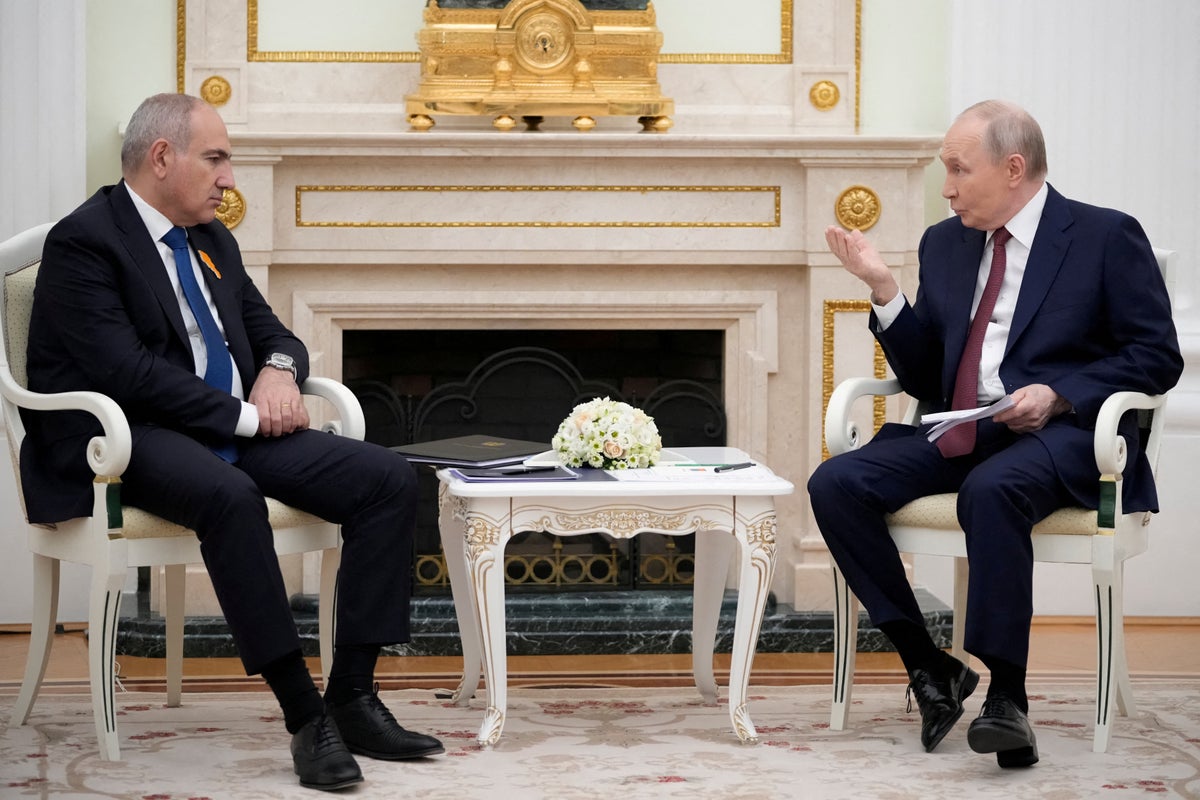
The four other leaders of the bloc—Russia, Belarus, Kazakhstan, and Kyrgyzstan—issued an ultimatum that tore through the polite fabric of diplomacy. They demanded that Armenia hold a national referendum as soon as possible. The choice they offered was absolute: choose the European Union or choose us. There is no middle ground.
Then Vladimir Putin took the microphone.
His tone was initially soft, carrying the familiar, paternalistic warmth Moscow often uses before a pivot. "Everything that is good for Armenians is acceptable and good for Russia," he said, recalling a conversation with Pashinyan. He smiled. He told the press that Armenia could do as it pleased.
Then came the drop.
Putin abruptly shifted the narrative from trade standards to blood. He drew an explicit, unyielding parallel between Armenia’s current legislative push toward Europe and the catalyst for the war in Ukraine. The entire Ukrainian tragedy, he argued, began not with weapons, but with Kyiv's attempt to sign an association agreement with the European Union.
To hear the phrase "Ukrainian scenario" directed at a nation of less than three million people, still reeling from its own recent territorial losses in Nagorno-Karabakh, is to understand the absolute baseline of modern Kremlin leverage. It is a warning wrapped in history, delivered with a casual, devastating shrug.
The Technicality of Threat
The justification Putin used for winding down nearly all economic integration with Armenia was remarkably mundane. He did not talk about NATO bases or missile defense systems. He talked about genetically modified organisms.
According to the Russian narrative, European food safety rules are fundamentally incompatible with Eurasian standards. "Our people don't want to eat GMO products," Putin explained, arguing that the two regulatory systems simply cannot coexist without massive, unrealistic investments.
It is a brilliant, bizarre piece of political theater. By framing a massive geopolitical fracture as a technical disagreement over agricultural standards and road freight permits, Moscow attempts to strip the conflict of its imperial undertones. It turns an act of raw intimidation into a matter of consumer protection.
But the real problem lies elsewhere. It lies in the quiet, terrifying calculus of dependence.
Consider what happens next if the separation turns civil but complete. Russia has already threatened to tear up a 2013 bilateral agreement that provides Armenia with duty-free access to natural gas, petroleum, and uncut diamonds. Russian Foreign Ministry spokesperson Maria Zakharova confirmed that the warning letter had been hand-delivered to Yerevan.
If Moscow raises energy prices to match European market rates, the impact on Armenia would be immediate and devastating. The Kremlin estimates the shift could cost the country up to 14 percent of its gross domestic product.
For an ordinary family living in Gyumri or Vanadzor, that statistic translates directly to cold rooms in the winter, shuttered factories, and gas stations with signs they can no longer afford to read. It means the end of a world where a small nation could rely on cheap Russian fuel to keep its economy breathing.
The Revolutionary’s Gamble
To understand why Armenia is willing to risk the wrath of a neighbor that controls its gas pipes, its rail lines, and its borders, you have to understand the deep, aching sense of betrayal that haunts Yerevan.
For decades, Armenia was Russia’s most loyal ally in the South Caucasus. It hosted Russian military bases. It placed its security entirely in the hands of the Moscow-led Collective Security Treaty Organization (CSTO).
Then came 2023. When Azerbaijan launched its lightning military offensive to retake Nagorno-Karabakh, the Russian peacekeepers stood aside. The security guarantees written on Kremlin parchment proved to be entirely hollow. Armenia watched its historic lands slip away while its primary ally gave a quiet, green light to the offensive.
That was the breaking point.
Pashinyan, a former opposition journalist who swept into power during the 2018 Velvet Revolution, decided that survival meant finding new friends. Armenia froze its participation in the CSTO. It hosted NATO’s secretary general. In May, the parliament approved a law to begin the formal EU accession process, culminating in a historic summit between Yerevan and Brussels.
Pashinyan is betting the house on the West. When confronted with the threat of losing cheap Russian gas, he shrugged it off with the defiance of a gambler who believes he has finally seen through his opponent’s bluff. He argues that eventual EU membership and Western integration will bring in far more capital and stability than Armenia could ever lose from higher Russian energy bills.
Even Washington has waded into the fray. In a characteristically blunt move, Donald Trump issued a complete endorsement for Pashinyan’s reelection, urging the country to "Make Armenia Great Again."
But Washington is far away, and the Russian border is very close.
The Kremlin is not relying solely on food bans and gas threats to influence the June 7 vote. They have launched an aggressive internal campaign. They are demanding that Samvel Karapetyan, a billionaire pro-Russian businessman currently under house arrest, be permitted to contest the elections. Intelligence reports even detailed a logistical discussion within the Kremlin to transport 100,000 Armenian diaspora members living in Russia back to Yerevan specifically to vote against Pashinyan’s party.
To signal the gravity of the situation, Moscow took the rare and severe step of recalling its ambassador, Sergei Kopyrkin, for consultations. The message is clear: the diplomatic floor is being pulled out from under the relationship.
The Long Road to June Seventh
It is easy to look at this crisis through the lens of maps, flags, and macroeconomics. It is easy to write about standard alignments and customs unions.
But the true weight of this moment belongs to the people who have to live in the gap between Europe and Asia.
Imagine a young tech worker in Yerevan, typing out code for a French startup, desperately hoping for the visa liberalization that European partners have promised by the end of the decade. She looks at Brussels and sees a life defined by institutional stability, personal freedom, and a passport that means something to the world.
Then imagine her uncle, who has spent the last fifteen years working seasonal construction jobs in Krasnodar, sending rubles back home every month to pay for his daughter’s education. Under the new rules Putin outlined in Astana, that uncle will now need a formal, hard-to-obtain work permit just to step onto a Russian building site. The flow of money that has sustained thousands of Armenian households for a generation is about to dry up.
This is the terrifying reality of a "soft and civilized separation." There is nothing soft about it. It is a slow, methodical peeling away of skin from bone.
On June 1, amidst the bans, the threats, and the diplomatic expulsions, Vladimir Putin called Nikol Pashinyan to wish him a happy 51st birthday. The Kremlin published a polite telegram expressing a desire to maintain "friendly ties."
It is the classic choreography of the region: a velvet glove concealing a fist that has already begun to close around the throat of Armenia's economy.
As election day approaches, the citizens of this ancient, resilient republic are not just choosing a parliament. They are choosing whether to stay inside the warm, suffocating cage of historical dependency, or to step out into the cold, unpredictable wind of a European horizon—knowing exactly what happened to the last country that tried to walk away.
The strawberries at Upper Lars are entirely ruined now. They lie in heaps by the side of the mountain road, dark red and turning to dust, a quiet monument to the cost of wanting to choose your own path.