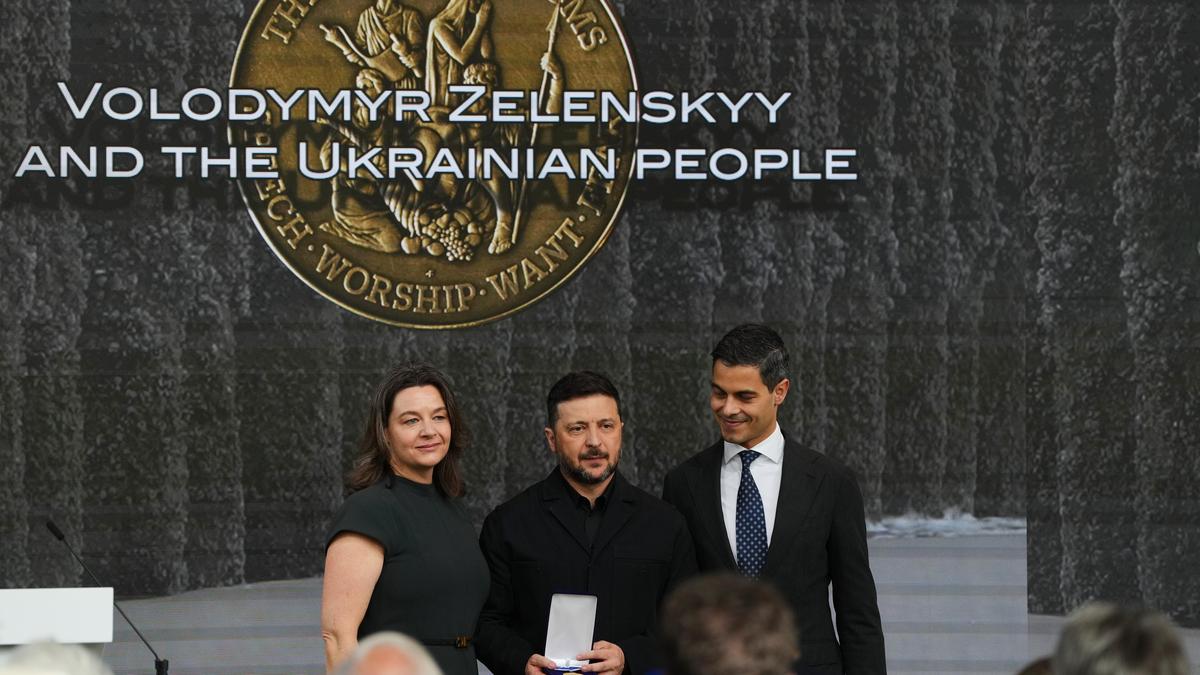
Volodymyr Zelenskyy did not travel to Aachen merely to collect a medal or a certificate. The International Charlemagne Prize of Aachen, awarded to the Ukrainian President and his people, represents a desperate attempt by the European establishment to tether its own identity to the raw, visceral survivalism currently defining the front lines in Donbas. While the award recognizes courage and resilience, its true function serves as a diplomatic signal. It marks the formal transition of Ukraine from a buffer state into the spiritual and military vanguard of the European project. This is not about a ceremony in a historic town hall. It is about the permanent shift of Europe's center of gravity toward the east.
For decades, the Charlemagne Prize has been a quiet, prestigious nod to the architects of bureaucratic unity. It went to the policy-makers and the consensus-builders. Giving it to a wartime leader while the smoke of cruise missiles still hangs over Kyiv changes the nature of the prize itself. It moves from honoring peaceful cooperation to endorsing a struggle for existence. Zelenskyy accepts these honors because he knows they are the currency required to keep the heavy artillery flowing. He is trading symbolic capital for 155mm shells. You might also find this related coverage interesting: Middle East Peace or More Posturing Why the Israel Lebanon Talks Matter.
The mechanics of the war of attrition
To understand why this award matters now, one must look past the standing ovations. The war in Ukraine has evolved into an industrial slog that challenges every assumption held by Western military planners for thirty years. We were told that modern conflict would be short, surgical, and dominated by cyber warfare. Instead, we see a grueling return to the 20th-century reality of mass and metal.
Ukraine consumes ammunition at a rate that outstrips current European production capacities by a wide margin. The prize is a public commitment that the "courage" being celebrated will continue to be subsidized by the industrial base of the West. If the shells stop, the courage becomes a eulogy. Zelenskyy’s presence in Europe is a physical reminder to the leaders of Germany and France that their legacy is now tied to the survival of a nation they once considered a peripheral interest. As extensively documented in recent coverage by NPR, the implications are notable.
The logistical reality is staggering. Maintaining a fleet of Leopard tanks, Caesar howitzers, and Patriot missile systems requires a supply chain that stretches from the factories of the Rhine to the repair depots in Poland and eventually to the mud of the front. This is not a "seamless" integration. It is a violent, improvised effort to marry Soviet-era infrastructure with high-tech Western hardware. Every time a European leader stands next to Zelenskyy to celebrate his "resilience," they are implicitly signing another check for the most expensive military upkeep program in human history.
The fracture of the old European order
The awarding of this prize in Aachen, the seat of Charlemagne’s empire, is dripping with irony. For years, the European Union's power resided firmly in the West—the Paris-Berlin axis. That axis has been shaken. The moral authority has migrated to Warsaw, Tallinn, and Kyiv. These are the nations that warned about energy dependence and revanchist neighbors while the West was busy building pipelines and cutting defense budgets.
Zelenskyy is the face of this new reality. He has mastered the art of shaming the comfortable into action. His rhetoric does not focus on the "synergy" of trade deals; it focuses on the right to live without being liquidated. This bluntness has effectively hijacked the European political agenda. Domestic issues in Germany or France are now secondary to the question of how many armored vehicles can be spared.
This creates a significant internal tension within the European project. While the elite celebrate Zelenskyy in Aachen, a growing undercurrent of economic anxiety ripples through the continent. Inflation, energy costs, and the long-term burden of reconstruction are topics that the Charlemagne Prize committee ignores, but the voters do not. The "courage" of the Ukrainian people is being used as a shield by European politicians to deflect from their own past failures in security policy.
The transformation of the leader as a brand
Zelenskyy’s journey from a television satirist to the recipient of the Charlemagne Prize is the most successful rebranding of a head of state in the modern era. He has successfully blurred the line between the individual and the cause. When he receives a prize, it is not for "Zelenskyy the man," but for the concept of Ukrainian defiance. This is a calculated and necessary strategy.
By becoming an icon, he makes it politically impossible for Western leaders to abandon him. To stop supporting Zelenskyy would be to admit the defeat of the values he has been coached to represent. However, icons are brittle. The pressure to maintain this image of the tireless, olive-drab-wearing defender is immense. Behind the scenes, the Ukrainian administration is a complex web of competing interests, wartime necessities, and the constant threat of internal fatigue.
The prize focuses on the heroism, but the investigative reality is that the Ukrainian state is currently a ward of the international community. Its economy is on life support. Its power grid is a patchwork of repairs. Its demographics are being hollowed out by the largest refugee crisis in Europe since 1945. The prize provides a moment of glory, but it does nothing to address the structural collapse that Ukraine faces even if it wins the war.
Beyond the optics of Aachen
The ceremony in Aachen featured grand speeches about a unified Europe and a shared future. But the hard truth is that the continent is more divided than the photos suggests. There is a deep-seated fear in certain Western capitals that a total Ukrainian victory would destabilize Russia to the point of chaos, while the Eastern flank fears anything less than a total victory will only lead to a larger war in five years.
Zelenskyy navigates this divide with a single-mindedness that borders on the fanatical. He has to. He knows that international prizes are often a precursor to "fatigue." History is full of leaders who were toasted in foreign capitals only to be forgotten when the domestic political tide turned. The Charlemagne Prize is a high-water mark of European enthusiasm. The challenge for the Ukrainian leadership is to convert this fleeting cultural moment into permanent security guarantees.
We are witnessing the birth of a new European security architecture where the center of gravity has moved definitively toward the borders of the old Russian Empire. The tanks provided by Germany and the long-range missiles provided by the UK are the real components of this prize. The gold medal and the parchment are merely the social proof required to justify the expenditure to a skeptical public.
The true test of the "resilience" mentioned in the award's citation will not come during the spring offensive or in the halls of Aachen. It will come in the second or third winter of the conflict, when the cameras have moved on and the cost of rebuilding a shattered nation becomes a line item that European taxpayers are no longer willing to fund. Zelenskyy’s task is to ensure that the "courage" of today does not become the "burden" of tomorrow. He is not just fighting a war against an invading army; he is fighting a war against the short memory of his own allies.
The prize is a recognition of what has been lost as much as what has been gained. It honors a nation that has been forced to become a fortress. While the dignitaries applaud, the real work continues in the mud of the trenches, where the abstract concepts of "freedom" and "democracy" are bought with the lives of men who will never see the inside of a town hall in Aachen. The award is a debt the West is paying for its own decades of complacency.
Every speech delivered at the ceremony is a brick in a wall that Ukraine is building between itself and its past. The goal is no longer just to survive, but to become indispensable. If Ukraine is the shield of Europe, then Europe must become the forge that keeps that shield intact. Anything less than a full, generational commitment to the reconstruction of Ukraine makes the Charlemagne Prize a cynical exercise in public relations. The gold of the medal must be backed by the steel of the assembly line.
Stop looking at the trophy and start looking at the maps. The borders of the European experiment are being redrawn in blood, and the people in Aachen are simply trying to keep up with a reality that has already outpaced their diplomacy. Ukraine has already won the moral argument. Now it has to win the war of production, and that is a prize that cannot be handed out in a ceremony. It has to be seized in the factories and on the battlefields, far from the polite applause of the European elite.
The era of the civilian bureaucrat as the hero of Europe is over. The era of the soldier-statesman has returned, and with it comes a level of risk that the continent hasn't faced in eighty years. The prize is a signal that there is no going back to the world of February 23rd. The fire has started, and all the medals in the world won't put it out.
Demand more than symbols from those who claim to lead.