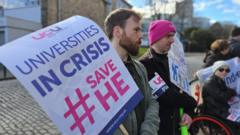
The rain in Dundee does not just fall. It sweeps sideways off the Firth of Tay, slicking the gray stone of Nethergate and blurring the yellow lights of the campus library. For decades, that library was a sanctuary. It was a place where the radiators clicked like dry bones and the air smelled of damp wool, cheap coffee, and the heavy, comforting ink of academic journals.
To the outside world, a university is an abstract ledger of credit hours, research grants, and global rankings. But to those who inhabit it, it is a collection of small, fiercely guarded habits. It is the specific creak of a lecture hall floorboard. It is the lecturer who remembers your name when you are failing. It is the cleaner who nods to you at 6:00 AM while you are pulling an all-night study session.
Now, those habits are being dismantled.
The announcement from the University of Dundee did not arrive with a bang. It came with the quiet, devastating efficiency of a corporate email: 190 more jobs are gone. The goal is to plug a massive £20 million black hole in the budget. On paper, it is a necessary fiscal correction. It is a strategic realignment. It is a balancing of the books.
But spreadsheet rows do not feel panic at three in the morning. People do.
Imagine—hypothetically, though based on the grim reality now facing hundreds—a mid-career researcher named Sarah. She has spent twelve years in Dundee, building a niche program, mentoring students who arrived terrified and left confident. For Sarah, the university is not just an employer. It is her community. It is where her children go to daycare. It is the mortgage on her terraced house. When 190 jobs disappear from a medium-sized Scottish city, they do not just vanish from the payroll. They vanish from the local economy, the local schools, and the shared culture of a region.
The real crisis in modern higher education is that we have begun to treat universities like factories, measuring their worth solely by output per unit of cost.
How did we get here? The math is brutal, but simple. For years, Scottish universities have relied on a fragile economic ecosystem. Home students have their tuition funded by the state, but that funding has failed to keep pace with inflation. To survive, institutions looked outward. They turned to international students, who pay significantly higher fees, to subsidize the core cost of running campuses. It was a high-stakes balancing act that worked beautifully—until the geopolitical and regulatory weather changed.
When international student visa rules tightened and global economic pressures shifted, the pipeline constricted. The financial buffer evaporated almost overnight. Suddenly, the ancient pursuit of knowledge collided head-on with the cold realities of cash flow. Dundee is not alone in this storm, but the impact here feels particularly acute. The university has long been an engine of social mobility in a city that has reinvented itself from a hub of "jute, jam, and journalism" into a modern center for biotech and digital design.
Consider what happens next when an institution trims its bone to save its skin.
It is a common myth that job cuts only affect administrative surplus or abstract overhead. In reality, the loss of 190 positions means fewer eyes on student essays. It means longer waits for mental health counseling services. It means the cancellation of specialized modules that do not attract massive enrollment but define the intellectual depth of a degree. The remaining staff are left to absorb the workload, watching their hours stretch and their energy fray. Excellence is not a commodity you can buy in bulk; it is grown slowly through time, stability, and trust.
When you erode that foundation, the cracks show up in small ways first. A missed email response. A delayed grade. A canceled seminar. But eventually, the entire structure shifts.
The true cost of a £20 million savings plan is paid in a currency that cannot be tracked on a balance sheet. It is paid in the loss of institutional memory. When an experienced administrator or a seasoned professor leaves, they take with them decades of unwritten knowledge—the undocumented shortcuts to helping a struggling student, the deep networks built with local community groups, the quiet understanding of how to keep a department running smoothly during a crisis.
There is a profound vulnerability in admitting that the places we trust to shape the future are themselves so precarious. Students arrive at Nethergate every autumn with bags packed full of ambition and anxiety, trusting that the institution standing before them is as solid as the volcanic rock beneath the city. They do not see the financial scaffolding holding it up, nor do they see how thin the ropes have become.
As the wind continues to batter the glass of the campus buildings, the lights inside stay on. Academics still grade papers. Technicians still prepare labs. Support staff still answer phones. They do this because the human instinct to care about the work does not shut off just because a budget template demands contraction.
But the atmosphere has shifted. The silence in the corridors is heavier now. It is the silence of a community waiting for the next shoe to drop, wondering who will be left to turn out the lights when the restructuring is done.
On the banks of the Tay, the university stands as it has for generations, a monument to the belief that learning can transform a life and a city. But monuments require maintenance, not just of their stone facades, but of the living, breathing people who give them purpose. Without them, the grand halls are just empty rooms, and the red brick is just clay.