The sound does not register as a weapon at first. It begins as a low, rhythmic thrumming, like a broken moped engine idling in the distance. In the dead of a Tuesday winter night in Kyiv, that sound makes your stomach drop. It is a Iranian-designed Shahed drone, packed with explosives, humming its way toward an electricity grid or an apartment block.
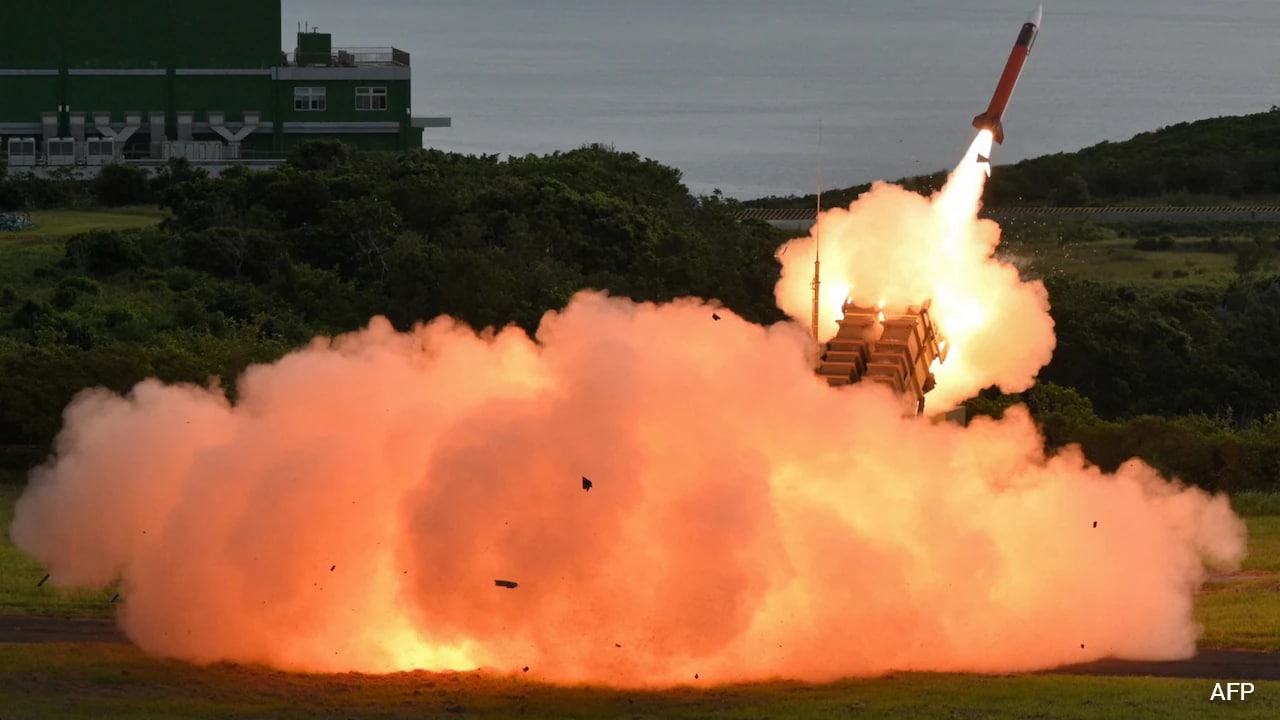
Then comes the second sound. It is the deafening, earth-shaking roar of an American-made Patriot missile launching into the darkness.
A few seconds later, a flash illuminates the clouds. The drone is vaporized. Lives are saved. The power stays on. The system worked perfectly.
But inside the command bunkers, no one is celebrating. Instead, someone is looking at a spreadsheet, doing a math problem that feels like a slow-motion defeat.
The drone that just blew up cost the enemy roughly twenty thousand dollars to manufacture. It is made of cheap fiberglass, a basic lawnmower engine, and a commercial-grade GPS chip. The Patriot interceptor missile that destroyed it cost roughly 3.8 million dollars.
Think about that math. To stop a weapon that costs the price of a used sedan, you must fire a weapon that costs the price of a luxury Manhattan penthouse. It is an unsustainable equation. You can win every single tactical battle in the sky and still lose the war on pure economics. Air defense, the most critical shield of modern warfare, has become a financial black hole.
But in undisclosed workshops across Ukraine, a quiet rebellion of engineers is changing the geometry of the sky. They are building an alternative. It does not look like a multi-million-dollar masterpiece of military-industrial engineering. It looks like a high-stakes science fair project.
It costs seven hundred thousand dollars. And it might just rewrite the future of global defense.
The Tyranny of the Luxury Shield
To understand why this matters, you have to understand how we got here. For decades, Western defense philosophy was built on a simple premise: perfection at any cost.
A Patriot missile system is a marvel of human ingenuity. Its radar can track objects moving at Mach numbers, its software calculates interception vectors in milliseconds, and its kinetic warhead hits a bullet with a bullet in the upper atmosphere. When you are defending against a nuclear-capable ballistic missile traveling at hypersonic speeds, you need that 3.8 million dollar perfection. You do not compromise.
But modern war changed while the procurement pipelines were still asleep.
The sky is no longer just the domain of multi-million-dollar fighter jets and ballistic missiles. The sky is now crowded with cheap, slow, plentiful junk. Asymmetrical warfare means an adversary can mass-produce thousands of buzzing suicide drones for the price of a single Western interceptor. If you use your elite missiles to shoot down the cheap drones, you run out of money and ammunition. If you do not shoot them down, they destroy your power plants.
It is a agonizing trap.
I remember talking to a logistics officer who described the feeling of watching an incoming swarm on a radar screen. It isn’t just fear of the blast; it is a profound sense of mathematical despair. You are watching a cheap flood drain your country’s lifeblood, one interceptor at a time. The West cannot manufacture Patriot missiles fast enough to keep up with the attrition rate.
The problem isn't the technology. The problem is the philosophy of scarcity.
The MacGyver Commandos
When your survival depends on balancing a budget that is actively trying to kill you, you stop looking for perfect solutions. You look for effective ones.
Deep within Ukraine’s domestic defense sector, a coalition of software coders, retired mechanics, and military planners stopped waiting for foreign aid packages to clear political hurdles. They asked a fundamentally different question: What is the minimum amount of technology required to destroy a flying object moving at one hundred miles per hour?
The result of that question is a homegrown air defense system that the Pentagon has quietly begun helping test and integrate. It does not have a sleek, cinematic name. It doesn't look like something out of a defense contractor's glossy brochure.
Consider how it actually functions. Instead of custom-built, military-grade supercomputers that take years to certify, the Ukrainian system relies heavily on off-the-shelf components, open-source software, and clever hacking.
To track incoming targets, they didn’t try to replicate a billion-dollar active electronically scanned array radar. Instead, they took thousands of ordinary smartphones, mounted them on poles across the country, microphone-side up, and linked them via a central network. When a drone flies overhead, the microphones pick up the acoustic signature. A custom AI algorithm filters out the sound of wind, dogs barking, and passing cars, triangulating the exact speed, altitude, and trajectory of the threat based entirely on the sound of its engine.
It is a national network of ears, built for a fraction of the cost of a single traditional radar dish.
Once the target is tracked, the system doesn't fire a missile packed with rare-earth metals and proprietary guidance sensors. It fires a heavily modified, locally produced rocket that utilizes basic optical tracking. If a Patriot missile is a scalpel forged in a cleanroom, this new system is a crowbar welded in a garage.
And it works.
At seven hundred thousand dollars per unit, the financial calculus flips completely. Suddenly, the defense is no longer being bled dry by the offense. The shield becomes as reproducible as the sword.
The Friction of Frictionless Thinking
There is an understandable skepticism that arises when you hear these numbers. Military experts in comfortable Western think tanks often argue that cheap systems lack the range, the radar cross-section resistance, or the electronic warfare protection of legacy systems.
They are right, of course. A seven-hundred-thousand-dollar system will not stop a Kh-47M2 Kinzhal hypersonic missile tearing through the stratosphere at Mach 10. If you try to use it for that, it will fail spectacularly.
But that argument misses the entire point of modern defensive layering.
Think of air defense like the locks on your house. You do not buy a bank-vault door with biometric scanners for every single closet in your home. You put the heavy, expensive lock on the front door. For the interior rooms, a simple latch suffices.
For the past several years, global militaries have been using bank-vault doors to secure their broom closets because they simply didn't have any latches. By deploying a massive network of these cheaper, seven-hundred-thousand-dollar interceptors, you offload the grunt work of air defense. They handle the low-altitude drones, the older cruise missiles, and the loitering munitions. This frees up the precious, scarce Patriot batteries to do what they were actually designed to do: hunt the big, fast, terrifying threats.
Admitting this requires a certain amount of intellectual humility. It forces established defense establishments to admit that bureaucratic elegance and massive budgets do not always equal security.
When the war started, the idea of Ukrainian-built air defense was viewed as a romantic pipe dream. Today, it is an operational reality. The system represents a shift from a hardware-first mindset to a software-first mindset. When a new enemy drone variant appears in the sky with a different engine tone or a new flight pattern, the Ukrainian engineers don't wait three years for a defense contractor to issue a hardware upgrade. They write a line of code, push a software update over an encrypted network, and the entire national defense system adapts by morning.
The Horizon Line
The sun rises late over the checkpoints outside Kyiv during the winter months. The air is crisp, smelling of woodsmoke and damp concrete.
On the back of a flatbed truck parked in a clearing surrounded by pine trees, a crew of young operators monitors a series of ruggedized laptops. They are not wearing the pristine uniforms of laboratory technicians. They have mud on their boots and dark circles under their eyes.
A few years ago, these men were software developers, logistics managers, and university students. Now, they are the curators of a new kind of sky.
They watch the green monitors. The acoustic sensors across the oblast are quiet for now. The truck hums with the generator's vibration. Attached to the bed behind them is a metal framework holding a pair of unassuming tubes—the seven-hundred-thousand-dollar antidote to a multi-million-dollar economic trap.
This isn't just about surviving the current conflict. The implications of this technological pivot are rippling outward, watched closely by military attachés from Taipei to Washington. The era of the monopoly on high-tech defense is fractured. The realization has set in that the future belongs not to the nation that can spend the most, but to the nation that can adapt the fastest.
The sky above remains open, vast, and silent. The men in the truck keep their eyes on the screens, waiting for the next low hum to disturb the cold air, ready to prove that the value of a shield is measured by the lives it protects, not the price tag it carries.