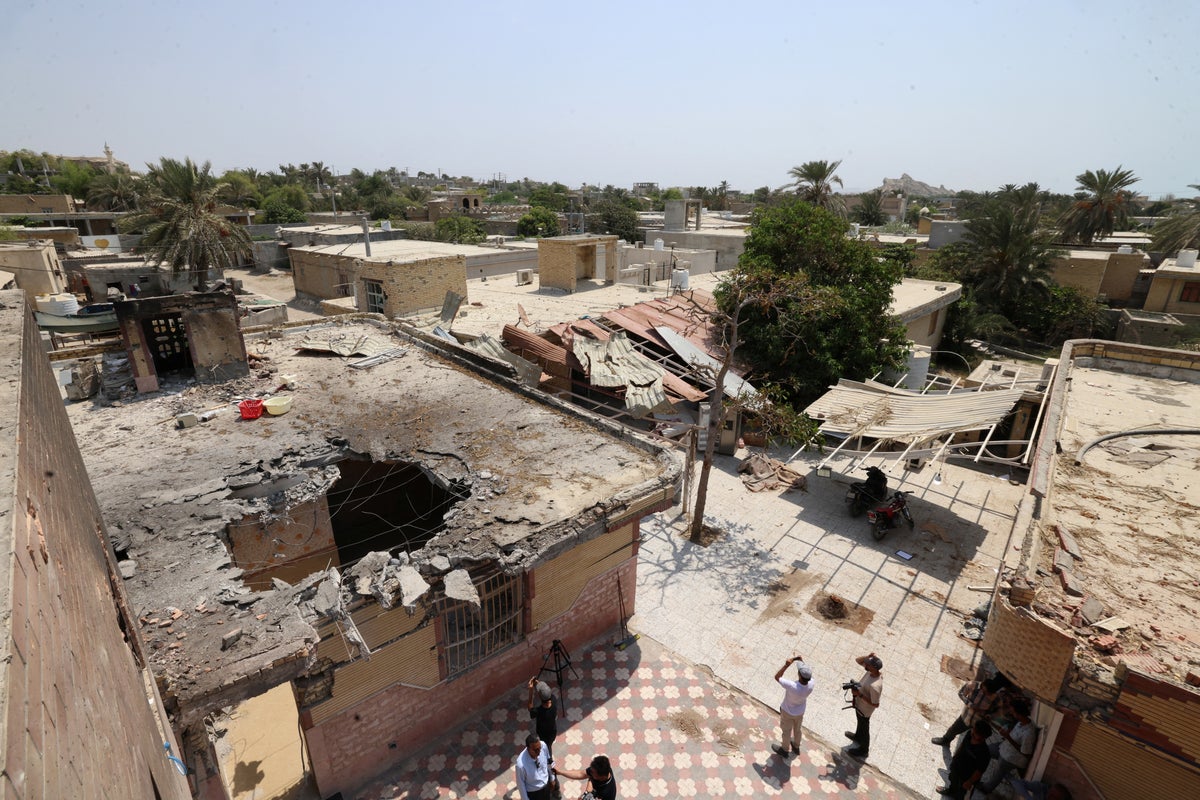
An American naval strike targeting a coastal communications complex in Kuhestak, Iran, went catastrophically astray on a Tuesday night, slamming directly into a residential roof where dozens of civilians had gathered for a wedding celebration. Four people died, including two children, and dozens more suffered severe injuries.
The Pentagon is currently investigating how a weapon meant for a military node drifted roughly 440 feet off course into a civilian crowd. Decades of covering military operations and examining post-strike forensic data reveal a grim reality. Modern precision munitions rarely miss because of software failures alone. They miss because the chaotic friction of war routinely overwhelms bureaucratic safeguards.
Military planners operating from regional command centers view targets through sanitized glass. They scrutinize satellite feeds, analyze communications chatter, and run algorithms designed to calculate collateral risk down to the meter. Yet the distance between a pristine operations room and a dusty coastal town in southern Iran is measured in blood.
The Mechanics of an Errant Vector
To understand how a precision-guided munition misses its mark by hundreds of feet, one must look past the marketing brochures of defense contractors. United States Navy jets launched six bombs during the Kuhestak operation. Five struck the intended communications tower with clinical accuracy. The sixth veered away.
Weapons experts reviewing imagery and video fragments identified the weapon design as consistent with an air-dropped system utilizing dual warheads and roughly two hundred pounds of high explosives. When such a device encounters minor atmospheric anomalies, minor GPS spoofing, or subtle guidance fin anomalies just seconds after release, its terminal trajectory shifts. At supersonic or high subsonic speeds, a fraction of a degree error at launch translates into catastrophic displacement downrange.
The target itself sat in a densely populated civilian neighborhood. Military doctrine mandates a rigorous assessment of the surrounding pattern of life before authorizing an attack. Analysts are supposed to map every adjacent structure, catalog civilian routines, and establish temporal windows when noncombatants clear the area.
Weddings do not broadcast their guest lists to military intelligence.
When the bomb struck the roof of the home in Kuhestak, it detonated on contact. The blast tore through concrete and corrugated material, raining shrapnel down upon a room filled with music, lights, and families celebrating a marriage. The subsequent casualty counts gathered by human rights monitors and local health officials quickly climbed past ninety injured. Bloody shoes and festive decorations remained scattered among the pulverized rubble when rescue workers finally arrived with flashlights.
The Illusion of Clinical Warfare
Public statements from Washington officials follow a well-worn script when these incidents surface. Investigations are promised. Regret is expressed. The friction of armed conflict is invoked as an implicit excuse for unavoidable tragedy.
Vice President JD Vance acknowledged the ongoing inquiry during a White House briefing, noting that the administration intends to find out exactly what happened. Central Command monitors incoming reports of civilian harm with bureaucratic distance.
Yet treating a wedding strike as an isolated anomaly ignores the cumulative weight of operational patterns spanning multiple campaigns. Whenever high-value military infrastructure is deeply embedded within urban or semi-urban environments, the margin for error shrinks to zero. Placing a communications tower inside a civilian sector guarantees that any deviation from flight paths will exact a human toll.
Defenders of modern targeting protocols argue that human error and mechanical failure represent statistical certainties in large-scale air campaigns. That argument offers little solace to families burying children in Kuhestak.
Military analysts often compartmentalize civilian casualties as collateral damage. Behind that sanitized phrasing lies the brutal truth of military technology. Every guidance system has a failure rate. Every targeting matrix possesses blind spots. When nations choose to drop thousands of pounds of high explosives into populated regions, they accept the statistical certainty that some percentage of those weapons will land on homes, schools, and wedding parties.
The investigation into the Kuhestak strike will likely conclude with technical jargon about wind shear, guidance drift, or unexpected electronic interference. It will offer administrative adjustments to future targeting parameters. It will not alter the fundamental dynamic of a conflict where precision weapons frequently miss, and civilians pay the final price.


