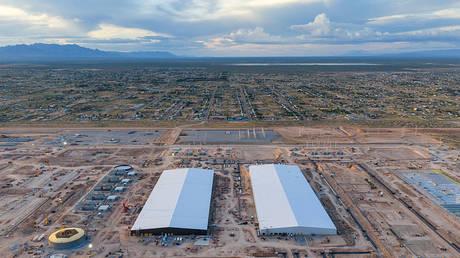
The quiet hills of Kentucky are transforming into the front lines of a resource war. Where once local farmers focused on crop yields and weather patterns, they now find themselves battling massive industrial developments fueled by the insatiable energy requirements of artificial intelligence. These data centers are not merely silent boxes of servers; they are gargantuan consumers of electricity and water, often requiring transmission infrastructure that cuts directly through family-owned fields. This conflict pits the traditional agricultural backbone of the state against the rapid expansion of global technology infrastructure, raising fundamental questions about land rights, rural electricity rates, and who actually benefits from the high-tech gold rush.
Agricultural operations in Kentucky rely on stable, affordable energy and unobstructed access to land. The arrival of massive data center campuses disrupts both. When a utility provider upgrades high-voltage power lines to feed a facility that consumes as much electricity as a small city, the physical footprint of that infrastructure can effectively bisect a working farm. Farmers are left with fragmented plots, hindered irrigation systems, and the long-term uncertainty of living under the hum of high-voltage transmission. This is not just a nuisance. It is an existential threat to the efficiency of land use that defines modern farming.
The Hidden Costs of the Digital Load
The central argument for these developments often centers on economic growth. Local governments see tax revenue and potential jobs, while technology firms promise to anchor the region in the future economy. However, the operational reality for the surrounding community is far more complex. Data centers demand a consistent, uninterruptible power supply, which forces utilities to prioritize industrial demand. When grid capacity reaches its limit, the burden of financing upgrades frequently shifts to the ratepayer base. A hypothetical farm family might find their monthly utility bill increasing not because their own usage changed, but because the local grid required massive capital investment to support a hyperscale data facility nearby.
Reliability becomes another friction point. As electricity demand spikes from cooling systems and server racks running twenty-four hours a day, the grid experiences increased stress. While grid operators work to balance these loads, the risk of localized outages or brownouts increases during peak seasonal demand. A farmer who needs stable power for automated milking systems or climate-controlled silos cannot afford these fluctuations. The industrialization of rural areas changes the very risk profile of agricultural business.
Land Sovereignty and Eminent Domain
Perhaps the most visceral aspect of this tension involves the acquisition of land and rights of way. Utility companies and developers often move to acquire easements or outright property titles to secure the necessary corridors for power delivery. The legal mechanisms involved, including the potential for eminent domain, turn neighbors against developers and, in some cases, against local officials.
Farmers value land not just as an asset, but as a multi-generational legacy. When a project arrives with the weight of state-backed utility support, the power dynamic is inherently lopsided. Individuals often lack the resources to litigate against the massive legal teams representing tech conglomerates or large utility providers. This imbalance creates a sense of profound powerlessness among people who have historically been the stewards of the land. They are not opposed to progress, but they are rightfully skeptical of progress that requires the destruction of their livelihoods to provide cooling for server farms that may offer only a handful of permanent local jobs.
Navigating the Regulatory Vacuum
State regulators often find themselves flat-footed. These projects move with a speed that outpaces traditional zoning laws and environmental impact assessments. Kentucky officials are currently struggling to craft policies that balance the state's aggressive push for technology investment with the preservation of agricultural land. The tension is compounded by the lack of transparency in the negotiation process. Many of these deals are finalized behind closed doors with promises of non-disclosure agreements that keep farmers in the dark about how their local geography will change until the earth-movers arrive.
The situation requires a move toward more rigorous oversight. Specifically, the state needs to mandate thorough assessments of how these energy loads affect the existing rural distribution network. It is not enough to look at whether the power is available; one must calculate the impact on the existing users who maintain the food supply chain. Without a coherent strategy that prioritizes local community health over rapid industrial expansion, the state risks hollowing out its agricultural base to serve the remote needs of global tech firms.
The Conflict of Resource Priority
Beyond power, water usage represents a secondary but equally critical front. Many high-performance computing sites rely on water-intensive cooling methods. In regions where farming depends on precise water table management or local reservoir access, the arrival of a facility that consumes millions of gallons per day is a point of acute anxiety. The technology sector treats water as an input commodity; the agricultural sector treats it as a lifeblood. When these two needs collide during a dry season, the legal and economic structures currently in place are heavily biased toward the industrial actor.
We are watching a shift in the definition of rural value. For decades, the value of Kentucky land was understood through the lens of productivity, soil health, and community stability. Now, that land is being re-categorized as a cost-effective site for massive, energy-dense infrastructure. This is a transformation that will not be undone. Once the power lines are hung and the concrete slabs are poured, the agricultural character of that specific acreage is gone.
The battle is not going away. It is moving into local zoning meetings, into state courts, and into the boardrooms of energy providers. For the farmers of Kentucky, the goal is simple but difficult to achieve: they want a seat at the table where the future of their land is being decided, rather than being the collateral damage of a digital expansion they never asked for. The true test of state leadership will be whether they can facilitate technological growth without sacrificing the bedrock industries that have sustained the regional economy for generations. As long as the grid is expanded without full accountability, the friction will only intensify.