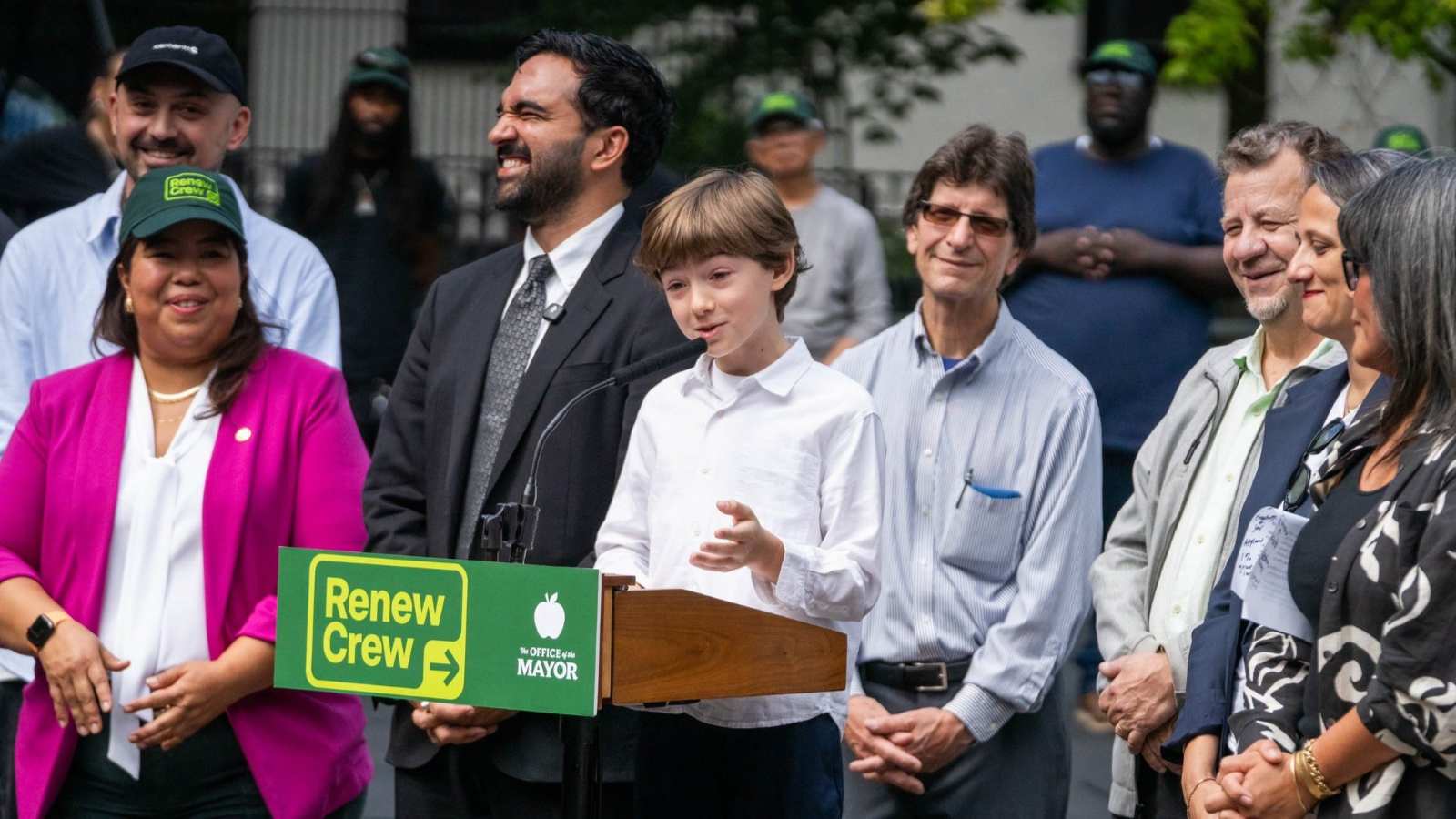
The heartwarming human interest story is the opiate of the urban masses. Hand a kid a microphone, let him make a cute plea to a politician, slap together a feel-good public relations initiative called the Renew Crew, and watch the headlines roll. Everyone feels good. The city looks responsive. The cameras capture the handshake.
And the actual structural rot of urban infrastructure remains completely untouched.
We have all read the lazy consensus pieces celebrating how an eight-year-old child supposedly shamed municipal government into fixing a broken playground. The narrative writes itself: brave youth confronts the machine, the machine listens, bureaucratic inertia melts away under the warm glow of community organizing. It is a fairy tale designed to comfort adults who would rather believe in magical administrative pivots than confront the brutal math of municipal asset management.
I have watched cities burn through millions of dollars on high-profile PR squads while foundational maintenance budgets starve. Let us look past the viral video and dismantle the comforting illusion that a special response team fixes a systemic failure.
The Myth of the Responsive Bureaucracy
When a city creates a specialized crew to handle high-profile community complaints, it is not demonstrating efficiency. It is admitting failure everywhere else.
If your standard operating procedure requires a viral media moment or a direct intervention by a high-ranking official just to fix a swing set or patch a rubber surface, your entire maintenance pipeline is fundamentally broken. A functional municipality does not rely on pediatric lobbying to prioritize capital repairs. It relies on data, inspection schedules, and preventive maintenance cycles that operate invisibly in the background.
The Renew Crew approach treats a symptom while ignoring the disease. The disease is deferred maintenance. For decades, cities have routinely low-balled their baseline infrastructure budgets because deferred maintenance does not win elections. Ribbons are cut for new ribbon-cuttings, not for waterproofing a concrete substructure or replacing sub-base drainage pipes under a slide.
When those neglected assets finally fail—because concrete and steel do not care about your campaign promises—they do not fail quietly. They break down into jagged hazards that trigger lawsuits or viral outrage. Then, instead of fixing the root cause, which is the chronic underfunding and understaffing of municipal parks departments, politicians assemble a flashy task force to rescue the news cycle.
The Economic Reality of Band-Aid Solutions
Let us talk about resource allocation. When you pull personnel and equipment to form a dedicated rapid-response unit for politically sensitive complaints, you are robbing Peter to pay Paul. Those workers come from somewhere. That budget comes from somewhere.
Imagine a scenario where a city has five hundred neighborhood parks, but only enough funding to properly maintain fifty. A flashy PR-driven crew descends on park number fifty-one because a child made the local news. Meanwhile, the other four hundred and ninety parks rot a little faster because their maintenance allocation was redirected to fund the photo op.
This is not progress. This is triage masquerading as strategy.
Economists who study municipal finance call this the maintenance debt spiral. Every dollar spent on reactive, high-visibility public relations patches is three dollars stolen from boring, unsexy preventative care that actually extends the lifespan of public assets. A rubber safety tile replaced under the glare of news cameras costs the taxpayer exponentially more in lost opportunity cost than routine scheduled inspections that catch the wear and tear six months earlier.
Why We Crave the Kid-Hero Trope
Why do media outlets and the public fall for this narrative every single time? Because it personalizes complex institutional failures into a neat, digestible battle between a cute kid and a stoic bureaucrat.
It lets us off the hook. If the problem is simply that politicians were not listening until an eight-year-old asked nicely, then the solution is simply to ask nicely louder and more often. It preserves the comforting illusion that our civic institutions are fundamentally sound, just occasionally hard of hearing.
The truth is much darker and less cinematic. Institutions are often deaf by design, trapped in political incentive structures that reward immediate visible outputs over long-term structural health. A politician does not get re-elected by quietly balancing a thirty-year capital replacement fund for park benches. They get re-elected by standing next to a smiling child on a freshly painted playground.
The Uncomfortable Truth About Parks Management
If you want functional public spaces, you have to abandon the romance of the populist rescue mission.
Real parks management is boring. It involves inventory audits, strict union scheduling agreements, rigorous supply chain management for replacement parts, and the political courage to raise taxes or reallocate funds away from vanity projects to pay for mundane things like drainage grates and anti-corrosion coatings.
There is no shortcut. You cannot crowdsource civic competence through viral charm.
When cities rely on special task forces to bypass their own standard workflows, they signal to every bureaucrat in the system that standard workflows do not matter. Why follow the work order queue? Why prioritize routine inspections? Just wait until a complaint gets traction on social media, and a special crew will materialize out of thin air to fix it. You have effectively incentivized neglect.
What Real Reform Looks Like
If we actually care about urban spaces, we need to stop celebrating administrative workarounds.
First, tie municipal job performance metrics directly to asset lifespan, not complaint resolution speed. If a park playground degrades prematurely due to neglected maintenance, the department head should answer for it, regardless of how many cute kids live nearby.
Second, protect baseline maintenance budgets from political raiding. The moment a city council starts treating park maintenance as a discretionary slush fund to be tapped when bad PR hits, the death spiral accelerates.
Third, stop pretending that government officials doing their basic job constitutes a heroic miracle. Fixing a playground is not a moon landing. It is the baseline duty of a functioning municipal administration. When we treat routine civic maintenance like a heartwarming holiday miracle, we lower our standards so far that we are practically begging to be milked for emotional manipulation while our cities crumble from the foundation up.
The playground is open. The cameras are gone. The kids are playing. And somewhere across the city, another neglected swing set is rusting quietly in the dark, waiting for a microphone.