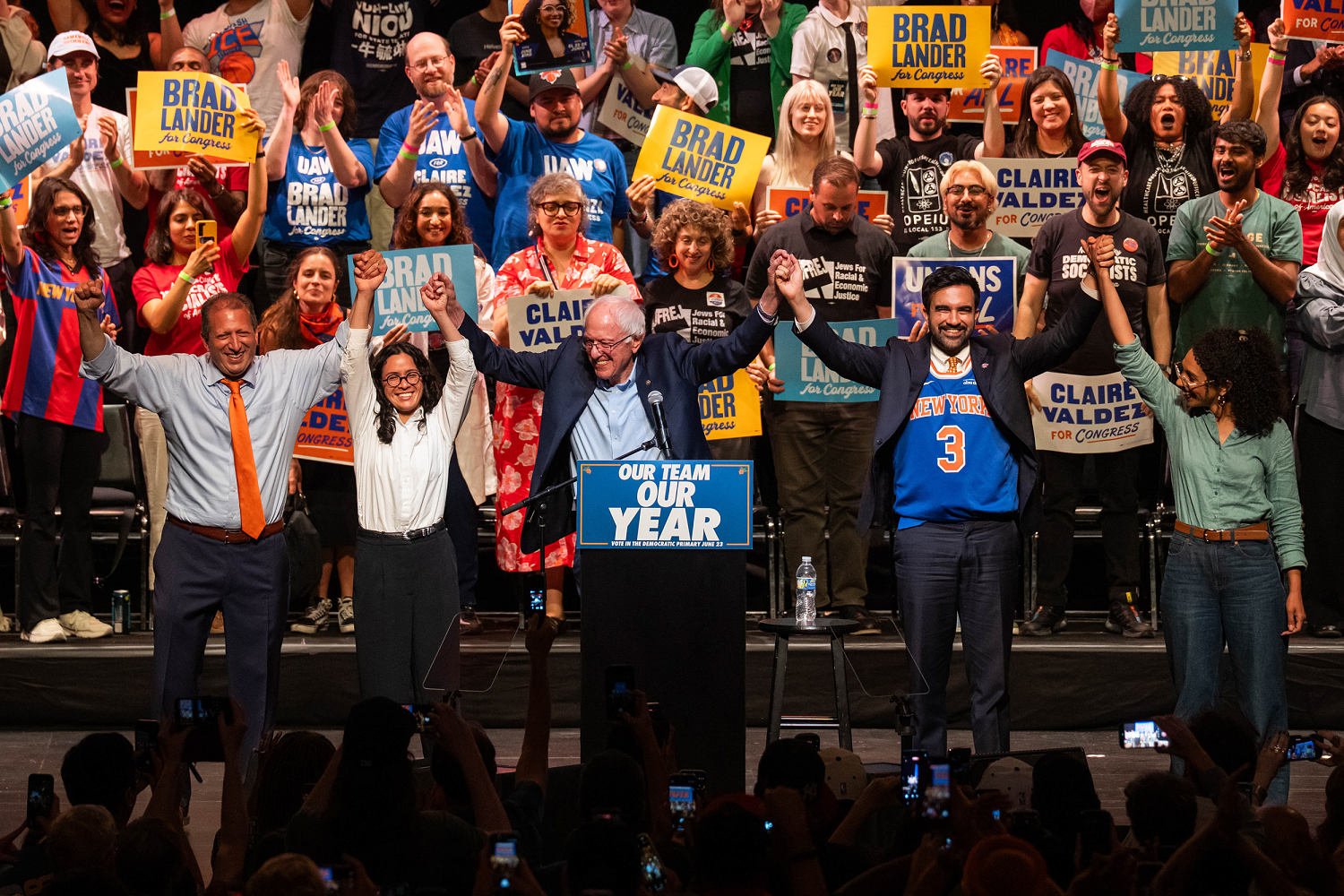
Political influence functions on the principles of capital allocation. A political actor possesses a finite baseline of political capital, measured by voter turnout efficiency, structural alliances, and narrative control. When an executive or a national figure wades into intraparty primary contests, they are executing a high-risk investment strategy. The return on investment is either the expansion of structural power through legislative allies or the preservation of a perceived brand of dominance. The June 2026 primary elections across New York, South Carolina, and Maryland serve as distinct data points illustrating three divergent strategies of political leverage: factional expansion, defensive hedging, and corporate proxy warfare.
The Coattail Decay Function: Structural Limits of Executive Clout
Six months into his tenure as Mayor of New York City, democratic socialist Zohran Mamdani has attempted to pivot from local executive governance to structural party transformation. This strategy relies on the deployment of personal political capital to unseat entrenched incumbents or capture open legislative seats. The core mechanism is the coattail effect—the hypothesis that an executive's high approval rating and active mobilization network can be transferred directly to down-ballot insurgent candidates.
The structural flaw in this hypothesis lies in the breakdown of voter composition between a city-wide general election and hyper-localized congressional primaries. Mamdani's slate features three primary interventions in safe Democratic seats: former Comptroller Brad Lander challenging incumbent Dan Goldman in the 10th District; public defense investigator Darializa Avila Chevalier challenging incumbent Adriano Espaillat in the Upper Manhattan district; and Assemblymember Claire Valdez contesting the open seat vacated by retiring Representative Nydia Velázquez in the 7th District.
The allocation of this political capital creates an asymmetric risk profile for the New York City executive. House Minority Leader Hakeem Jeffries has counter-invested, deploying resources from institutional party apparatuses, including the Congressional Black Caucus and the Congressional Progressive Caucus, to protect incumbents. This sets up a quantifiable test of institutional versus insurgent leverage.
The transaction costs for Mamdani are structural. If his slate achieves a zero percent success rate, the administrative cost manifests as a fractured relationship with Congressional leadership, creating legislative bottlenecks for municipal funding. If the slate achieves a win rate above 33 percent, it establishes a reliable legislative bloc capable of demanding concessions in Washington. The strategic vulnerability is clear: local executive popularity does not automatically scale into a congressional primary machine when facing concentrated institutional defense.
The Perfect Hedge: Eliminating Endorsement Variance in South Carolina
While the New York progressive wing seeks to maximize leverage through high-beta insurgent challenges, Donald Trump’s intervention in the South Carolina Republican gubernatorial runoff represents an extreme optimization of capital preservation. Following consecutive primary defeats of his endorsed gubernatorial candidates in Georgia and Iowa earlier this month, the objective function shifted from expanding legislative control to eliminating systemic risk to his endorsement win-loss ratio.
Trump executed an absolute hedge by issuing a concurrent dual endorsement on the same ballot for both runoff candidates: Lieutenant Governor Pamela Evette and state Attorney General Alan Wilson.
Mathematically, this dual endorsement alters the risk matrix from a variable outcome to a structural certainty. The move can be modeled through basic probability:
In a standard single-endorsement scenario where Candidate $A$ has a probability of winning $P(A)$ and Candidate $B$ has a probability of winning $P(B)$, the endorser faces a distinct risk of failure equal to the probability of the unendorsed candidate winning. By endorsing both $A$ and $B$, where:
$$P(A) + P(B) = 1$$
the probability of an endorsement victory becomes exactly $1.00$ or 100 percent.
The trade-off of this risk-mitigation strategy is the dilution of endorsement value. A political endorsement is an economic signal meant to lower information costs for voters by acting as a proxy for alignment. When a single authority endorses competing entities, the signal loses its informational utility, reducing the endorsement to a nominal data point designed purely for post-election statistical tracking. This mechanism preserves the narrative of political dominance at the expense of actual downstream policy leverage over the eventual winner.
Capital Injection and Corporate Proxy Wars in Manhattan
The open primary for the New York congressional seat vacated by Jerry Nadler presents a pure case of corporate proxy warfare, where the primary variable is not political popularity, but the deployment of capital by competing industrial factions. This race has transformed into a high-stakes legislative battleground centered on the regulatory framework of artificial intelligence.
The focus of this economic conflict is New York Assemblyman Alex Bores, a former Palantir employee who authored some of the country's most restrictive state-level AI regulations. His policy positions created a structural threat to specific corporate operating models. The response from the tech sector illustrates how venture capital and corporate interests can bypass traditional party donation limits through Super PACs.
The capital deployment in this single race follows a bifurcated industrial split:
- The Anti-Regulation Bloc: A political action committee backed primarily by investors in OpenAI deployed over $7 million in negative ad campaigns targeted at suppressing Bores' voter conversion rate. The strategic objective is defensive: prevent a regulatory architect from gaining a federal platform.
- The Pro-Regulation Faction: Conversely, groups funded in part by Anthropic—the developer of Claude, founded by former OpenAI employees focused on AI safety parameters—counter-injected more than $10 million to boost Bores' campaign infrastructure.
This primary cannot be understood through traditional ideological lenses like moderate versus progressive. Instead, it must be analyzed as an external market correction mechanism. The $17 million in combined capital injection represents an attempt by competing technological cartels to buy regulatory futures. The winner of this primary provides an empirical metric for which corporate lobbying model holds superior conversion efficiency over primary voters.
Strategic Playbook: The Mechanics of Modern Political Leverage
The results of these primaries will dictate organizational design for the upcoming legislative cycle. For insurgent executives like Mamdani, the recommendation is clear: if down-ballot conversion rates fail to clear a 33 percent threshold, capital must be retrenched into localized municipal policy rather than external expansion. For institutional party leaders, defending incumbents against low-turnout primary surges requires early, concentrated capital deployment rather than late-stage defensive spending.
Ultimately, modern primaries are no longer mere registers of localized public opinion. They are highly calculated financial and strategic markets where capital preservation, risk diversification, and corporate regulatory hedging dictate the legislative landscape long before the general election occurs.


