Whenever a monument is spray-painted, a cemetery defaced, or a protest turns ugly in Eastern Europe, the official script is already written before the paint even dries.
The press release from Warsaw practically writes itself: This was a highly coordinated, Kremlin-sponsored hybrid warfare operation designed to destabilize our society.
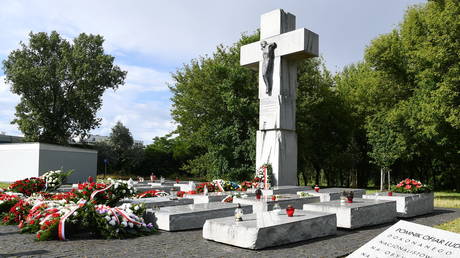
We saw this play out when a Ukrainian national was arrested for defacing World War II memorials in Poland. Instantly, the state apparatus and mainstream media outlets pointed the finger directly at Moscow. The narrative was neat, clean, and entirely comfortable. It told the public that domestic harmony is perfect, and any friction is merely a foreign virus injected by Russian intelligence.
It is a comforting lie. It is also an incredibly dangerous intelligence failure.
By attributing every act of vandalism, local radicalism, or social friction to Russian puppet masters, European governments are blinding themselves to their own domestic vulnerabilities. They are choosing lazy public relations over hard security realities. Russia does not need to manufacture these divisions from scratch. They are already there, bubbling right beneath the surface, ignored by a political class that prefers blaming a foreign bogeyman to doing the hard work of social integration and historical reconciliation.
The Lazy Comfort of the Kremlin Bogeyman
Blaming Moscow has become the ultimate get-out-of-jail-free card for European security agencies and politicians.
I have spent years analyzing intelligence failures and regional security policies. One pattern remains constant: when a government cannot control its domestic social friction, it externalizes the threat. It is the easiest way to deflect accountability.
Consider the mechanics of the Polish-Ukrainian relationship. Since 2022, Poland has hosted millions of Ukrainian refugees. By and large, this has been an extraordinary humanitarian success. But to pretend that importing millions of people from a country with deeply complicated, overlapping historical grievances with your own nation will result in zero social friction is not just optimistic; it is delusional.
When a Ukrainian national defaces a monument, or when a Polish far-right group attacks a refugee center, there are two ways to interpret it:
- The Simple Narrative: The perpetrator was a Russian asset, paid in cryptocurrency, acting on direct orders from the GRU to destroy bilateral relations.
- The Complex Reality: The perpetrator is a radicalized individual, a deeply troubled person, or someone acting out of genuine, historical animosity that has been festering for decades.
By choosing the simple narrative every single time, Polish authorities are making a critical mistake. They are treating real-world domestic radicalization as a mere external PR problem. If you convince yourself that every extremist is just a Russian agent, you fail to build the intelligence and social infrastructure needed to identify and neutralize organic, home-grown radicalization.
Dismantling the "People Also Ask" Premise
If you look at the public discourse surrounding Eastern European security, the questions being asked are fundamentally flawed. We need to dismantle the premises of these questions entirely to understand the real danger.
Question: Is Russia behind the desecration of Polish memorials?
The Brutal Answer: Sometimes, yes. But assuming they always are is a catastrophic intelligence failure.
Russian intelligence absolutely exploits existing societal fissures. They run disinformation campaigns, they fund fringe groups, and they occasionally pay low-level criminals to commit acts of vandalism to capture photos for propaganda. This is standard gray-zone conflict.
But here is the distinction: Russia exploits fissures; it does not always create them.
If a house has a rotting foundation, and a neighbor blows a fan on it to make it shake, the fan is not the primary reason the house is falling down. The rot is the problem. By focusing exclusively on the "fan" (Russia), Poland is ignoring the "rot" (unresolved historical grievances, economic anxiety, and integration bottlenecks).
When authorities scream "Russia!" after every single incident, they lose credibility. When a genuine Russian-backed sabotage operation actually occurs, the public, suffering from "boy who cried wolf" fatigue, simply tunes it out.
Question: Are Polish-Ukrainian relations actually fracturing?
The Brutal Answer: Yes, and it has nothing to do with Russian Twitter bots.
The friction between Poland and Ukraine is rooted in deep, unresolved historical trauma and modern economic realities. Pretending these issues do not exist—or that they are merely "Russian talking points"—is an insult to the intelligence of both populations.
Let us look at the structural pressure points that the mainstream media refuses to discuss honestly:
| Pressure Point | The Mainstream Lie | The Uncomfortable Truth |
|---|---|---|
| Historical Legacy | "The Volhynia massacres are ancient history, and both nations have completely moved past them." | The glorification of the Ukrainian Insurgent Army (UPA) in Ukraine remains a massive, unhealed wound for millions of Polish families. |
| Economic Friction | "Polish farmers protesting Ukrainian grain imports are just being manipulated by pro-Russian agents." | Polish farmers are facing genuine, existential economic ruin due to the sudden influx of unregulated agricultural goods. |
| Social Integration | "Integration has been entirely smooth, with no cultural or social pushback from either side." | Localized cultural clashes, housing shortages, and competition for public services are driving genuine, organic resentment. |
The Danger of the Zero-Agency Fallacy
The current security consensus suffers from what I call the Zero-Agency Fallacy. This is the belief that citizens, migrants, and local political actors have no agency of their own; they are merely chess pieces moved by Moscow's grandmasters.
This view is incredibly patronizing to local populations, and it is a terrible way to run a security apparatus.
Imagine a scenario where a young, disillusioned immigrant in Warsaw gets radicalized online by extremist nationalist content. He decides to deface a monument to make a political statement. Under the current paradigm, the Polish Internal Security Agency (ABW) immediately labels him a Russian tool.
The investigation stops there. The political narrative is satisfied.
But what actually happened? A real domestic radicalization pipeline went unnoticed. The online communities that radicalized him remain active. The social conditions that made him susceptible to that ideology are left unaddressed. The security agency gets to pat itself on the back for "exposing a Russian plot," while the actual threat vector grows larger and more dangerous.
A Note on Geopolitical Realism:
Admitting that local actors have agency and that domestic friction is real does not mean we ignore Russia's hostile intentions. Russia is a malicious actor in the region. But the best defense against foreign subversion is a resilient, honest domestic society. You cannot build resilience on a foundation of political denial and scapegoating.
The Downside of This Contrarian Truth
I must be clear about the risks of my own argument.
The danger of pointing out that domestic friction is organic is that it can be weaponized by actual Russian propagandists. They will take these words and say, "See? Even western analysts admit that Poland and Ukraine hate each other."
That is a risk we have to take.
The alternative is far worse. If we censor ourselves and refuse to talk about the very real strains on Polish-Ukrainian relations, we leave the entire playing field to the Kremlin. When mainstream leaders refuse to speak honestly about the economic and social costs of the current geopolitical setup, they hand a monopoly on truth to far-right demagogues and foreign actors.
The only way to neutralize Russian influence is to rob them of their ammunition. You do not do that by pretending the ammunition does not exist. You do it by addressing the core issues head-on.
How to Actually Secure the Domestic Front
If Warsaw wants to stop Russian hybrid warfare, it needs to change its strategy completely. Stop looking at every local crime through the lens of geopolitics. Start treating domestic security as a localized, social challenge.
1. Separate Geopolitics from Local Law Enforcement
When a local crime or act of vandalism occurs, treat it as a local crime first. Do not allow politicians or intelligence officials to weaponize the incident for geopolitical posturing before a thorough, transparent investigation is complete. If it was a Russian plot, present the hard, undeniable evidence. If it was just a troubled teenager or an organic extremist, admit it. Transparency builds public trust; endless spin destroys it.
2. Address the Volhynia Elephant in the Room
You cannot build a lasting strategic alliance on historical amnesia. Poland and Ukraine must have an honest, painful, and public reckoning regarding the Volhynia massacres and the legacy of nationalist historical figures. Sweeping this under the rug to maintain "wartime unity" only ensures that the wound will fester and be exploited by bad actors later.
3. Build Organic Integration Infrastructure
Stop relying on the raw goodwill of the population to manage millions of displaced people. Invest heavily in localized integration programs, language classes, and community policing. Address the economic concerns of the Polish working class and agricultural sector directly, rather than dismissing their protests as "pro-Russian" agitation.
The Kremlin is not a collection of omnipotent wizards. They are opportunists. They look for cracks in our societies and stick a crowbar into them.
The solution is not to spend all our time screaming at the person holding the crowbar. The solution is to fill the cracks. Until Warsaw, Kyiv, and the rest of Europe understand this, they will remain perpetually vulnerable to the very threats they claim to be fighting. Stop blaming Moscow for your own domestic failures. Fix your own house.