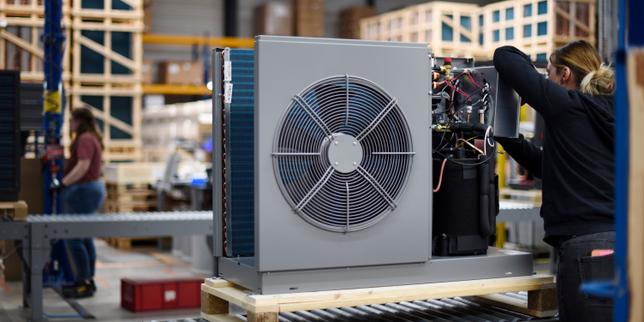
The metallic hum in the basement used to sound like victory.
Every time the compressor kicked in, sending a faint vibration through the floorboards, it felt like a quiet act of redemption. For years, heating a home meant burning something. Oil, gas, wood—carbon rising into the sky, thickening the blanket trapping heat around the planet. Replacing that old, oil-guzzling boiler with a sleek, modern heat pump felt like pulling a thorn out of the earth. It was clean. It was efficient. It was the future we were promised. In other developments, we also covered: Inside the Academic Cheating Crisis Where Students and Machines Win.
But there is a cold irony circulating through those copper pipes.
As we rush to seal the cracks in our atmosphere, we are quietly leaking a different kind of permanence into our soil, our water, and our blood. The very machines engineered to save us from climate chaos have become the single largest source of per- and polyfluoroalkyl substances—PFAS—emissions in Europe. The savior has a shadow. And it is growing. TechCrunch has also covered this important subject in great detail.
The Chemistry of a Clean Conscience
To understand how we trapped ourselves in this paradox, we have to look inside the metal casing of the modern air conditioner and heat pump.
These machines do not create heat or cold out of nothing. They move it. They rely on a chemical medium, a refrigerant, to absorb warmth from the outside air—even on a freezing winter night—and compress it into usable heat for your living room. For decades, the industry used hydrofluorocarbons (HFCs). But HFCs are potent greenhouse gases, possessing global warming potentials thousands of times higher than carbon dioxide.
Under the banner of European decarbonization, regulators pushed for a rapid phase-out of HFCs. The industry needed a quick, non-flammable, efficient alternative.
Enter a new generation of synthetic refrigerants, predominantly hydrofluoroolefins (HFOs). They do not trap heat in the atmosphere for centuries like their predecessors do. On paper, the climate math worked out beautifully. The spreadsheet was balanced.
But chemistry does not care about spreadsheets.
When these new refrigerants leak—and they do leak, during manufacturing, through microscopic fissures in aging joints, and during clumsy disposal—they do not simply vanish. They break down rapidly in the atmosphere into trifluoroacetic acid (TFA), a highly persistent sub-type of PFAS.
PFAS are famously known as "forever chemicals." The definition is literal. The carbon-fluorine bond is one of the strongest known to science. It is an unbreakable knot. Nature has no scissors to cut it. Once these molecules are introduced to the environment, they stay. They accumulate. They wait.
The Invisible Downpour
Consider a hypothetical homeowner named Thomas, living just outside Frankfurt. Thomas is proud of his eco-renovation. He tracks his solar panel yield on an app. He feels a sense of alignment with the future.
When Thomas’s heat pump develops a slow, undetectable micro-leak in its external unit, nothing changes immediately. The house stays warm. The app still shows peak efficiency. But out in the yard, molecules of gas are escaping into the breeze. Within days, sunlight breaks those molecules down, converting them into TFA.
The next time it rains over Frankfurt, the water falling on Thomas’s roof, his vegetable garden, and his children’s faces carries a microscopic payload of forever chemicals.
TFA is exceptionally mobile. It does not stick to soil particles; it glides through them, hitching a ride with rainwater straight into the groundwater. From there, it enters the municipal water supply. Standard water treatment plants, built to filter out bacteria, heavy metals, and organic waste, are completely powerless against it.
Thomas drinks it in his morning coffee. His children ingest it from the garden tomatoes.
Multiply Thomas by millions of households across the European continent. Recent environmental data reveals a staggering reality: the vast majority of PFAS emissions in Europe no longer come from Teflon pans or waterproof jackets. They come from our cooling and heating infrastructure. The infrastructure of transition.
We are witnessing an environmental shell game. We have successfully traded a global atmospheric crisis for a localized, molecular one.
The Toxicity of Certainty
The terrifying truth about the PFAS crisis is the vast expanse of what we do not know.
Science has established clear, chilling links between long-chain PFAS exposure and a cluster of human health issues: thyroid disease, elevated cholesterol, liver damage, developmental delays in children, and decreased immune responses to vaccines. But TFA, the specific forever chemical blooming across Europe due to heat pumps, is a short-chain variant.
For years, chemical manufacturers argued that short-chain PFAS were safer because they do not bioaccumulate in human fatty tissue the same way older variants did. They pass through us faster.
But passing through us faster doesn't mean they are harmless, especially when the exposure is continuous and unavoidable. We are bathing our ecosystems in a constant drizzle of TFA. Recent toxicological studies are beginning to suggest that high concentrations of TFA can affect liver function and disrupt hormonal balance.
The uncertainty is where the anxiety lives. We are running a massive, uncontrolled chemical experiment on the European population, and the control group does not exist.
It is easy to blame the manufacturers, to point at corporate greed and regulatory blindness. But the reality is more complicated, wrapped in a blanket of good intentions. European policymakers were desperate to hit carbon reduction targets. The threat of a warming planet was loud, visible, and immediate—wildfires in Greece, droughts in Spain, melting glaciers in the Alps. The threat of chemical accumulation was quiet, invisible, and delayed.
We chose the danger we could see over the danger we couldn't.
The Architecture of the Trap
Can we just fix the leaks?
It sounds simple. Tighten the valves. Standardize the maintenance. Inspect the units annually. But anyone who has ever owned a car or a refrigerator knows that mechanical systems degrade. Vibrations loosen seals. Copper corrodes.
The European market for heat pumps has exploded, driven by subsidies and mandates. Millions of units are being installed by a workforce scrambled together to meet demand. Not every installation is perfect. Not every technician is a master craftsman. The sheer volume of machinery ensures that leakage is not a malfunction; it is a statistical certainty.
Even if every operating unit remained perfectly sealed for its entire lifespan, the end-of-life crisis looms. What happens when these millions of units reach the end of their utility in fifteen or twenty years?
Scrapping an appliance is a dirty business. In theory, refrigerants are supposed to be recovered, pumped into pressurized cylinders, and safely destroyed. In practice, recovery is expensive and time-consuming. Scrap yards are filled with compressed metal where gases were simply vented into the night air to save time and money. The enforcement of recovery laws is notoriously difficult, bordering on impossible across thousands of disparate salvage operations.
The current trajectory means the volume of TFA in European drinking water is projected to rise exponentially over the next decade. We are building a toxic legacy in the name of sustainability.
Breaking the Paradox
The most frustrating element of this dilemma is that it was entirely preventable.
Alternatives exist. They always have. Natural refrigerants—such as propane (R290), carbon dioxide (R744), and ammonia—can perform the exact same thermodynamic work without producing a single molecule of PFAS. Propane, in particular, is highly efficient and breaks down into completely harmless components in the environment.
But natural refrigerants require a different engineering approach. Propane is flammable. Ammonia is toxic in high, direct concentrations. Using them requires sturdier designs, enhanced safety features, and a reimagining of indoor plumbing layouts. It requires a willingness to innovate rather than retrofitting old designs with new chemical patches.
Some European manufacturers have seen the writing on the wall and are shifting production exclusively to propane-based systems. But the market inertia of the synthetic chemical giants is massive. They have lobbied fiercely for exemptions, arguing that a sudden ban on PFAS-based refrigerants would derail Europe’s decarbonization timeline, leaving the continent vulnerable to missing its climate goals.
They have set up a false choice: save the climate or save the water.
We do not have to accept those terms. True sustainability cannot be achieved by poisoning the well to put out the fire. It requires an honesty that admits when a solution has failed, an expertise that looks at the whole ecosystem rather than a isolated metric, and the courage to demand machines that protect both the sky above us and the water beneath our feet.
The hum in the basement can be a sound of true progress. But until we change what flows through those pipes, it remains a ticking clock.