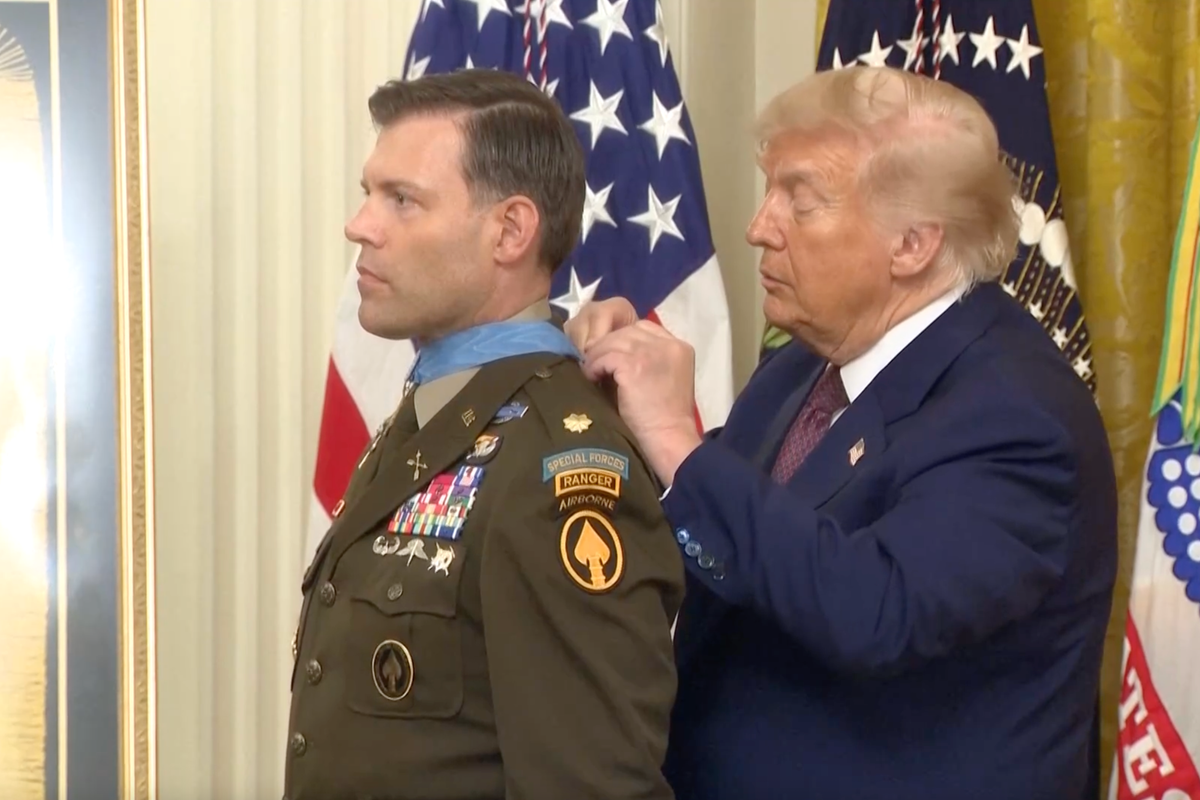
The media obsession with presidential motor skills is a predictable, seasonal disease. Every few months, an outlet catches a clip of a commander-in-chief fumbling a pen, misjudging a step, or struggling with a heavy medallion, and uses it to construct a grand narrative about cognitive decline or a crumbling administration. We saw it with the frantic analysis of a White House ceremony where Donald Trump labored to fasten a Medal of Honor around a veteran's neck. The consensus was swift and lazy: a sign of physical struggle, an awkward failure under the bright lights.
It is a garbage take. It misses the entire operational reality of high-stakes public ritual.
As someone who has spent two decades behind the scenes of corporate and political staging, dealing with the precise mechanics of public presentations, I can tell you that the "awkward fumble" narrative is a fundamental misunderstanding of spatial pressure, ergonomic design, and human physical limits. The media wants you to look at a trembling hand and diagnose neurological failure. The reality is far more boring, far more structural, and far more instructive for anyone who has to perform under pressure.
We need to dismantle the premise that physical precision under television lights is a direct proxy for leadership or competence. It is an optical illusion designed to generate clicks from people who have never had to perform a delicate mechanical task while fifty high-definition cameras track their every millimeter of movement.
The Ergonomics of the Medal Fumble
Let us look at the actual physics of the task. The Medal of Honor is not a necklace bought at a mall. It is a heavy, awkwardly weighted piece of military craftsmanship attached to a thick neck ribbon that features an incredibly small, traditional hook-and-eye or snap clasp mechanism.
Imagine a scenario where you are standing on a riser, under thousands of watts of hot stage lighting that dries out your skin and spikes your body temperature. You are wearing a thick, tailored wool suit that restricts your shoulder mobility. You are being asked to reach around the neck of a highly decorated, often physically imposing military veteran—who is likely stiffening up out of respect—and blind-fasten a microscopic metal hook behind their head while keeping your face angled perfectly for the press pool.
This is an ergonomic nightmare.
- The Blind Zone: You cannot see the clasp. You are relying entirely on tactile feedback through fingers that are likely slick with sweat from the stage lights.
- The Scale Mismatch: Large, aging hands do not naturally excel at micro-manipulation. A man in his seventies, regardless of his political party or health status, faces natural joint stiffening. Expecting jewelry-store precision in a high-stress, blind environment is structurally absurd.
- The Fixed Geometry: The presenter cannot easily pull the recipient closer or adjust the angle without breaking protocol and creating a truly bizarre image for the cameras.
When you break down the mechanics, the wonder isn't that a president struggles with the clasp; the wonder is that they ever get it on the first try. The media reads political weakness into what is simply a bad combination of low-grade arthritis, terrible lighting design, and ancient hardware engineering.
The Lazy Logic of "People Also Ask"
Look at the search trends around these events and you will find a flood of poorly framed questions. People want to know: "Is a struggle with fine motor skills a definitive sign of cognitive decline?" Or "Why do presidents look clumsy during ceremonies?"
The premise of these questions is fundamentally broken because they treat the presidency as a performance art of physical grace. We have been conditioned by decades of television to expect presidents to behave like Hollywood actors playing presidents. We want the fluid, frictionless movements of a choreographed stage play.
But public ritual is not a movie set. There are no second takes. When a president hesitates, fumbles, or adjusts their grip three times, it is not a data point for a medical diagnosis; it is the natural human correction mechanism operating under extreme scrutiny. If you recorded your own daily physical movements with a high-speed camera—every time you dropped your keys, missed a zipper, or fumbled with a phone charger—and broadcasted it to millions of partisan critics, you could be successfully diagnosed with a dozen neurological disorders by dinner time.
The contrarian truth nobody wants to admit is that physical stiffness is often the result of intense focus, not failure. When a leader is hyper-aware of the gravity of the moment, they over-correct. They slow down their movements to avoid dropping the medal, which ironically makes their actions look jerky and uncoordinated on camera. The "struggle" is actually an exercise in deliberate caution.
The Real Risk: The Illusion of Polish
If you want to talk about real danger in leadership, do not look at the leader who fumbles a clasp. Look at the one who performs the ritual with flawless, unthinking smoothness.
In my years managing corporate rollouts and advising executives, I learned to fear the hyper-polished presenter. Smoothness is easy to manufacture. It requires nothing more than endless rehearsal, a complete lack of genuine emotion, and a willingness to treat a sacred honor as a blocking assignment. A leader who treats a Medal of Honor ceremony like a Broadway cue is a leader who is entirely detached from the actual weight of the event. They are managing the brand, not the moment.
The downsides of our contrarian view? Sure, if you ignore these minor physical slip-ups, you risk missing genuine health crises when they actually occur. Physical capacity does matter in a crisis. But you do not diagnose a crisis by watching a clip of a man trying to hook two pieces of metal together behind someone else's ears. You diagnose it through systemic policy failures, fractured decision-making pipelines, and an inability to handle shifting strategic data. Everything else is just reality TV critique masquerading as journalism.
Stop analyzing the clasp. Start analyzing the choices that put the person on the stage in the first place.
The Actionable Protocol for High-Stakes Presentations
If you are an executive, a public official, or anyone who has to perform a physical task under intense public scrutiny, you cannot change the media's appetite for a failure narrative. But you can change your operational strategy to completely eliminate the point of failure.
- Modify the Hardware: Never accept standard issue gear for a public ceremony. If you are presenting an award, an oversized ceremonial key, or a commemorative item, ensure the touchpoints are engineered for high-visibility success. Magnetic clasps, oversized grips, and weighted bases prevent the micro-fumble. If the military refuses to update its medal hardware, you practice the hand-off, not the fastening.
- Break the Protocol Early: If you feel a physical task failing on stage, do not try to force it smoothly for thirty agonizing seconds while the cameras click. Break the fourth wall immediately. Acknowledge the physical absurdity of the task. Step around, smile, and ask for assistance or adjust the recipient openly. Authenticity destroys the media's ability to frame the moment as a secret weakness.
- Control the Staging Geometry: Never allow yourself to be forced into a blind physical maneuver. If you must place something over someone's head, have the recipient lower their posture or step down onto a slightly lower tier of the stage. Lowering the target by just four inches completely changes the biomechanical leverage of your shoulders, turning a blind reach into an easy, downward placement.
The media will keep hunting for the micro-stumble because it requires zero intellectual effort to report on. It requires no understanding of foreign policy, no grasp of macroeconomics, and no deep investigative work. It just requires an intern with a video editing suite and an appetite for cheap engagement.
If you want to understand the actual trajectory of an administration or a corporation, look at the structural integrity of their long-term decisions, not the split-second mechanics of their fingers. The next time you see a headline mocking a public figure for struggling with a physical object on stage, remember that you are watching a triumph of bad staging design and cheap optics over actual substance. Turn off the broadcast and look at the ledger.


