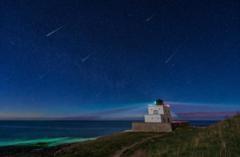
You’re standing in a dark field, neck craned back, staring at a sky so thick with stars it looks like spilled salt on velvet. Suddenly, a streak of light tears through the atmosphere. A meteor. You scramble for your phone, tap the shutter, and look at the screen. It’s a grainy, black mess with a single gray smudge. It’s frustrating. We’ve all been there, trying to capture the shifting drama of the heavens only to realize our cameras aren't built like our eyes.
Capturing the sky isn't just about having an expensive lens. It’s about timing, patience, and understanding that the sky is a living thing. From the neon glow of the aurora borealis to the sharp, fleeting zing of a Perseid meteor, the atmosphere is constantly performing. If you want to move beyond blurry snapshots and start taking photos that actually tell a story, you have to stop treating the sky like a static backdrop. It's the lead actor. For a different look, read: this related article.
The Science Behind Those Streaks of Light
When you see a meteor, you aren't looking at a "falling star." You're watching a piece of space debris—often no bigger than a grain of sand—burning up as it hits Earth's atmosphere at speeds of up to 45 miles per second. That friction creates an intense heat that ionizes the air around the pebble, creating that glowing trail.
If you want to photograph these, you can't just wait for one and click. You have to use long exposures. This is where most people fail. They try to "catch" the meteor. Instead, you should keep your shutter open for 15 to 30 seconds at a time, hoping a meteor crosses your frame during that window. It’s a numbers game. NASA and the American Meteor Society point out that during a peak shower like the Geminids, you might see 100 meteors an hour. That sounds like a lot, but they’re spread across the entire dome of the sky. Further analysis on the subject has been published by Refinery29.
Light Pollution is Killing Your Best Shots
You can have the best gear in the world, but if you're shooting from a suburban backyard, your sky photos will look flat and orange. Light pollution is the enemy of the changing sky. It washes out the subtle gradients of a sunset and makes the Milky Way invisible.
Check a tool like the Dark Sky Map before you head out. Finding a "Bortle Class 1 or 2" location—the gold standard for darkness—changes everything. Suddenly, those faint rays of light you thought were clouds reveal themselves as the edges of our galaxy. If you're stuck in a city, don't try to fight the light. Lean into it. Use the orange glow of streetlights to contrast with the deep blue of the "blue hour," that short window just after sunset when the sky holds a saturated, royal hue.
Why Crepuscular Rays Look Like God Beams
We’ve all seen those dramatic shafts of light breaking through clouds, often called "God rays" or crepuscular rays. They look like they're diverging from a single point, fanning out across the landscape. Here’s a weird fact: they’re actually parallel.
The fan effect is an optical illusion caused by linear perspective. It’s the same reason railroad tracks seem to meet at a point on the horizon. These rays happen when something—usually a mountain or a heavy cloud—blocks the sunlight but allows gaps for the light to pass through. The air needs to be slightly hazy or dusty for the light to have something to reflect off of.
To photograph these, underexpose your shot. If you let the camera decide the brightness, it’ll try to make the dark clouds look medium-gray, which blows out the beautiful rays into a white blob. Dial down your exposure compensation. Make those clouds dark. Let the rays pierce through.
The Aurora Borealis is More Than Just Green
Social media has conditioned us to think the Northern Lights are always a neon, radioactive green. In reality, the sky can shift into reds, purples, and even pinks. These colors depend on which atmospheric gases the solar particles are hitting. Oxygen at lower altitudes produces that classic green, but oxygen high up—around 200 miles—can glow red. Nitrogen gives you the blues and purples.
The problem is that our eyes aren't great at seeing these colors in the dark. Our "scotopic" vision—the way we see in low light—is mostly black and white. Your camera, however, doesn't have that limitation. A long exposure will "see" colors that you can only vaguely sense. If you’re out there and the sky looks like a faint, moving gray mist, take a photo anyway. Your sensor might reveal a crimson explosion that your eyes simply couldn't process.
Atmospheric Optics and the Green Flash
If you're lucky and the horizon is perfectly clear, you might catch the "green flash" at the very last second of a sunset. It’s not a myth. It’s caused by the atmosphere acting like a giant prism, bending the sunlight. The red light is bent the least, and the green/blue light is bent the most. As the sun disappears, the red light is technically already below the horizon while the green light is still being refracted toward your eyes.
It’s blink-and-you-miss-it fast. Don't look directly at the sun while you're waiting for it—you'll ruin your night vision and potentially your retinas. Use your camera's Live View screen.
Equipment Matters Less Than You Think
People obsess over full-frame sensors and $2,000 lenses. Honestly, some of the best sky shots I've seen lately came from mid-range smartphones with decent night modes. The trick isn't the glass; it's stability.
You cannot hold a camera steady enough for a three-second exposure. Period. Your heartbeat is enough to blur the stars. Use a tripod. If you don't have one, prop your phone against a rock or a fence post. Use a remote timer or the 2-second delay feature so the vibration of your finger touching the screen doesn't shake the device.
Creating Your Own Sky Journal
If you want to get serious about capturing the changing sky, stop being a fair-weather fan. Some of the most dramatic light happens right before or after a massive storm. The way the light hits the underside of mammatus clouds—those weird, pouch-like formations—can make the world look like another planet.
Don't just take the photo and forget it. Note the conditions. What was the humidity? Was there a cold front moving in? Over time, you’ll start to "smell" when a good sky is coming. You’ll see the clouds stacking a certain way and know that in twenty minutes, the light is going to turn into liquid gold.
- Download a tracking app. Use something like Stellarium or PhotoPills to know exactly where the sun, moon, and Milky Way will be at any given second.
- Watch the dew point. If the temperature drops to the dew point, your lens will fog up. Hand warmers rubber-banded around the lens barrel can prevent this.
- Shoot in RAW. If your phone or camera allows it, avoid JPEGs. RAW files hold way more data in the shadows and highlights, which is vital when you're dealing with the extreme contrast of a night sky.
- Find a foreground. A photo of just the sky is a texture. A photo of the sky above a lone tree or a jagged mountain is a story. Give the viewer a sense of scale.
The sky is never the same twice. You can stand in the exact same spot every night for a year and see 365 different versions of the universe. Stop waiting for the "perfect" gear and start paying attention to the weather patterns. The best shots happen when you're actually there to see them.