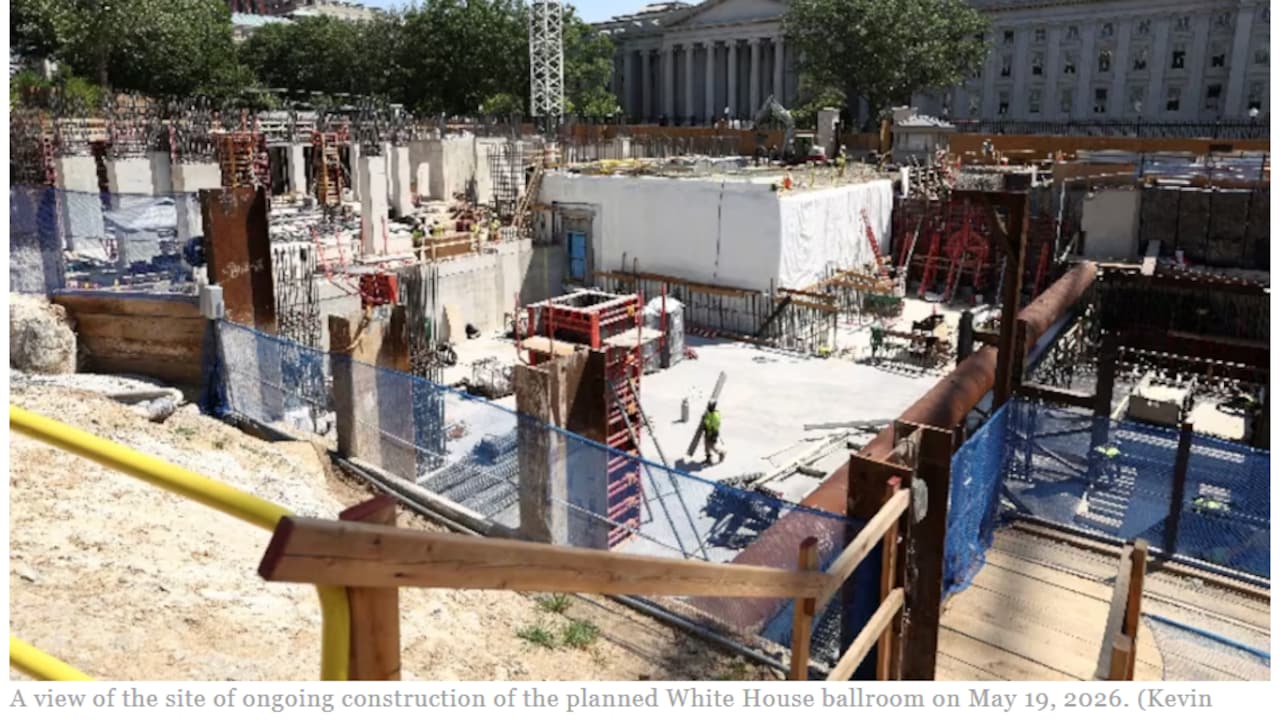
The headlines sound like something straight out of a political thriller. Critics are screaming about a $400 million "ego project" while conspiracy theorists whisper about a president preparing for Doomsday. Donald Trump is flattening parts of the historic White House lawn to build a massive, 90,000-square-foot state ballroom.
But the real story isn't happening above ground. It's happening beneath it.
When news broke that the historic East Wing was completely demolished to make way for this sprawling complex, preservationists panicked. They filed lawsuits. A federal judge even ordered the above-ground work to stop. But the court left a massive loophole, allowing underground construction to continue uninterrupted for "national security" reasons.
That loophole exposed the true heart of this project. The ballroom is basically a giant cover story—or as Trump himself put it to reporters on Air Force One, a "shed" for the massive military installation being dug beneath the surface.
This isn't just about throwing bigger dinner parties. It's about completely rebuilding the nerves of American continuity of government.
The Death of the 1940s Bunker
To understand why a new underground facility is being built, you have to look at what was already down there. Beneath the East Wing sat the Presidential Emergency Operations Center, known to insiders as the PEOC.
Franklin D. Roosevelt built the original bunker in 1942 after Pearl Harbor. While tech upgrades happened over the decades, the structural bones of the PEOC were dangerously outdated. It was small, cramped, and built for an era of propeller planes and basic aerial bombs.
Think back to the terrifying hours of September 11, 2001. When Secret Service agents literally grabbed Vice President Dick Cheney by the belt and dragged him underground, they crowded into a relatively small room. The National Archives later released photos of that day. You can see officials like Condoleezza Rice packed shoulder-to-shoulder under fluorescent lights.
It worked then, but barely. The facility simply couldn't handle the massive support staff required to run a modern war or survive a multi-day siege.
Fast forward to May 2020. As protests raged outside Lafayette Park, Secret Service agents rushed Trump to that exact same underground bunker. Reports leaked, headlines mocked him, and the vulnerability of the aging space became glaringly obvious. The tech was sluggish, the air systems were old, and the space was entirely inadequate for 21st-century threats.
So, the administration made a choice. Instead of trying to patch up an 80-year-old basement, they brought in the heavy machinery, demolished the East Wing, and started digging deep.
What Is Actually Going Under the Ballroom
The sheer scale of the excavation has sent shockwaves through Washington. Trump's team shifted the design mid-stream, bringing in architect Shalom Baranes to handle a rapidly ballooning blueprint. What started as a modest expansion is now a multi-story subterranean fortress.
We aren't talking about a simple concrete room anymore. Court filings from the Secret Service and public admissions from the administration paint a wild picture of what's being installed.
- A Full-Scale Military Hospital: This isn't a first-aid station. The new build includes a major medical facility equipped for complex surgeries and long-term emergency care, ensuring the executive branch doesn't rely on outside hospitals during a lockdown.
- Droneproof Shielding and Drone Ports: Modern warfare changed. Drones are now the primary threat. The roof of the above-ground structure is reinforced to withstand kamikaze drone strikes, while the underground complex features its own secure defense mechanisms.
- Bio-Defense Air Systems: Independent, sealed air-handling units are being buried deep to scrub out chemical, biological, or radiological contaminants.
- Six Stories of Subterranean Infrastructure: Rumors of a six-floor deep complex have circulated, backed by the massive amount of heavy-duty concrete and steel beams being hauled onto the property.
The strategy mimics the massive infrastructure project undertaken during the Obama administration around 2010. Back then, a massive hole was dug next to the West Wing. The government tried to hide it behind high fences, ordering contractors to tape over company logos on their trucks. Officially, they called it an "air conditioning upgrade." In reality, everyone in Washington knew they were installing multi-story command facilities.
Trump is doing the exact same thing now, just on a much larger, louder scale.
The Hypocrisy of the Funding Battle
The political theater surrounding this construction is exhausting. Critics point out that Trump bypassed Congress to start the demolition, sparking a massive legal battle with the National Trust for Historic Preservation.
Supporters claim the project won't cost taxpayers a dime because wealthy donors and corporate giants like Amazon, Meta, and Lockheed Martin are picking up the tab for the ballroom. But that's only half true.
Private money might pay for the gold-trimmed walls and seating for 999 guests upstairs. But taxpayers are absolutely funding the security apparatus underneath. The White House Military Office and the Secret Service have made it clear that the underground fortress requires heavy federal funding.
The administration has pushed for a massive security budget to cover the high-grade bulletproof glass, advanced telecommunications, and tactical command centers. Security experts like Matthew Quinn, the Deputy Director of the Secret Service, have stated in court filings that leaving the site unfinished "imperils" the agency's ability to protect the president. Security isn't optional, and it isn't free.
The Reality of Secret White House Tunnels
Whenever heavy machinery rolls onto Pennsylvania Avenue, the internet loses its mind over secret tunnels. People love to imagine a web of passages connecting the Oval Office to the Pentagon or Capitol Hill.
Let's separate fact from internet fiction. The White House does have a proven tunnel system, but it's practical, not magical.
Harry Truman completely gutted the White House in 1948 because the building was structurally collapsing. During that massive rebuild, workers installed a concrete tunnel connecting the West Wing and East Wing, allowing easy, hidden access to the bomb shelter.
During the Reagan administration in 1987, another secure tunnel was built. This one allows the president to slip out of the Oval Office through a hidden wall panel, descending a secret staircase that leads directly to the basement of the residence near the private elevator.
There's also a historic tunnel built by FDR that links the East Wing basement to the basement of the nearby Treasury Building. It was meant as a quick escape route during World War II.
Does this new project connect to those old paths? Absolutely. You can't build a massive, multi-story military bunker under the East Wing without hooking it into the existing subterranean network. The construction workers aren't just digging down—they're stitching together decades of hidden defensive infrastructure.
How to Track the Construction Safely
If you're a political junkie or an architecture enthusiast visiting Washington, D.C., don't expect to see top-secret blueprints hanging on the fences. You can, however, watch history happen in real-time.
Walk down to the north side of the White House near Lafayette Park. While you can't get close enough to see the depth of the hole, the fleet of heavy cement trucks, steel transport vehicles, and massive cranes tells the story.
Keep an eye on the public docket for the National Capital Planning Commission. They meet monthly, and because the White House is forced to submit modified design plans to mollify historic preservation boards, their public presentations offer rare, heavily scrutinized glimpses at the changing footprint of the executive mansion.
The debate over aesthetics, presidential authority, and historic preservation will drag on in federal appeals courts for months. But while lawyers argue about the ballroom above, the cement mixers keep pouring concrete into the earth below. The old PEOC is gone, and a new fortress is taking its place.