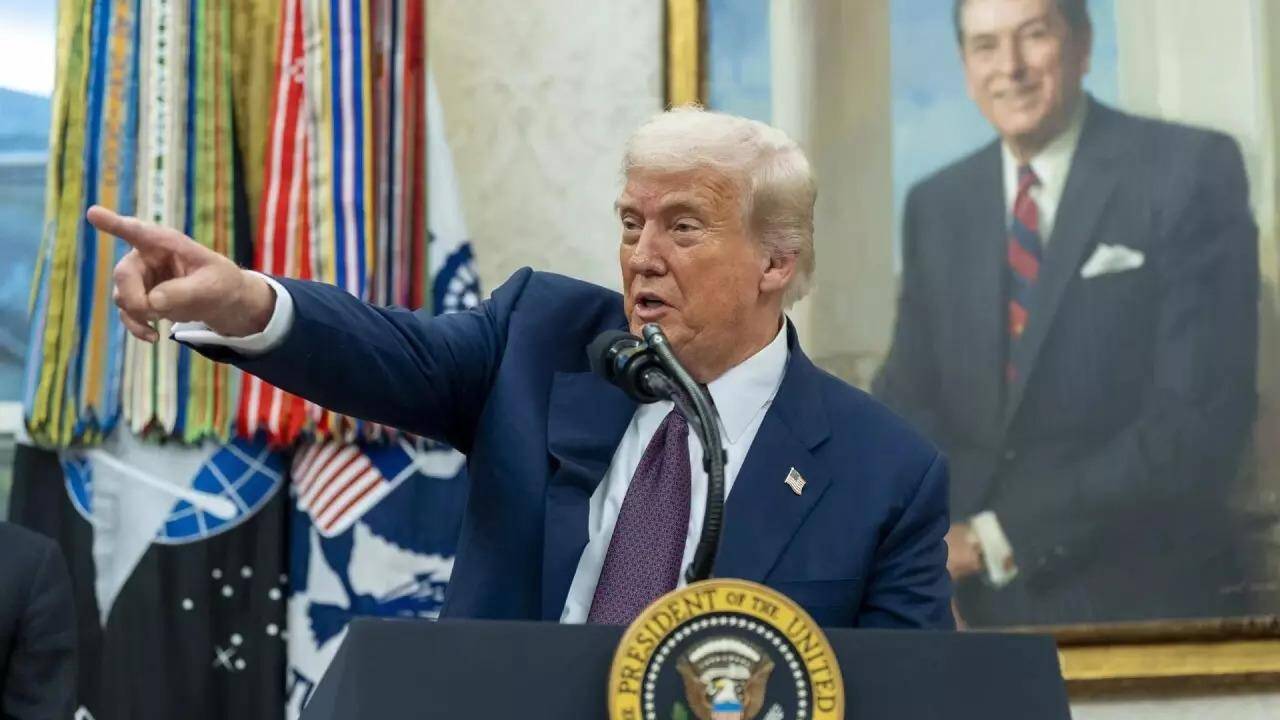
Donald Trump just declared there are no limits to his ability to exert power. Fresh off signing the Islamabad Memorandum of Understanding to halt the recent US-Iran war, the president sat down with Axios and doubled down on his favorite theme: absolute dominance. When pushed on whether he actually learned anything about the structural boundaries of the presidency during the bloody conflict, his response was pure vintage Trump.
"There are no limits. I haven't learned that lesson yet. I know there are, but there are no limits."
It's a wild statement. It's also completely wrong. While Trump points to the brutal efficiency of the US naval blockade as proof of his infinite leverage, the actual fine print of how this war ended shows the exact opposite. The conflict didn't prove American power is limitless. It proved that even the world’s most dominant military machine has to bend when global supply chains start to snap.
The real question behind this whole ordeal isn't whether Trump thinks he's unstoppable. It's how a war that began with demands for "unconditional surrender" ended in a negotiated compromise at the Palace of Versailles.
The Unconditional Surrender That Wasn't
Let's look at the actual facts on the ground rather than the rhetoric coming out of the Oval Office. Trump entered this conflict loudly demanding that Tehran completely capitulate. Instead, the war wrapped up with the Islamabad Memorandum of Understanding—a temporary 60-day ceasefire mediated not by Washington alone, but through backchannels in Pakistan, Qatar, and Oman.
When pressed on this massive gap between his initial demands and the actual deal, Trump tried to bridge the chasm with sheer spin. "Well, it really probably is unconditional surrender," he told interviewer Marc Caputo.
But a closer look at the strategic reality shows a very different picture.
- The Nuclear Stockpile: Iran enters this truce holding roughly 440 kilograms of uranium enriched to 60%. That is a stone's throw from weapons-grade material. The deal calls for down-blending this stockpile under International Atomic Energy Agency (IAEA) supervision, but the complex verification infrastructure hasn't even been built yet.
- The Reconstruction Bill: The deal sets up a framework for a massive $300 billion Gulf-backed fund to rebuild Iran's shattered infrastructure. Think about that. A war meant to crush a regime ends with a diplomatic roadmap toward a multi-billion-dollar reconstruction package.
- Persistent Resistance: Despite US Central Command wiping out an estimated 80% to 90% of Iran's formal defense industrial base, the regime proved it could still bite. Just days before the ceasefire, an Iranian drone collided with and downed a US Army helicopter near the Strait of Hormuz.
The Chokepoint Dilemma
Trump isn't wrong when he brags about the sheer mechanics of American military force. The naval blockade he ordered was devastating. For weeks, US warships choked off the Islamic Republic, ensuring virtually no commercial traffic moved out of Iranian ports.
"Who else could have done a blockade like that?" Trump boasted. "I did a naval blockade where not one ship was able to get through."
But the blockade was a double-edged sword, and that's the part the administration doesn't want to talk about. You can't choke Iran without suffocating the global economy.
The Strait of Hormuz is a geographic reality that no amount of military bravado can alter. When the strait closes, oil prices spike, markets panic, and domestic political pressure mounts at home. Trump admitted as much during his interview, acknowledging that continuing to drop bombs for another few weeks would have kept the vital waterway locked tight.
"We wouldn't have oil for months," Trump noted. "As long as you're dropping bombs, that thing is automatically closed."
This admission cuts right through the "no limits" rhetoric. The limit isn't a lack of bombs or a lack of military will. The limit is the global economy's tolerance for disruption. Wall Street and global energy markets effectively set the boundaries of the war. The moment the ceasefire was signaled, oil prices plummeted and stocks surged—a market reaction Trump instantly took credit for on social media, apparently blind to the irony that the markets were cheering the end of his military campaign, not its continuation.
A Fragile Peace Built on Moving Parts
What happens next isn't up to Trump alone, despite his claims of absolute authority. The 60-day pause is an incredibly fragile window. Iran's Supreme National Security Council announced that traffic through the Strait of Hormuz will only increase gradually, dangling the flow of global oil as a tool for ongoing leverage. To sweeten the deal for commercial shippers, Tehran is even waiving transit fees for the next two months.
Meanwhile, domestic players on both sides are already poisoning the well. In Tehran, Parliament Speaker Mohammad Bagher Ghalibaf warned that any excessive American demands would be met with a "crushing response," bragging that the US had already been "slapped once" in the conflict. Even Iran’s Supreme Leader, Mojtaba Khamenei, publicly signaled he held a "different view" on signing the deal but allowed it anyway, preserving his ability to walk away if future talks don't go his way.
In Washington, the pushback is just as fierce. Capitol Hill lawmakers, entirely excluded from the Versailles negotiations, are openly questioning whether Tehran can be trusted to down-blend its uranium. Republicans and Democrats alike are looking toward the upcoming midterm elections, hyper-aware that voters are deeply exhausted by a costly, inflationary foreign conflict.
If you are trying to make sense of where this leaves American foreign policy, drop the assumption that Washington can simply dictate terms to the world. The lesson of the war isn't that American power is infinite. It's that coercive force can successfully disrupt an adversary, but it cannot automatically build a stable regional order.
The immediate next steps require watching the IAEA's technical team as they attempt to deploy inspectors inside Iran's facilities. If those verification mechanisms falter over the next 60 days, or if the regional proxies like Hezbollah break the fragile silence, the illusion of total control will evaporate completely. Watch the oil prices and the inspector logs, not the victory laps on television.


