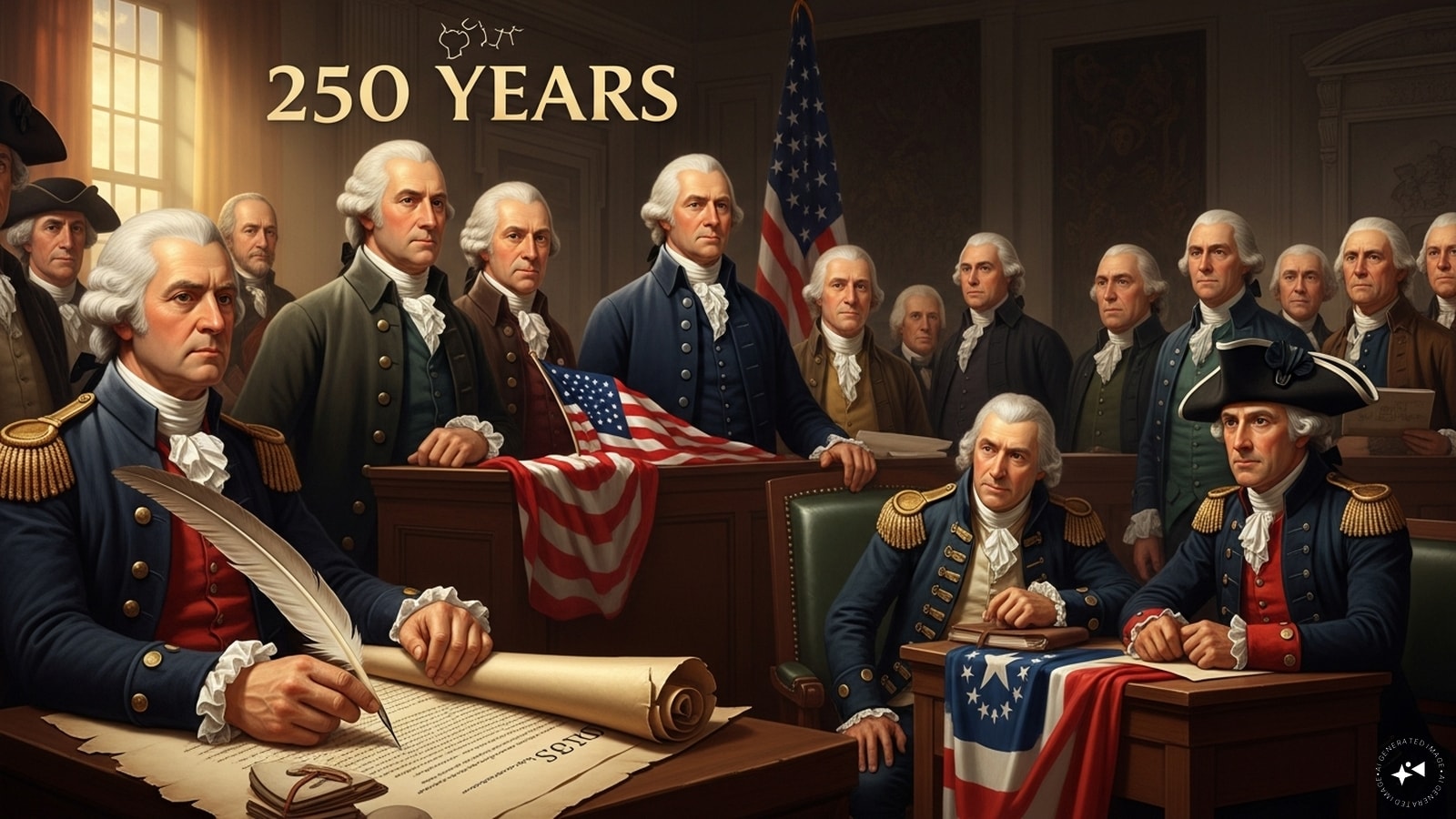
We treat America’s founding fathers like marble statues instead of flesh-and-blood politicians. Pop culture portrays them as a unified team of flawless geniuses who sat down in a quiet room in Philadelphia and neatly drew up the blueprint for modern democracy.
That version of history is mostly fiction. Discover more on a connected subject: this related article.
The men who built the American republic were actually a chaotic, deeply divided group of lawyers, plantation owners, and merchants who couldn't stand each other half the time. They traded brutal insults, ran smear campaigns in partisan newspapers, and disagreed on almost every fundamental question of power. If you want to understand why American politics feels so broken today, you have to stop looking at the myths. You need to look at the messy, fragile compromises that built the system in the first place.
The Myth of the Unified Revolution
The biggest mistake we make is assuming the founders shared a singular vision. They didn't. Additional analysis by BBC News explores comparable perspectives on this issue.
Once the common enemy of King George III was gone, the fragile alliance between these men evaporated. The 1780s and 1790s weren't an era of good feelings. They were defined by vicious partisan warfare.
Take Alexander Hamilton and Thomas Jefferson. Their hatred was legendary. Hamilton wanted a strong central government, a national bank, and an urban economy driven by manufacturing. Jefferson envisioned a decentralized nation of independent farmers, fearing that a powerful federal state would inevitably turn into a monarchy.
They used pseudonyms to write anonymous attack articles against each other in rival newspapers. Jefferson even hired a journalist named James Callender to explicitly target Hamilton's reputation. This wasn't a minor policy debate. It was an existential fight for the soul of the nation.
Then you have John Adams and Jefferson. They went from close friends during the writing of the Declaration of Independence to bitter rivals. During the election of 1800, Adams's camp called Jefferson a weak-willed infidel, while Jefferson's camp shot back that Adams had a hideous hermaphroditical character. They didn't speak for years afterward. The system survived not because these men agreed, but because they figured out how to build a framework that could handle their mutual animosity.
How America’s Founding Fathers Designed a System of Friction
When the delegates gathered for the Constitutional Convention in 1787, they weren't trying to create a perfect utopia. They were trying to stop a country from falling apart under the weak Articles of Confederation.
The system they designed was intentionally inefficient.
The founders deeply distrusted concentrated power. They didn't just worry about a tyrannical president; they were equally terrified of the "tyranny of the majority." They feared that a sudden wave of public passion could sweep through the population and destroy the stable order of society.
To prevent this, they built a machine designed to jam up.
- The Senate gave equal power to small states, checking the raw population power of the House of Representatives.
- The Electoral College insulated the presidency from the direct popular vote.
- The Supreme Court was insulated from elections entirely through lifetime appointments.
Every branch was given a weapon to fight the others. The president could veto laws, Congress could impeach the president, and the courts could strike down legislation. This gridlock wasn't an accidental bug. It was the core feature. They wanted change to be slow, painful, and difficult.
The Tragic Compromises of 1787
You can't talk about the creation of the republic without facing its darkest realities. The Constitution was a bundle of deals made to keep the Southern states from walking out of the room.
The most notorious was the Three-Fifths Compromise. Slavers in the South wanted their enslaved population counted for congressional representation to boost their political power, but they didn't want them counted for taxation. The North wanted the opposite. The result was a cold math calculation that counted an enslaved human being as three-fifths of a person.
This gave the slave-holding South an artificial lock on the federal government for decades. Out of the first five US presidents, four were Virginia slave owners.
They also barred Congress from banning the transatlantic slave trade until 1808. James Madison, often called the father of the Constitution, owned dozens of slaves and never freed them, even in his will. George Washington held hundreds of people in bondage at Mount Vernon.
These contradictions aren't side notes. They are foundational elements of the system. The founders built brilliant mechanisms for protecting liberty, but they deliberately drew a boundary around who got to enjoy that liberty.
Why the Founders' Predictions Failed
The creators of the American system were not prophets. They got a lot of things wrong about how the future would actually work.
First, they completely failed to predict the rise of permanent political parties. Madison wrote extensively in Federalist No. 10 about the danger of "factions," believing that the sheer size of the United States would prevent any single political group from dominating the whole country. He thought regional interests would always cancel each other out.
He was wrong within five years. By the early 1790s, the Federalists and the Democratic-Republicans had formed national networks. The structural checks and balances designed to pit the executive branch against the legislative branch broke down. Today, a senator's loyalty is almost always to their political party, not to the Senate as an institution.
Second, they never anticipated a world of rapid communication and instant mass media. They assumed leaders would have days or weeks to deliberate on major decisions, away from the constant noise of public opinion.
Stop Looking for Original Intent
Many legal thinkers and politicians argue that we must strictly interpret the Constitution based on the original intent of America's founding fathers.
But searching for a single intent is a fool's errand. There was no consensus.
Every single clause in the Constitution was a hard-fought deal. Some delegates wanted a president who served for life; others wanted a multi-person executive committee. Some wanted federal power to veto state laws; others wanted states to remain fully sovereign. The text we have is the messy middle ground that enough people were willing to sign just so they could go home.
If you want to understand American history, stop reading the sanitized textbook versions. Start reading their actual words, their private letters, and their vicious newspaper columns.
To begin exploring the real history without the mythology, take these three practical steps.
- Read Federalist No. 10 and Federalist No. 51 by Madison and Hamilton to see exactly how they thought the system would prevent corruption.
- Read Madison’s Notes of Debates in the Federal Convention of 1787 to see the raw arguments, the anger, and the deals that went down behind closed doors.
- Read the letters between John Adams and Thomas Jefferson late in their lives, where they finally reconciled and discussed what they thought their creation would become.