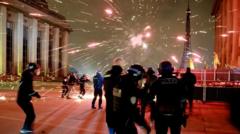
Winning should be the easy part. But in Paris, a major football victory feels less like a celebration and more like a tactical urban battle. On Wednesday night, Paris Saint-Germain (PSG) booked their ticket to the Champions League final after a grueling 6-5 aggregate win over Bayern Munich. It should've been a night of pure joy. Instead, it ended with 127 people in handcuffs, 23 injured cops, and a city center smelling of tear gas and burnt rubber.
Interior Minister Laurent Nuñez confirmed the numbers on Thursday morning. Out of those 127 arrests, 107 happened right in the heart of Paris. This isn't just about a few fans getting rowdy. It’s a systemic problem that seems to trigger every time the capital’s club nears European glory. If you’re wondering why your favorite Parisian landmarks look like a scene from an action movie after a big match, you aren't alone.
The Cost of Moving to the Final
PSG's 1-1 draw in Germany was enough to push them through, but the reaction back home was anything but peaceful. As soon as the final whistle blew, the Champs-Élysées and the area around the Parc des Princes transformed. While thousands of fans gathered to sing and light flares, a predictable "hardcore" element showed up with different plans.
According to Nuñez, the arrests were mostly for "participation in a group formed to commit violence," setting off illegal fireworks, and damaging property. We saw 67 rubbish-bin fires and three vehicles go up in flames. This isn't "celebrating." It’s opportunistic chaos.
The injuries are the most sobering part of the night:
- 34 total injuries reported across the city.
- 23 police officers sustained minor injuries while trying to keep the peace.
- 11 civilians were hurt, including one person in serious condition after being hit by a pyrotechnic mortar.
Think about that for a second. Someone is in a hospital bed right now with severe injuries because someone else thought it was a good idea to fire a mortar in a crowded street. It’s reckless, and frankly, it’s embarrassing for a city that’s supposed to be the world's cultural capital.
Security Friction and Political Finger Pointing
It didn't take long for the political blame game to start. Interior Minister Nuñez didn't hold back when discussing Paris Mayor Emmanuel Grégoire’s recent moves. Grégoire had already announced a massive city fan zone for the final on May 30, but apparently, he forgot to tell the police.
"Normally, we talk about that a bit with the police prefect beforehand," Nuñez told CNews. You can feel the tension there. The government is worried that a fan zone will just become a focal point for more violence, while the city wants to give fans a place to gather. It’s a classic case of local government vs. national security, and it leaves the residents of Paris caught in the middle.
Nuñez’s frustration stems from the fact that his teams had to intervene systematically to stop rioters from blocking the Paris ring road (the Périphérique). Imagine the logistical nightmare of having one of Europe's busiest roads shut down by a mob while you're already trying to manage thousands of people on the Champs-Élysées.
A Pattern of Post Match Violence
If this feels like déjà vu, that’s because it is. Paris has a long, documented history of football-related unrest that goes back decades.
Last year, when PSG actually won the title, the national arrest count topped 500. In 2020, after a loss to Bayern in the final, police grabbed 148 people. Even way back in 2013, when the club won its first league title in nearly 20 years, the trophy presentation was cut short because of running battles between fans and riot police.
The club has tried to distance itself from the violence, but the "ultras" and the fringe groups that follow them have a complicated relationship with the city’s identity. For many of these guys, the match is just the warmup. The real event is the confrontation with law enforcement that follows.
What This Means for the Final in Budapest
On May 30, PSG faces Arsenal in Budapest. While the match is happening in Hungary, the real headache remains in Paris. Nuñez has already warned that security will be "just as forceful" for the final.
If you're planning to be in Paris that night, don't expect a relaxed atmosphere. You'll likely see a massive paramilitary police presence, restricted access to major squares, and a very short fuse from law enforcement.
The city is stuck. It wants to celebrate its team's success—a team that has now reached three finals since 2020—but it can't seem to do so without the night ending in sirens and smoke. Whether the fan zone actually happens is still up in the air, but one thing is certain: the authorities are done playing games.
If you're heading out to support the team, keep your head on a swivel. Avoid the groups carrying mortars, and maybe stay a block or two away from the main flare-lit crowds. The line between a historic party and a police booking is thinner than ever in Paris.
Stay safe, stay smart, and maybe watch the final from a bar with a back exit.