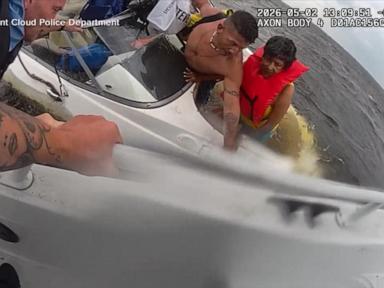
Marine rescue operations executed by civilian actors are often framed as spontaneous acts of heroism, but a structural analysis reveals they are actually complex exercises in real-time risk assessment, kinetic management, and resource allocation. When a father-and-son team intervenes to save distressed boaters, they are not merely "helping"; they are functioning as a tactical response unit operating under severe constraints. The success of such an intervention depends on three distinct variables: situational awareness (SA), the mechanical advantages of the rescue vessel, and the physics of maritime towing or extraction.
The Triad of Maritime Distress Resolution
The efficacy of a civilian rescue is governed by a specific set of operational pillars. If any of these pillars fail, the rescuers transition from assets to additional liabilities, compounding the burden on professional Coast Guard or emergency services.
1. Kinetic Synchronization and Relative Motion
The primary challenge in any water-based rescue is the management of energy between two unanchored masses. Unlike a roadside assistance scenario where the ground provides a stable friction coefficient, maritime rescues involve constant movement across three axes: pitch, roll, and yaw.
- Vessel Inertia: The rescuing boat must have sufficient mass and engine torque to counteract the drift of the disabled vessel.
- Hydrodynamic Drag: Once a line is established, the drag on the disabled hull increases exponentially with speed. Rescuers who apply too much throttle too quickly risk snapping lines or destabilizing their own craft.
- Vector Alignment: Approaching a vessel from the windward side risks being pushed into the casualty, while a leeward approach requires precise throttle control to prevent drifting away.
2. Information Asymmetry and Communication
Distressed boaters rarely provide accurate technical data regarding their situation. Civilian rescuers must perform a rapid "triage of the hull" upon arrival. This involves identifying whether the failure is mechanical (engine out), structural (taking on water), or environmental (grounded on a sandbar). The failure to correctly identify a taking-on-water scenario before attempting a tow can lead to the "sink-on-pull" effect, where the forward motion forces water into a compromised bow.
3. Resource Redundancy
A successful intervention requires the presence of specific hardware that is often under-maintained on civilian vessels.
- Cleat Integrity: The sheer force of towing a dead weight through a chop can rip standard cleats out of a fiberglass deck if they are not backed by steel plates.
- Line Elasticity: Using a non-elastic line (like certain braids) for a tow creates a "jerk" effect that can damage both vessels. Kinetic energy must be absorbed by the line or the water.
The Physics of the Tow: Tension and Vector Dynamics
When the father and son initiate a rescue, they are engaging with the laws of fluid dynamics. The tension on a towline ($T$) is not just a function of the weight of the boat; it is a calculation involving the speed of the tow ($v$) and the resistance coefficient of the hull ($C$).
$$T = \frac{1}{2} \rho v^2 A C_d + \text{Static Friction}$$
The rescuer must maintain a "catenary" in the towline—a slight dip that acts as a shock absorber. A taut line is a dangerous line. If the line snaps under high tension, it undergoes "snap-back," a lethal release of stored kinetic energy that can traverse the length of the boat in milliseconds. This is the most common point of failure in civilian interventions.
Human Capital: The Multi-Generational Coordination Advantage
The involvement of a father and son introduces a specific psychological and operational benefit: high-trust communication. In high-stress maritime environments, the "OODA Loop" (Observe, Orient, Decide, Act) is compressed.
Decentralized Command
In this specific dyad, roles are typically bifurcated between the helm and the deck. The father, generally acting as the senior operator, focuses on the macro-navigation and engine management. The son provides the "eyes on target," managing the physical deployment of lines and monitoring the gap between vessels. This division of labor reduces the cognitive load on a single individual, which is critical when environmental conditions (waves, wind, or low light) degrade sensory input.
The Liability of the Good Samaritan
While maritime law (and specifically the International Convention on Salvage) encourages assistance, it does not absolve the rescuer of negligence. The "Standard of Care" required of a civilian is lower than that of a professional, but the rescuer must not worsen the situation. A failed rescue that results in a collision or an injury to the distressed party can lead to complex litigation, especially if the rescuer lacked the proper equipment to execute the maneuver they attempted.
Structural Bottlenecks in Civilian-Led Rescues
The transition from a successful rescue to a safe harbor is often where the greatest risks emerge. Civilian vessels are rarely designed for the lateral stability required to tow another craft in a cross-current.
- Fuel Exhaustion: Towing doubles or triples fuel consumption. Many rescuers fail to account for the "return-trip delta"—the amount of fuel needed to fight the tide while under load.
- Transom Stress: Most recreational boats are designed for forward propulsion, not for pulling weight from the stern. Sustained towing can lead to hairline fractures in the transom or engine mounts.
- The "Pivot Point" Problem: When a towline is attached to the stern of the rescuing boat, it restricts the boat’s ability to turn. If the disabled vessel begins to swing, it can "trip" the rescuing boat, pulling its stern sideways and causing a capsize (a phenomenon known as "girting" in the tugboat industry).
The Economic and Logistical Impact of Civilian Intervention
From a macro perspective, civilian rescues act as a "shadow infrastructure" for the Coast Guard. By resolving low-complexity distress signals, these individuals prevent the deployment of high-cost government assets (helicopters, cutters, and professional crews).
- Cost Avoidance: A single Coast Guard MH-65 Dolphin sortie can cost upwards of $15,000 per hour. A civilian intervention costs the price of a few gallons of fuel and a length of rope.
- Response Time Compression: In maritime emergencies, the "Golden Hour" is often reduced to minutes due to the threat of hypothermia or vessel submersion. The proximity of civilian actors is the only variable that can effectively bypass the geographical limitations of official rescue stations.
Strategic Recommendation for Maritime Operators
Operators should prioritize the installation of "towing bitts" over standard cleats if they intend to operate in high-traffic or high-risk zones. Furthermore, the adoption of VHF-DSC (Digital Selective Calling) technology is mandatory for reducing the information gap between the rescuer and the casualty. Relying on visual signals or cell phones is a failure of redundancy.
In any encounter with a disabled vessel, the lead rescuer must execute a "Reverse-Risk Assessment." Instead of asking "How do I save them?", the question must be "Under what conditions will I cut the line?". Establishing a "hard abort" criteria before the tow begins—such as a specific sea state or fuel level—is the only way to ensure that one distressed vessel does not become two. The most effective rescue is one that maintains the operational integrity of the rescuing platform at all costs.