The Operational Mechanics of Low Water Stress
Critical infrastructure vulnerability rarely emerges from catastrophic single-point failures. Instead, operational degradation typically stems from the slow convergence of baseline environmental variance and inflexible mechanical design. When hydrological levels in the Danube River drop below historical operational parameters, facilities relying on once-through cooling systems face an immediate thermodynamic constraint. Nuclear power generation requires a continuous, high-volume heat sink to maintain thermal efficiency and prevent reactor trips. At the Cernavoda facility in Romania, declining water flow alters the intake capacity of Reactor Unit Two, exposing a structural dependency on river depth that standard operational planning often fails to price correctly.
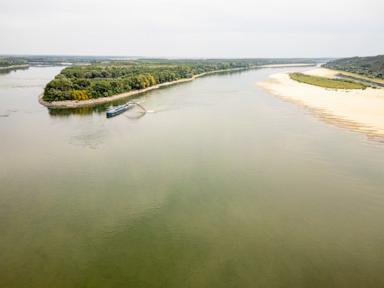
The primary mechanism governing this vulnerability is the mass flow rate of cooling water required to condense steam exiting the turbine generator. As ambient river levels recede, the hydraulic head pressure at the intake structures diminishes, reducing volumetric throughput. Without engineering interventions, declining intake volumes force plant operators to either curtail power output to match available cooling capacity or risk exceeding thermal discharge limits imposed by environmental regulations. The emergency sinking of barges in the Danube represents an ad-hoc hydraulic diversion tactic, designed to channel remaining river currents directly toward the intake canal and artificially preserve the requisite mass flow rate.
Systemic Vulnerabilities in River-Cooled Assets
Evaluating infrastructure resilience requires dissecting how external environmental variables translate into internal operational bottlenecks. River-cooled industrial assets operate within a tightly coupled system where hydrological changes immediately cascade into economic and electrical grid impacts.
The Hydraulic Head Deficit
Water intake structures depend on a specific elevation differential between the river surface and the pump wells. When drought conditions lower the river surface, the resulting head deficit reduces the efficiency of primary cooling pumps. This creates a mechanical ceiling on how much water can be drawn, regardless of electrical demand on the grid.
Thermal Compliance Thresholds
Environmental frameworks restrict the temperature differential between extracted water and discharged effluent to protect aquatic ecosystems. During low-flow regimes, the reduced volume of ambient water absorbs less waste heat, causing the discharge temperature to spike. Operators must navigate a narrow operating window bounded by reactor safety limits on one side and ecological compliance ceilings on the other.
Logistical Band-Aid Interventions
Relying on physical obstructions such as sunken barges to redirect channel flow illustrates a tactical response to a strategic design limitation. While this intervention alters local bathymetry to force water into the intake zone, it introduces new variables. Uncontrolled sediment accumulation around the obstruction can alter local scouring patterns, creating secondary blockages that require ongoing dredging or mechanical remediation.
Strategic Framework for Hydraulic Risk Mitigation
Managing water-dependent generation assets under tightening climate variability demands a transition from reactive physical engineering to predictive resource modeling. The structural limitations exposed at Cernavoda highlight three distinct phases of risk management that asset operators must integrate into their core architecture.
- Hydrological Stress Testing: Operators must model worst-case low-flow scenarios against thermal output curves to identify the exact tipping point where power curtailment becomes mathematically mandatory. This removes guesswork during seasonal droughts.
- Intake Redundancy Engineering: Fixed-position concrete intake canals lack adaptability. Upgrading to modular, variable-depth intake systems or installing auxiliary submerged pumping stations ensures water access can track shifting river channels without requiring emergency physical alterations.
- Closed-Loop Hybrid Integration: Relying entirely on once-through cooling exposes an installation to absolute environmental dependency. Integrating auxiliary evaporative cooling towers or localized temporary retention basins provides a buffer mechanism, absorbing thermal spikes during peak low-water periods.
Infrastructure longevity in the energy sector depends on recognizing that environmental inputs are no longer stationary. Design parameters rooted in historical median averages must be replaced by dynamic, worst-case stress architectures that account for systemic volatility before operational crises force improvised physical remedies.