The Psychology of Granular Oversight as Stress Mitigation
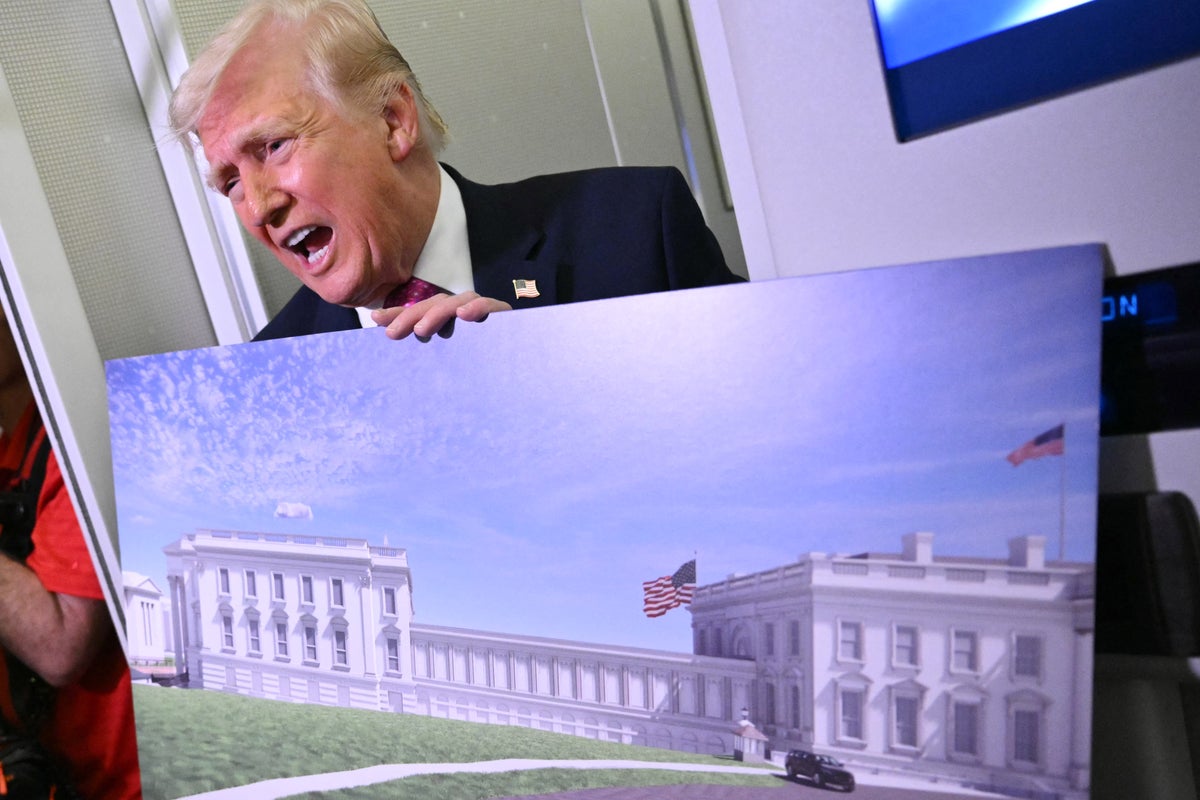
For high-stakes executives, the transition from macro-level geopolitical decision-making to micro-level aesthetic management is not merely a hobby; it is a calculated cognitive reset. Reports indicating that Donald Trump concludes his day by reviewing construction updates on personal assets—specifically the Mar-a-Lago ballroom—reveal a strategic pivot from abstract power to tangible control. This behavior identifies a specific executive archetype: the "Operator-Architect," for whom the certainty of physical measurements provides a psychological hedge against the volatility of political capital.
Traditional leadership theory often suggests that a leader’s value scales with their ability to delegate. However, the Trump model inverted this. By immersing himself in the specificities of marble sourcing, chandelier placement, and floor plans, he engages in what can be defined as Operational Escapism. This is the process of replacing complex, multi-variable problems (where outcomes are uncertain) with low-complexity, high-certainty physical variables.
The Architecture of Tangible Certainty
The allure of a ballroom construction project lies in its binary nature. A wall is either straight or it is not. A budget is either met or exceeded. In the theater of international relations, "victory" is subjective and often deferred. In construction, "completion" is a visible, tactile reality.
Three specific frameworks explain why a high-capacity leader would prioritize these updates during their "unwind" period:
- The Feedback Loop Compression: Construction provides immediate visual feedback. Unlike legislative agendas that may stall in committee for months, a masonry update offers a 24-hour delta that can be verified through photographs or briefings.
- Domain Reclamation: Within the White House, a President is a tenant governed by the General Services Administration (GSA). By focusing on his own ballroom, Trump reclaims the role of the ultimate arbiter. In this domain, his authority is absolute and unchallenged by judicial or legislative oversight.
- The Sensory Anchor: High-stress environments create a "cognitive fog." Focusing on "the grain of the wood" or "the hue of the gold leaf" acts as a sensory anchor, pulling the executive out of abstract stressors and into a world of hard materials and defined costs.
Identifying the Construction-Stress Correlation
The frequency of these construction "briefings" likely correlates with the intensity of the news cycle. When external variables become unmanageable, the human brain seeks "internal" wins. This is a common trait among founders who have transitioned from building products to managing people. The technical "pull" of the original craft remains a primary source of dopamine.
The ballroom, in this context, serves as a Control Variable. In an environment where a leader feels the "system" is rigged or the "deep state" is obstructive, the physical renovation of a private asset becomes the only theater where the leader’s will is translated directly into physical matter without friction.
The Opportunity Cost of Micro-Interest
While these updates provide psychological relief, they represent a significant diversion of cognitive bandwidth. In a standard corporate environment, a CEO spending three hours on carpet samples for a satellite office would be flagged for "Functional Fixedness"—a cognitive bias where one limits an object or person to the way they are traditionally used. Trump, however, views his properties as extensions of his brand equity. To him, the ballroom is not just a room; it is a manifestation of his perceived "winning" status.
The mechanism at play here is Equity Displacement. The leader displaces the stress of managing the nation's equity into the management of their own brand's physical infrastructure. This creates a "safe zone" of competence.
The Logistics of the Late-Night Briefing
The reported mechanism—listening to updates at the end of the day—suggests an informal reporting structure that bypasses traditional executive assistants. This indicates a preference for Direct Feed Information.
- Information Density: These briefings are likely high in data (costs per square foot, delivery timelines) but low in political nuance.
- Asynchronous Processing: By reviewing these updates at night, the executive processes the information when the "Prefrontal Cortex" is fatigued, allowing for a more emotional, aesthetic-driven response rather than a purely logical one.
- The Proximity Effect: The ballroom was a physical project occurring within his primary residence (at the time). This proximity collapses the work-life distinction, allowing the "work" of construction to masquerade as the "rest" of home life.
Vertical Integration of Self-Image
Construction is an additive process. Politics is often a subtractive or compromise-based process. For a personality built on the ethos of "The Builder," the act of creation is the ultimate validation of self-worth.
The ballroom represents a High-Fidelity Asset. Every detail is a reflection of the owner's taste. This is why the updates are not merely progress reports but are treated as strategic intelligence. If a contractor fails to meet a specification, it is not viewed as a vendor error; it is viewed as an affront to the brand’s integrity.
This leads to a management style characterized by Selective Perfectionism. The leader may be comfortable with broad, sweeping generalizations in policy but will demand extreme precision in the alignment of a marble tile. This duality creates a confusing environment for subordinates who do not understand that the "small things" are actually the "big things" in the leader's internal hierarchy of value.
The Cost Function of Personal Legacy
Ultimately, the obsession with construction updates reveals a preoccupation with Durability. Political legacies are fragile and easily overturned by the next administration. A ballroom, built of stone and steel, has a half-life that exceeds a four-year term.
The strategic shift here is from the "Transient" (laws, treaties, polls) to the "Permanent" (structures, landmarks, estates). For a leader concerned with their place in history, the physical structure acts as a monument that requires no vote to sustain.
Strategic Implications for Observers
When a leader of this magnitude focuses on the minute details of a renovation, it serves as a leading indicator of their internal state. It suggests a need for a "closed-loop" environment where they can exercise total agency. For those negotiating with such an individual, understanding this need for Tactile Control is paramount.
The ballroom is the "Laboratory of the Ego." It is where the leader tests their ability to command the world into a specific shape. If the world outside refuses to conform, the ballroom must be perfect.
The optimal strategy for a leader prone to this behavior is to schedule "tactile blocks" throughout the week. Rather than allowing these interests to bleed into the late-night hours—thereby disrupting the sleep cycle and recovery—they should be integrated as "Designated Control Periods." This allows the executive to satisfy the urge for micro-management in a sandbox environment, preventing those same impulses from interfering with macro-level delegations. By compartmentalizing the "Architect" and the "President," the leader can maintain the psychological benefits of construction without the associated cognitive drain on state affairs.