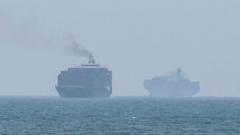
Every desk in London and Houston is currently hyperventilating over diplomatic signals out of Muscat. Oman claims diplomatic progress on the Strait of Hormuz. Tehran warns that any potential deal still leaves the shipping lanes choked. The lazy consensus across the financial press is simple: peace brings flow, flow brings supply, supply crashes prices, and everyone pops champagne.
It is a child’s understanding of global logistics.
I have spent two decades watching markets misprice geopolitical risk because analysts prefer comforting fictions to hard physical reality. I have seen funds blow millions positioning for supply spikes that vanished, while ignoring the structural trap door hidden right beneath the tanker traffic.
Let us fix the foundational error right now. Everyone treats the Strait of Hormuz as a tollbooth. They think the only question is whether the gate is open or closed. That framing is amateurish. Hormuz is not a tollbooth. It is a pressure valve for a volatile, over-leveraged global energy machine. If you crank that valve wide open through a naive diplomatic grand bargain, you do not achieve stability. You trigger a supply glut that obliterates upstream capital expenditure, starves long-term field development, and sets the stage for a physical supply cliff five years down the road that will make the 1970s look like a minor inventory correction.
Stop cheering for a diplomatic breakthrough that ignores the mechanics of modern petro-economics.
The Myth of the Chokepoint Panic
The dominant narrative relies on a lazy premise: Iran holds a knife to the throat of global commerce by threatening to mine or blockade the narrow passage where roughly a fifth of the world's petroleum passes daily.
The market response is always predictable. Tensions rise, war risk premiums spike on marine insurance, futures tick up, and talking heads warn of five-hundred-dollar crude. Then, diplomats fly to Oman, handshakes happen, and the narrative flips to bullish recovery.
This entire framework assumes that physical flow is the primary variable that matters. It ignores the invisible architecture of storage, refining margins, and spare capacity. When tankers stack up or routes face friction, the market does not simply run dry. Inventories absorb the shock. Floating storage acts as a massive financial and physical shock absorber.
More importantly, look at the actual mechanics of what Tehran is warning about. When Iranian officials state that a diplomatic pact will not automatically open the strait to frictionless business, they are not just posturing. They understand a brutal truth that Western bureaucrats refuse to acknowledge: Iran uses the ambiguity of the strait to manage its own domestic economic desperation and geopolitical leverage. A clean, rules-based open corridor strips them of their primary asymmetrical deterrent.
But here is where the mainstream analysis completely faceplants. Even if you forced an absolute, permanent, bulletproof guarantee of open navigation tomorrow—backed by international armadas and digital monitoring—the economic fallout for energy producers would be catastrophic.
Why Artificial Scarcity Keeps the System Alive
Markets hate chaos, but they despise terminal stagnation even more. The constant low-level friction around the Persian Gulf provides a vital pricing function. It embeds a permanent security premium into every barrel of crude.
That premium is the only thing funding long-cycle upstream projects in complex basins around the world. Without that margin of safety, capital flees exploration.
Imagine a scenario where a comprehensive regional treaty completely eliminates any perceived risk of closure in Hormuz. Overnight, the risk premium evaporates. Tanker turnaround times compress. Logistics bottlenecks vanish. Millions of barrels of deferred and shut-in capacity hit spot markets simultaneously.
What happens next? Prices crater.
We saw a micro-version of this movie during past inventory shocks. When supply outstrips immediate refining demand by even a fraction of a percent, storage fills up, contango steepens, and physical prices disconnect from paper promises. Producers in high-cost basins, from the Permian shale fields to offshore Brazil, find their debt service ratios underwater. Rig counts plummet. Capital expenditure budgets get slashed to the bone.
The consensus thinks an open strait secures energy independence and low prices forever. In reality, a permanently pacified Hormuz removes the economic incentive to drill the next generation of wells. You trade short-term price relief for a multi-year supply famine.
The Flawed Questions Everyone Keeps Asking
Go to any financial forum or policy panel right now, and you will hear the same tired questions looping on repeat. Let us take them apart.
- Will a deal in Oman lower crude prices at the pump by next quarter?
The premise assumes retail prices track spot crude linearly and immediately. They do not. Refining bottlenecks, regional tax structures, and distribution margins dictate pump prices far more than a diplomatic communiqué. Even if crude drops ten dollars on a headline, retail adjustment is sluggish at best. - Can alternative pipelines bypass Hormuz entirely and render the strait irrelevant?
This is the favorite daydream of energy security planners. Projects like the Habshan-Fujairah pipeline in the UAE or the East-West pipeline in Saudi Arabia offer nominal bypass capacity. But do the math on the volume. They cannot absorb the total throughput of the Persian Gulf at peak flow. Relying on them as a complete substitute is like planning to evacuate a major metropolis using a single two-lane bridge. It looks good on a PowerPoint slide, but it fails under stress. - Does Iran's warning mean military conflict is inevitable?
This is the false dichotomy that drives media clicks. Peace or war. Open or closed. The real world operates in the grey zone of perpetual friction. Iran prefers economic warfare, cyber disruption, and grey-zone maritime harassment precisely because it avoids total war while keeping adversaries off balance. They have zero incentive to shut the strait permanently, because their own export revenue depends on those same waters. They want the threat of closure, not the reality.
The Uncomfortable Rules of Engagement
If you want to trade or manage risk in this environment, you have to unlearn the comforting lies sold by mainstream commentators.
First, treat geopolitical noise as a lagging indicator, not a leading one. By the time diplomats are holding press conferences in Muscat, smart capital has already positioned for the structural reality that follows.
Second, stop viewing energy security through the lens of political goodwill. Energy markets run on physics, chemistry, and debt obligations. A handshake in an Omani palace does not change the depletion rate of a mature super-giant oil field in Ghawar. It does not lower the lifting cost of tight oil.
Third, embrace the friction. The anxiety surrounding the Persian Gulf is an unfortunate tax on global commerce, yes, but it is also a stabilizing mechanism that prevents complacency. It forces consumers to price in resource scarcity accurately.
When the headlines scream about breakthrough talks and the unhindered flow of oil, do not cheer for lower prices. Look down the road at the starved balance sheets of upstream producers. Look at the capital flight from long-term supply security.
The threat is not that the strait stays closed. The real danger is what happens to the world the day everyone finally believes it will stay open forever.