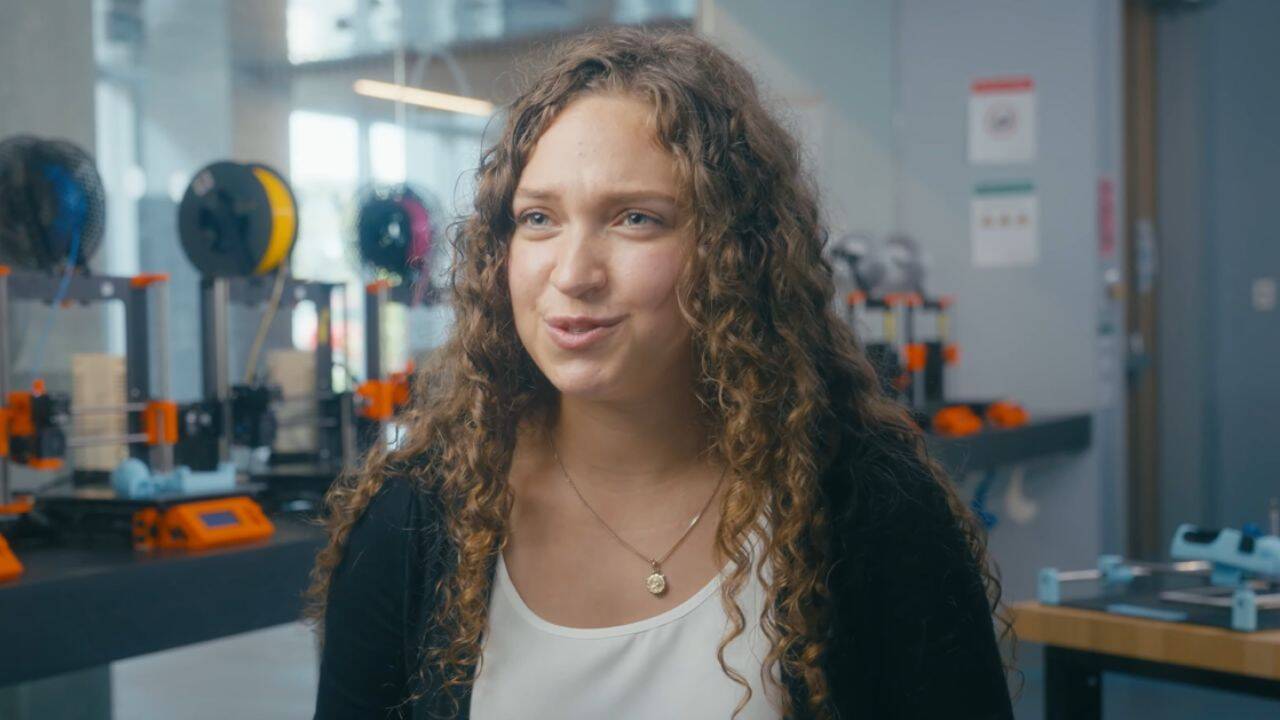
Straws, pipe cleaners, and a kitchen sponge do not belong in a medical lab. Yet, those exact dollar-store items formed the skeleton of a movement that now spans more than 25 countries.
When Lianna Genovese sat down as an 18-year-old biomedical and mechanical engineering student at McMaster University in Canada, she wasn't trying to start a global enterprise. She was trying to solve a heartbreaking human problem. Her friend Elissa, who lives with cerebral palsy, had lost the physical ability to hold a paintbrush. For someone who loved creating art, losing that outlet was devastating. For a deeper dive into similar topics, we suggest: this related article.
Most engineering students build standard prototypes for class credit and forget them by semester's end. Genovese took a different path. She listened closely to the actual users, tested iterations through trial and error, and engineered a device called Guided Hands that helps individuals with limited hand mobility paint, write, draw, and use touchscreens.
How Simple Materials Sparked a Global Assistive Tech Company
The core engineering behind Guided Hands relies on a sliding mechanism inspired by the movement mechanics of a 3D printer. Instead of forcing a user to rely on fragile fine motor skills in their fingers, the device utilizes linear axes and bearings to let users harness the larger, more reliable motor skills of their shoulders and arms. For broader details on this issue, comprehensive coverage is available on ZDNet.
You attach a pen, paintbrush, marker, or stylus to the end of the sliding apparatus. The device doesn't do the work autonomously; it supports and guides the user's own movements. That distinction matters immensely. It preserves the user's agency, autonomy, and creative expression.
When Genovese watched a young girl named Bella use the early prototype to paint, color, and play on an iPad, the reaction changed everything. Bella turned to her mother and said she needed one of her own. A week later, at just 19 years old, Genovese incorporated her company, ImaginAble Solutions.
Breaking Down the Barriers of Traditional Accessibility Design
Too much assistive technology is clunky, overly expensive, and designed for disabled people rather than with them. That approach fails. If you don't involve the end-user in every phase of prototyping, you end up with equipment that sits gathering dust on a shelf.
Genovese spent months consulting with over 150 patients, occupational therapists, and healthcare professionals across Canada. She learned that conditions like cerebral palsy, arthritis, spinal cord injuries, and strokes share a common frustration: the sudden or gradual loss of independent daily tasks.
By keeping manufacturing localized in Hamilton, Ontario, and leaning into Canada's robust startup grants and incubator programs, she scaled operations from a dorm-room hobby into an international enterprise. By early 2026, the company surpassed major revenue milestones and even gained formal compatibility recognition from Apple, proving that student-led hardware innovations can scale globally without losing their original community-first mission.
What You Can Learn From This Breakthrough
If you are looking at building products or solutions for underserved communities, the playbook here is clear. Stop guessing what people need. Talk to them directly, iterate cheaply with whatever materials are on hand, and refuse to treat accessibility as an afterthought.
Self-expression isn't a luxury feature. It's a fundamental human right. When you build tools that honor that truth, the market will follow you anywhere.