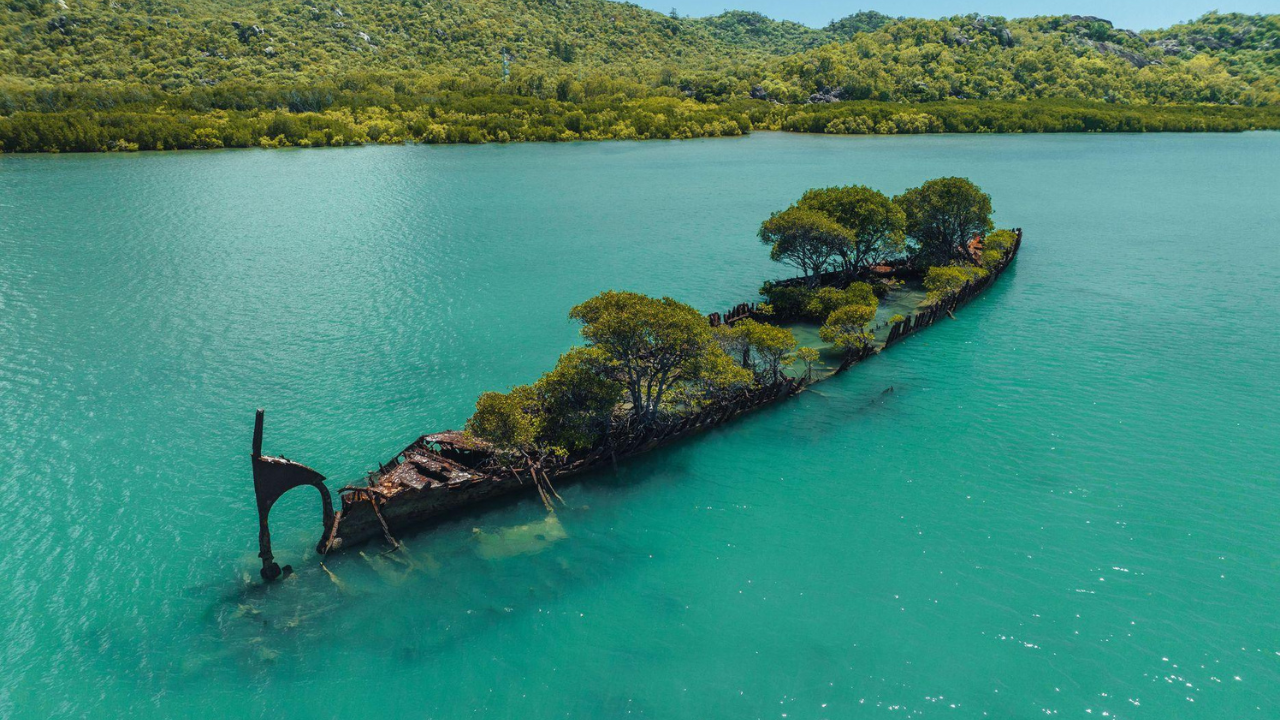
One hundred and sixty years ago, a merchant vessel caught fire off a tropical coastline, burned to the waterline, and sank into the shallow coastal shelf, leaving behind a charred skeleton of oak, iron fastenings, and a cargo destined for the abyss. Today, that forgotten hull is no longer a shipwreck. It is a thriving mangrove island, a dense thicket of stilt roots and tangled canopy rising above the tide line where deep water once rolled. This transformation is not a miraculous accident of nature. It is a calculated, biological sequence of decay, entrapment, and colonization that turns human tragedy into ecological permanence.
The Maritime Realities of the Nineteenth Century
To understand how a burning hull transforms into a living islet, we must first look back at the maritime realities of the 1860s. Global trade was entirely dependent on timber and canvas. Wooden hulls were thick, heavy, and saturated with pitch, tar, and oils that made them exceptionally flammable once a galley stove tipped or spontaneous combustion ignited cargo holds filled with coal, cotton, or oil. When a ship caught fire mid-voyage, crews had few options beyond running the vessel aground or abandoning ship as the inferno consumed the upper decks. Those that sank in shallow, nutrient-rich estuarine waters did not vanish into the sediment. Instead, they became artificial reefs before the term even existed.
The destruction of the ship was only the opening act. Fire stripped away the rigging, cabins, and upper bulwarks, leaving a submerged or semi-submerged timber grid resting against the seabed. Iron knees, copper bolts, and charred ribs remained anchored in place, driven deep into the sand or coral rubble by the weight of the ballast stone. This skeletal frame offered something rare in shifting coastal environments: a hard substrate. In shifting sands and muddy deltas, marine life struggles to find a stationary anchor point. The wreckage provided a permanent foundation, resisting the relentless push of tidal currents and storm surges.
The Engineering of Biological Decomposition
Marine organisms arrived almost immediately. Shipworms, or Teredo mollusks, along with various species of boring clams, began chewing through the charred outer layers of oak and teak. While this wood-boring activity might seem destructive, it actually accelerated the structural breakdown of the dense timbers, creating micro-cavities, fissures, and porous surfaces. Barnacles, oysters, and tube worms encrusted the metal fasteners and burnt wood, forming a biological cement that locked the framework together. Bacteria and fungi colonized the inner grain, softening the timber and transforming rigid structural members into organic sponges capable of holding moisture and nutrients.
The chemistry of the sea worked in tandem with these organisms. Saltwater penetrated the charred pores, initiating slow electrochemical reactions with the remaining iron fittings. The oxidation of iron created rust-cements that bound sand grains and shell fragments directly to the metal frames, effectively stonewalling the skeleton. Tannins naturally present in the dense oak timbers reacted with mineral ions in the seawater, slowing down bacterial rot in the anaerobic core of the logs while surface layers broke down into nutrient-rich humus. This mineral accumulation provided additional mass, ensuring that winter gales and tropical storm waves could not dislodge or drift the wreckage into deeper water. The ship was bolted to the earth by its own chemical corrosion.
The Mechanics of Sediment Trapping
Then came the sediment. Coastal waters are choked with suspended particulate matter, silt, and organic detritus stirred up by river discharge and tidal action. As ocean currents swept past the submerged wreck, the irregular geometry of the charred ribs and protruding iron frames disrupted the flow. Water velocity dropped instantly in the lee of the structure. Suspended particles fell out of suspension, settling into the hull's interior compartments, the hold, and the spaces between the floor timbers. Within a few decades, what had been a hollow vessel filled with cargo was transformed into a solid mound of mud, sand, and decaying organic matter resting upon a wooden base.
This accumulation of sediment changed the ecological calculus entirely. Mudflats and shallow shoals are dynamic, hostile environments for terrestrial plants due to high salinity, tidal inundation, and shifting substrate. Yet, they are the exact domain of the mangrove. Mangrove seeds, known as propagules, drift endlessly along tropical coastlines. Unlike standard plant seeds that drop into soil and wait for rain, mangrove propagules are specially adapted maritime travelers. Many are viviparous, meaning they germinate while still attached to the parent tree, dropping into the water as fully formed seedlings equipped with a rudimentary root system and the ability to float horizontally for weeks or months.
The Physiology of Botanical Colonization
As these drifting propagules encountered the shallow waters surrounding the wreck, they drifted into the slackened currents created by the protruding hull structure. The accumulated mud and organic sediment inside the sunken hold offered a shallow, sheltered nursery. Propagules wedged between the rusted iron ribs and the rotting floor timbers found purchase. They dropped their anchors—sturdy primary roots designed to pierce soft mud and wedge into tight crevices.
Mangroves possess specialized physiological mechanisms that enabled them to conquer this harsh industrial relic. Their root membranes employ ultrafiltration to exclude salt, allowing them to absorb water from the saline estuarine sediment. Furthermore, specialized structures called pneumatophores emerge upward from the buried roots, acting like biological snorkels that supply oxygen to the underground tissues submerged in anoxic, waterlogged mud. Without these evolutionary adaptations, no plant could survive the toxic mix of rotting bilge water, heavy metals from rusted iron, and shifting silt.
The Permanent Alteration of the Coastline
Once established, the first generation of mangroves altered their immediate environment irrevocably. Their roots acted as physical sieves, trapping more floating debris, dead leaves, and fine silt with every incoming tide. The sediment mound grew taller, rising steadily above the mean high-water mark. As the roots multiplied, they formed an intricate, impenetrable web that reinforced the mud bank, preventing erosion from storm waves and seasonal monsoons. The wooden hull beneath, protected from oxygen and wave action by the accumulating mud, slowed its rate of decay, transitioning from a sinking ship into the foundational pilings of a permanent landmass.
The transition from a dead hull to a living forest took generations. As the pioneer mangroves matured, they dropped their own propagules directly into the sediment they had helped create. A dense thicket formed, expanding outward from the original footprint of the ship. Birds arrived, carrying seeds of coastal shrubs, grasses, and flowering vines in their digestive tracts or feathers, introducing terrestrial flora to the newly formed islet. Insects, spiders, and land crabs colonized the upper branches and root mats, establishing a self-sustaining food web completely disconnected from the open ocean.
Today, beneath the canopy of green leaves and tangled prop roots, the physical evidence of the disaster is hidden beneath feet of peat and mangrove muck. Only an occasional iron knee protruding from the mud or a rusted anchor shank embedded in the root mass hints at the vessel's fiery past. The ship did not simply sink and disappear. It served as the architectural template for a permanent geographic feature, a testament to how biological persistence can repurpose human catastrophe into ecological longevity.
The ocean does not tolerate empty space. Every wreck, whether iron steamship or wooden galleon, initiates a cascade of colonization that alters the surrounding marine topography. When fire claims a vessel near a tropical coastline, the end of human navigation is merely the beginning of botanical engineering. The flames consume the wood, but the remnants anchor the future, proving that nature wastes nothing, not even the ash of a century-old disaster.