Jensen Huang wants you to believe that the factory of the future will be crawling with newly hired, highly paid workers.
During his high-profile victory laps from Silicon Valley to Texas, Nvidia’s CEO has repeatedly pitched a comfortable narrative: artificial intelligence will not destroy manufacturing jobs; it will supercharge them. The corporate press swallowed the hook, line, and sinker, running glowing profiles of Texas facilities acting as the ultimate test beds for this supposed blue-collar renaissance.
It is a beautiful corporate fairytale. It is also entirely wrong.
The lazy consensus in tech journalism accepts the premise that because automation historically created new industries, AI will follow the exact same playbook. This line of thinking ignores the fundamental economic mechanics of computational labor.
I have spent fifteen years consulting for industrial firms trying to wring efficiency out of legacy assembly lines. I have watched executives blow tens of millions of dollars on overhyped automation suites based on promises just like Huang’s.
Here is the brutal reality nobody in a leather jacket wants to admit: AI is not going to save the manufacturing worker. It is going to eliminate the need for them entirely, and the factories currently being built in Texas are the blueprints for that exact displacement.
The Flawed Logic of the Job Creation Myth
The argument for AI job creation relies on a fundamental misunderstanding of what a factory actually does. Optimists point to the industrial revolution or the introduction of personal computers, noting that while old roles vanished, an entire ecosystem of desktop-driven employment emerged.
That analogy fails because previous technological shifts automated muscle and routine calculation. They left the cognitive layer—judgment, adaptation, troubleshooting—firmly in human hands.
Nvidia's proprietary omniverse platforms and digital twins do not just automate physical tasks. They simulate, predict, and optimize the cognitive layer itself.
Imagine a scenario where a precision manufacturing line experiences a micro-alignment failure. In a traditional automated plant, an experienced technician diagnoses the vibration, interprets the sensor data, and manually calibrates the machinery. The human is the bridge between the digital alert and the physical fix.
In an AI-integrated facility utilizing Blackwell chips and real-time neural rendering, the system simulates millions of operational permutations per second. It detects the microscopic anomaly before it manifests as a failure, rewrites its own operational parameters, and instructs a robotic arm to adjust its torque by a fraction of a millimeter. The human technician is not upskilled in this scenario. The human technician is bypassed.
Dismantling the Texas Test Case
The media coverage surrounding advanced manufacturing hubs in Texas points to rising employment numbers as proof of an AI-driven boom. This is a classic correlation error.
Current hiring surges are driven by the massive capital expenditure required to build the physical infrastructure. Constructing facilities, laying fiber, installing cleanrooms, and positioning heavy machinery requires human boots on the ground. This is construction labor, not a permanent shift in manufacturing employment.
Once these facilities reach operational equilibrium, the labor curve drops off a cliff. The goal of deploying autonomous industrial systems is to drive the marginal cost of labor as close to zero as possible.
Look at the financial statements of major manufacturing conglomerates. Labor remains one of the largest variable costs on the balance sheet. No board of directors approves a multi-billion-dollar AI infrastructure upgrade with the intention of maintaining or expanding their payroll liabilities. They do it to compress margins and scale production without a linear increase in headcount.
The Skill Gap Illusion
A common counterargument is that factories will need an army of data scientists, prompt engineers, and machine learning specialists to maintain these autonomous systems.
This claim ignores the reality of modern software development. The goal of enterprise AI is to make the interface so intuitive that it requires zero specialized technical skill to operate. Large language models and natural language processing interfaces are designed specifically to eliminate the need for dedicated programmers on the factory floor.
A plant manager will not need to write code or analyze raw telemetry. They will ask a localized model a question in plain English, and the system will execute the optimization. The "highly skilled tech jobs" being promised to manufacturing communities are being automated out of existence before the workers can even finish their retraining programs.
The Real Winner of the Automation Race
If the workers lose, who wins? The answer is obvious: the owners of the compute.
Nvidia is not a philanthropic organization dedicated to revitalizing the American rust belt. It is a hardware and software monopoly selling the picks and shovels for an unprecedented corporate margin expansion. By convincing political leaders and the public that AI is a job creator, tech monopolies secure massive state subsidies, tax breaks, and regulatory greenlights to build their infrastructure.
The true cost of this transition will be borne by the communities that built their local economies around the promise of permanent, high-tech manufacturing employment. When the construction crews leave and the digital twins take over, those towns will be left with massive, highly automated fortresses that generate billions in revenue but require only a skeleton crew of security guards and facility managers to keep the lights on.
The Uncomfortable Truth
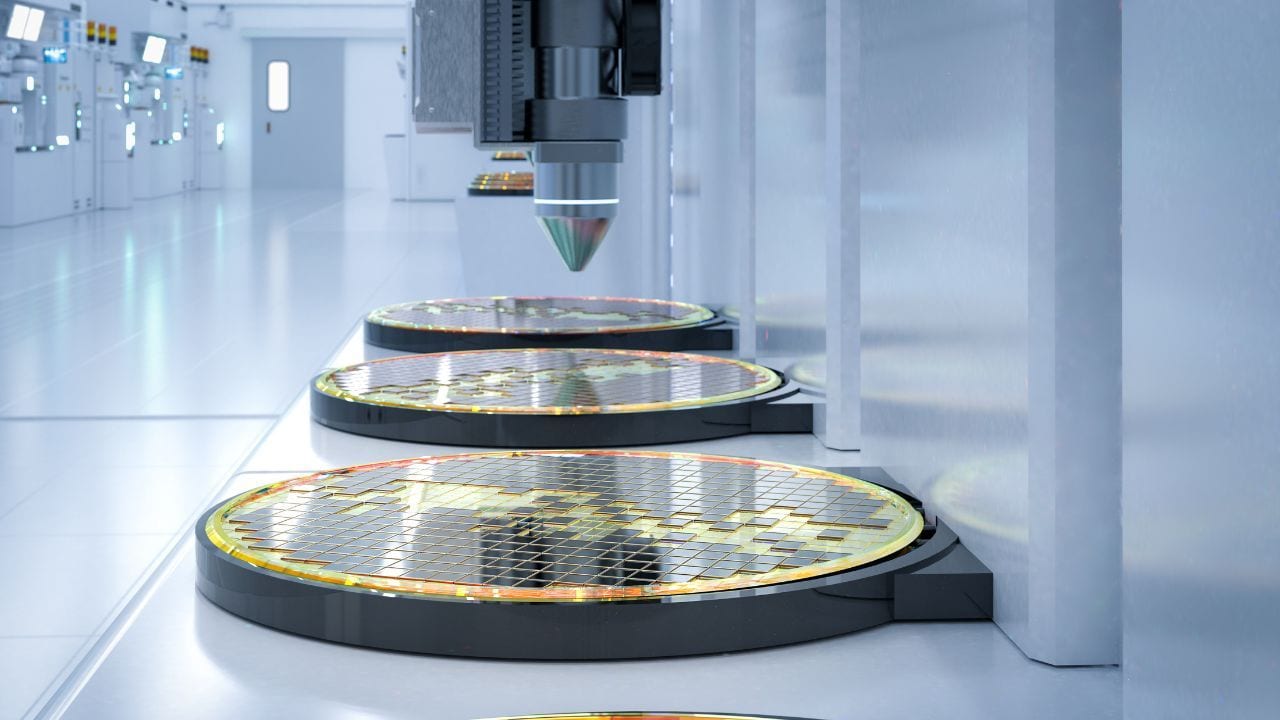
To see the trajectory of advanced manufacturing, look at the semiconductor fabrication plants currently under construction. These are the most complex manufacturing environments on earth. They are already so heavily automated that human presence is treated as a contaminant risk rather than an asset. As AI integrates deeper into standard automotive, aerospace, and electronics manufacturing, those industries will adopt the same hands-off operational ethos.
Stop asking how many jobs AI will create in manufacturing. It is the wrong question. The right question is how society will adapt when the world’s most vital physical goods are produced by systems that require no human labor at all.
The corporate PR machine will continue to broadcast images of smiling workers collaborating with sleek robotic arms. But behind the marketing smoke and mirrors, the math does not lie. The autonomous factory is coming, and it does not have an opening for you.