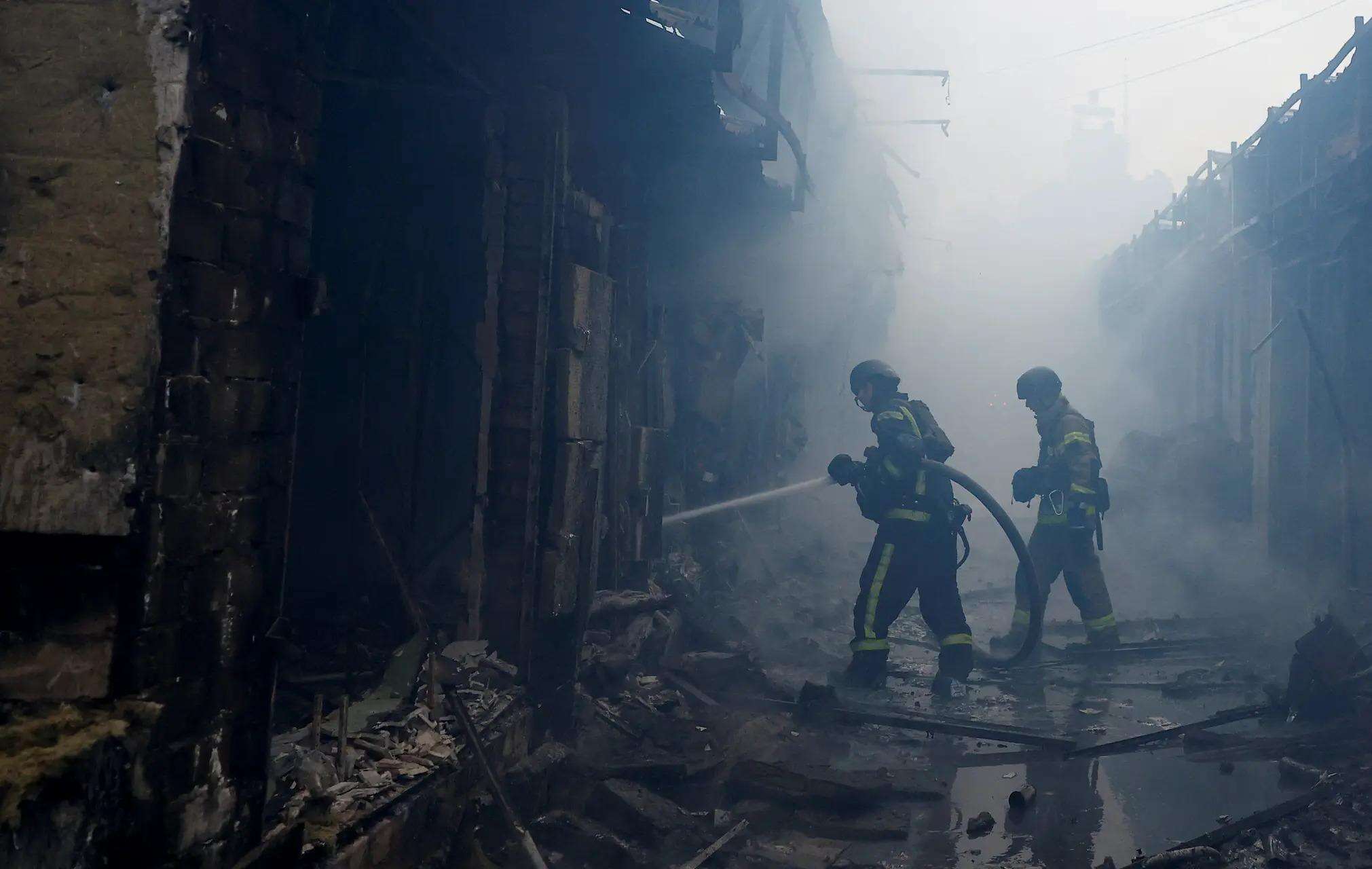
The air in Kyiv right before dawn has a specific, fragile stillness. It is the time when the city’s stray cats emerge onto the cobblestones of Podil and the first delivery trucks rumble toward bakery doors. But on this particular Tuesday, that quiet did not fade naturally into morning. It was torn apart.
First came the low, rhythmic drone, a sound like a lawnmower engine amplified a thousand times, vibrating through the glass panes of high-rise apartments. Then, the sirens. They do not wail so much as they moan, a heavy, mechanical grief that pulls millions of people out of sleep and flings them into the cold reality of concrete basements.
For the residents of the Ukrainian capital, this is not a headline. It is a Tuesday.
This latest assault—a coordinated swarm of Iranian-designed Shahed drones and high-velocity cruise missiles—was not a random act of aggression. The timing was calculated with precision. Miles away, in the grand, carpeted halls of Ankara, Turkey, world leaders were unpacking their suits for a critical NATO summit. The message sent from Moscow via explosive payloads was clear: international diplomacy cannot shield the skies above Ukraine.
The Anatomy of an Alert
Imagine standing in your kitchen, holding a half-made bottle of baby formula, when the walls begin to hum.
Let us call her Olena. She is thirty-four, an architect, and a mother of two. Her reality is the lens through which we must understand the geopolitical chess board. When the air defense systems engage, the sound is deafening. It is a double-tap of thunder that shakes the fillings in your teeth. That is the Patriot missile system, a gift from Western allies, rising to intercept an incoming threat.
On this night, Russia launched a multi-wave attack designed to overwhelm these defenses. Drones came first, flying low, hugging the terrain to blind the radar. They are the scouts, cheap and expendable. Behind them came the cruise missiles, changing trajectory mid-flight to confuse the operators stationed in hidden bunkers beneath the city.
Data from the Ukrainian Air Force later confirmed that over two dozen drones and multiple missiles were active in the airspace simultaneously. Air defense teams successfully neutralized the vast majority. Yet, success in aerial defense is a harrowing statistic. If you intercept ninety percent of incoming missiles, the remaining ten percent still find a home. Sometimes, that home is a residential courtyard. Sometimes, it is a power grid.
When an intercept happens directly overhead, the danger does not vanish. It transforms. Tons of burning metal, unspent fuel, and shrapnel rain down at terminal velocity. On this night, debris crashed into a northern district of Kyiv, sparking fires that licked the sides of ten-story apartment blocks and turning parked sedans into charred skeletons.
The Ankara Shadow Play
While Olena swept shattered glass from her children’s bedroom, diplomats in Turkey were arguing over commas in a joint communique.
The NATO summit was intended to address the long-term security architecture of Europe, specifically the timeline for Ukraine’s potential integration into the alliance. By launching a massive strike on the capital hours before the opening remarks, the Kremlin effectively forced its way into the room. It was a violent reminder to every head of state in attendance that Russia remains the volatile variable in European stability.
The strategy relies on fatigue. The calculation is that Western voters, insulated from the smell of cordite and burning rubber, will eventually grow weary of funding a distant war. By escalating the violence precisely when Western leaders gather, Russia attempts to demonstrate the futility of foreign aid. They want to show that no matter how many air defense batteries are shipped to Kyiv, the sky will still bleed.
But this strategy misjudges the psychological armor of the people on the ground.
The Architecture of Endurance
Fear is a resource. In the early days of the full-scale invasion, it was abundant, paralyzing, and chaotic. Now, after years of sirens, fear has been refined into something resembling a utility. It is managed, rationed, and channeled into action.
Step into the Kyiv metro during an alert. It is a subterranean city. People bring folding chairs, yoga mats, and thermoses of hot tea. Teenagers sit against the tiled walls, scrolling through Telegram channels that track missile trajectories in real-time. There is little crying. Instead, there is an eerie, disciplined quiet.
This resilience is not innate; it is forged. The human mind adapts to the unthinkable because the alternative is collapse. When the strikes target energy infrastructure, the city responds with a chorus of gasoline generators humming on every sidewalk. When the windows blow out, the plywood goes up within hours.
This is the invisible stakes of the conflict. The war is fought with artillery on the steppes of the Donbas and with jets in the sky, but the ultimate target is the collective will of the civilian population. If Kyiv breaks, the front line shifts west.
The Paradox of Protection
The international community views these attacks through the ledger of military logistics. How many interceptors are left? What is the cost-to-benefit ratio of utilizing a million-dollar missile to down a twenty-thousand-dollar drone?
These are valid questions for defense ministries. But for the people watching the sky, the math is simpler. Every delay in delivery, every political debate over the escalation of weapon ranges, translates directly into a hole in the roof of a civilian home. The air defense umbrella over Kyiv is arguably the most sophisticated in the world right now, yet it remains porous.
The summit in Turkey concluded with the usual boilerplate statements of unwavering support and strategic solidarity. The communiques were polished, the press conferences orderly.
But back in Podil, as the morning sun finally broke through the smoke hanging over the Dnieper River, Olena did not look at the news from Ankara. She walked her children past the blackened crater in the park, held their hands a little tighter, and watched the street sweepers already clearing the debris from the asphalt, preparing the city for tomorrow.