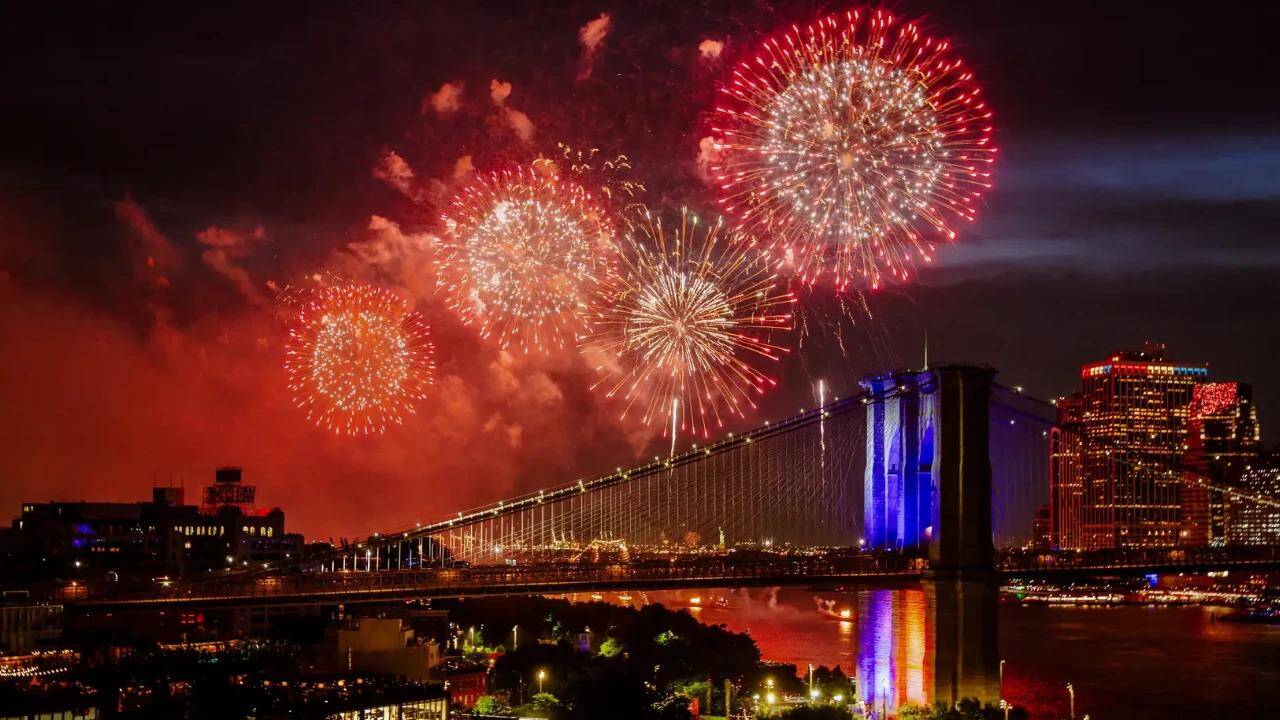
The ground on the Fourth of July is a chaos of celebration. Below the clouds, millions of people look up, sending sparks, sulfur, and brilliant hues of crimson and gold into the night. It is a collective exhale of a nation, noisy and bright. But step inside an aluminum tube traveling at two hundred miles per hour through that exact same sky, and the perspective changes entirely. Up there, the air is not a canvas for celebration. It is a workplace. And on one particular holiday night over Chicago, that workplace became a theater of sudden, heart-stopping uncertainty.
A commercial flight deck during an approach is a study in intense, quiet concentration. The cabin lights are dimmed. The multi-colored displays throw a soft, muted glow over the pilots' faces. Every click of a switch, every crackle of the radio from air traffic control is part of a deeply rehearsed choreography. For the crew of a Delta Air Lines flight descending into the Chicago airspace, the night felt routine, despite the festive glittering of the suburbs unfolding thousands of feet below them.
Then came the sound.
It was not the distant thump of a celebration. It was an immediate, visceral shudder. The captain would later describe it with unsettling simplicity: they felt a big bang.
In aviation, a sudden noise at a low altitude triggers an instantaneous, unspoken cascade of adrenaline. The mind flashes through a checklist of nightmares. Bird strike? Engine compressor stall? Mechanical failure? Or something entirely native to this specific calendar night? The flight continued, landing safely, but the shudder left an echo that reached far beyond the runway. It forced a conversation about an invisible boundary line we cross every summer—the line where amateur celebration meets the unforgiving physics of aviation.
The Chemistry of a Collision
To understand what happens when an aircraft encounters fireworks, you have to look at the sky through the eyes of an aeronautical engineer. We tend to view fireworks as ethereal, momentary bursts of light. We forget that they are, by definition, unguided missiles. They are projectiles packed with black powder, heavy metals, and chemical binders designed to explode with immense kinetic force.
Consider a standard commercial airliner during its landing sequence. The aircraft is descending through the lower atmosphere, its skin meeting the air with incredible resistance. When an object traveling at high speed strikes a stationary or rising projectile, the energy transferred is massive. It is a matter of simple mass and velocity.
Imagine a hypothetical piece of commercial-grade fireworks mortar. It weighs only a few pounds, but it rises at speeds exceeding one hundred miles per hour. If that mortar intersects with a Boeing or an Airbus descending at one hundred and fifty knots, the impact is not a minor scrape. The force concentrated on a single point of the aircraft’s nose cone, windshield, or engine cowl can tear through composite materials or shatter reinforced glass.
Worse still is the threat to the engines. A modern turbofan engine is a marvel of engineering, capable of swallowing massive amounts of air and rain. But it is highly vulnerable to foreign object debris. If a firework is ingested into the engine intake, the explosion does not just stop the airflow. The sulfur and heat can warp the delicate titanium fan blades. A single warped blade can cause a catastrophic imbalance, tearing the engine apart from the inside within milliseconds.
The Invisible Threat in the Terminal Area
The danger is compressed into a very specific window of flight. When an airliner is cruising at thirty-five thousand feet, it exists in a serene, isolated vacuum far above human activity. The threat level is zero. But during the final fifteen minutes of a flight, the aircraft must descend through the shared airspace—the terminal radar approach area.
This is where the geometry of risk tightens.
Chicago’s airspace is among the busiest in the world. On any given night, planes are stacked in invisible highways, separated by precise margins of time and space. On the Fourth of July, those highways run directly above thousands of backyards, parks, and block parties.
The pilots cannot steer around every flash of light. They are locked onto a specific glide slope, guided by instruments and air traffic controllers who are trying to thread multiple needles simultaneously. The crew cannot simply swerve to avoid a rogue rocket. They must hold their course, trusting that the airspace remains clear.
When the Delta pilot reported that big bang, it sent a ripple of tension through the air traffic control tower. The immediate priority is always the safety of the souls on board, but the secondary reaction is a collective realization of how little control authorities actually have over the airspace at lower altitudes during national holidays. The Federal Aviation Administration sets strict rules about where and how high objects can fly near airports, but those rules rely on the compliance of people on the ground. People who may have had a few drinks, bought illegal, high-altitude mortar shells across state lines, and set them off without a single thought about the flight paths overhead.
The Illusion of the Empty Sky
We suffer from a collective blind spot regarding the sky. Because it looks vast and empty from our position on the ground, we assume it can absorb anything we throw into it. We launch lanterns, we fly drones, and we fire off explosives with the comforting assumption that the sky is infinite.
It is not.
The sky is crowded, highly regulated, and surprisingly fragile. The incident over Chicago serves as a stark reminder of the friction between public celebration and public safety. For decades, the primary concern for aviation safety on holidays was laser pointers—bored teenagers blinding pilots during critical phases of flight. That was bad enough. But the escalation to physical projectiles represents a entirely different tier of hazard.
The investigation into the Delta flight aimed to determine the exact nature of the impact. Was it a stray consumer firework that reached an unexpected altitude? Was it a commercial display that breached its permitted ceiling? Or was it an entirely unrelated atmospheric event or mechanical anomaly that happened to coincide with the holiday?
Regardless of the final technical diagnosis of that specific hull, the reality of the threat remains unchanged. The fear felt in that cockpit was real. The potential for a catastrophic intersection of a celebration and a commute is higher than most passengers care to admit.
The Human Factor at Two Thousand Feet
Step back into the shoes of the crew. You are responsible for nearly two hundred lives. You are tired, nearing the end of a long holiday shift, looking forward to getting home to your own family. You are doing the heavy mental math required to land a massive machine safely in variable winds.
Suddenly, a sound rocks the airframe.
You cannot pull over to the side of the road to check the damage. You cannot step outside to look at the fuselage. You must rely entirely on the feel of the controls, the readings on your instruments, and your training. You must maintain total composure, communicating with air traffic control in a calm, measured monotone, ensuring that the passengers behind you never catch a hint of the adrenaline surging through your veins.
The system worked in Chicago. The plane landed. The passengers gathered their luggage, complained about the airport traffic, and went home to enjoy the rest of their holiday, completely unaware of the moment of tension that had just played out in the cockpit above them.
But the aviation industry watches these moments with a long memory. Every near-miss, every unexplained bang, and every report of a projectile near an active runway is a data point. It is a warning sign written in the sky, flashing brightly against the darkness, telling us that our celebrations cannot blind us to the physical realities of the world above our heads.
The next time you watch a rocket ascend into the summer night, tracing a beautiful, smoky arc toward the stars, look just a bit higher. Listen past the boom. Somewhere up there, a crew is watching that same light, hoping the sky stays theirs alone.