The frost in Calgary arrives early. It bites at the edges of windowpanes long before the first official drift of winter settles over the prairies, turning the air brittle and thin.
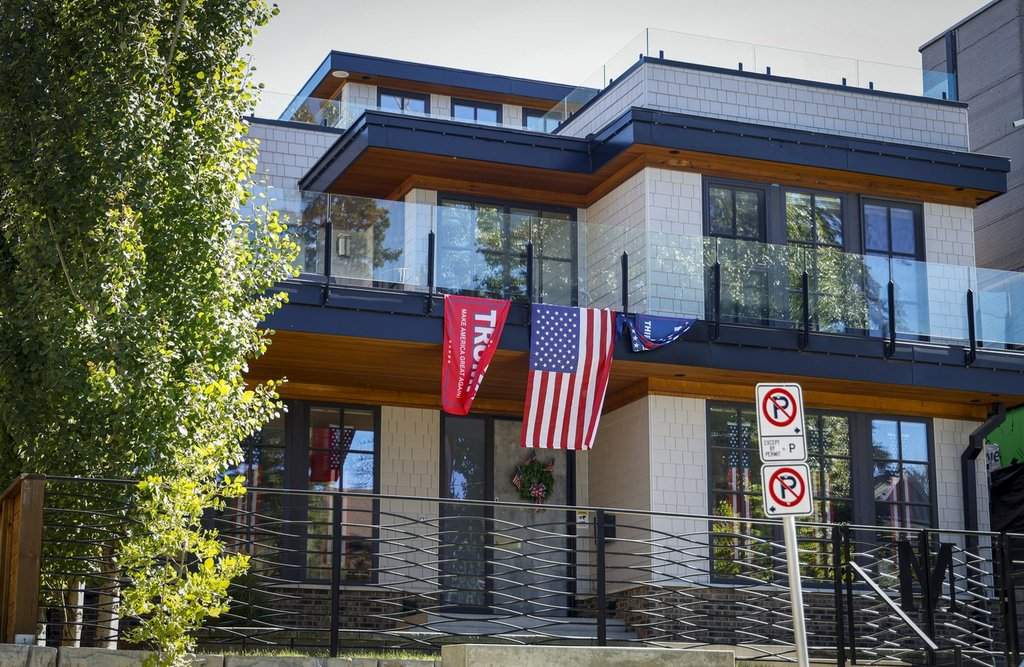
On a quiet suburban street, the sort of place where the loudest sound on a Tuesday morning is usually the rhythmic whir of a distant snowblower or the crunch of gravel beneath a mail carrier’s boots, a porch light cut through the dark. Beneath that light fluttered two banners. One bore the maple leaf of a defensive local identity; the other carried the red, white, and blue insignia of a southern political movement that had somehow, impossibly, migrated north across thousands of miles of pine forests, border stations, and shared history.
Then came the shatter.
Glass doesn't just break in the cold; it rings. It shatters with a sharp, crystalline snap that hangs in the frozen air for a heartbeat too long. By morning, the glass was swept into gray piles against the curb, and the flags—tangled, torn, and smeared with dark paint—hung like wounded birds.
Across the continent, headlines flashed about tariffs, retaliatory measures, and the slow-motion collision of trade policies between two nations that have spent a century pretending they are the same country while quietly guarding their differences. Economists spoke in smooth, antiseptic cadences about supply chains, lumber quotas, and aluminum levies. Bureaucrats traded memos in windowless rooms in Ottawa and Washington.
But down here, on the asphalt, policy had teeth.
To understand why a house in Alberta became a canvas for political rage, you have to look past the ink-stained broadsheets of financial desks and step into the restless psychology of a neighborhood under siege by uncertainty. When the price of oil dips, when the cost of a head of lettuce at the local Safeway doubles, when the future feels like something being decided in a room where you don't even have a chair, people reach for symbols.
Symbols are armor. If you feel small, you fly something big.
The homeowner, whom we can picture not as a statistic in a police blotter but as a neighbor wrestling with the quiet dread of an emptying bank account, had chosen his armor carefully. In the flat, unchanging sprawl of the suburbs, belonging is an invisible architecture. You mow your lawn to a specific height; you shovel your walk before the sun hits noon; and sometimes, you nail your convictions to a wooden pole so the world knows you refuse to vanish.
Except the world didn't just look. It struck back.
It is easy to draw a straight line from a politician's podium in a distant capital to a spray-painted driveway in Western Canada, but the wire connecting them is frayed with human contradiction. Trade wars are rarely fought by generals. They are fought by grocers paying more for imported citrus, by mechanics watching their tool shipments stall at the Ambassador Bridge, and by neighbors who no longer look each other in the eye across shared chain-link fences.
Consider what happens when economic anxiety turns into a localized storm.
For months, the news had been a relentless drumbeat of friction. Threats of sweeping tariffs on Canadian steel and aluminum hung over the prairie provinces like low-altitude smoke. Every evening broadcast brought new talking heads warning of a fractured partnership, of a historic alliance straining under the weight of divergent national egos. People who had spent thirty years working in the oil patch or manufacturing sectors felt a cold draft beneath their doors that had nothing to do with the weather.
When systemic pressures mount, human beings look for a villain they can touch. A distant president feels weightless, untouchable, an abstraction on a glowing screen. But a flag on a porch? That is physical. That is proximal. That is right there, defying the ambient mood of the street.
The vandalism in Calgary wasn't just a petty crime. It was a symptom of a deeper, more corrosive malady: the importation of foreign tribalism into communities that used to pride themselves on weathering hard times together, shoulder to shoulder.
We have begun outsourcing our anger. We watch cable news channels broadcast from foreign studios, absorbing their cultural wars, their venom, and their polarized choreography as if it were our own birthright. We have started treating our neighbors as enemy combatants stationed just across the lawn, forgetting that when the temperature drops to thirty below, we are all made of the same fragile warmth.
By noon the day after the glass was cleared, the homeowner stood on his porch. He didn't replace the flags immediately. He just looked down at the dark stain marring his concrete, a jagged scar shaped like a footprint.
The wind picked up, rattling the bare branches of the neighborhood maples. Somewhere down the block, a dog barked, a door slammed, and life resumed its mundane rhythm. But the air felt heavier. The frost had settled deeper than the soil, biting into the quiet understanding that holds a community together when the rest of the world starts to pull apart at the seams.