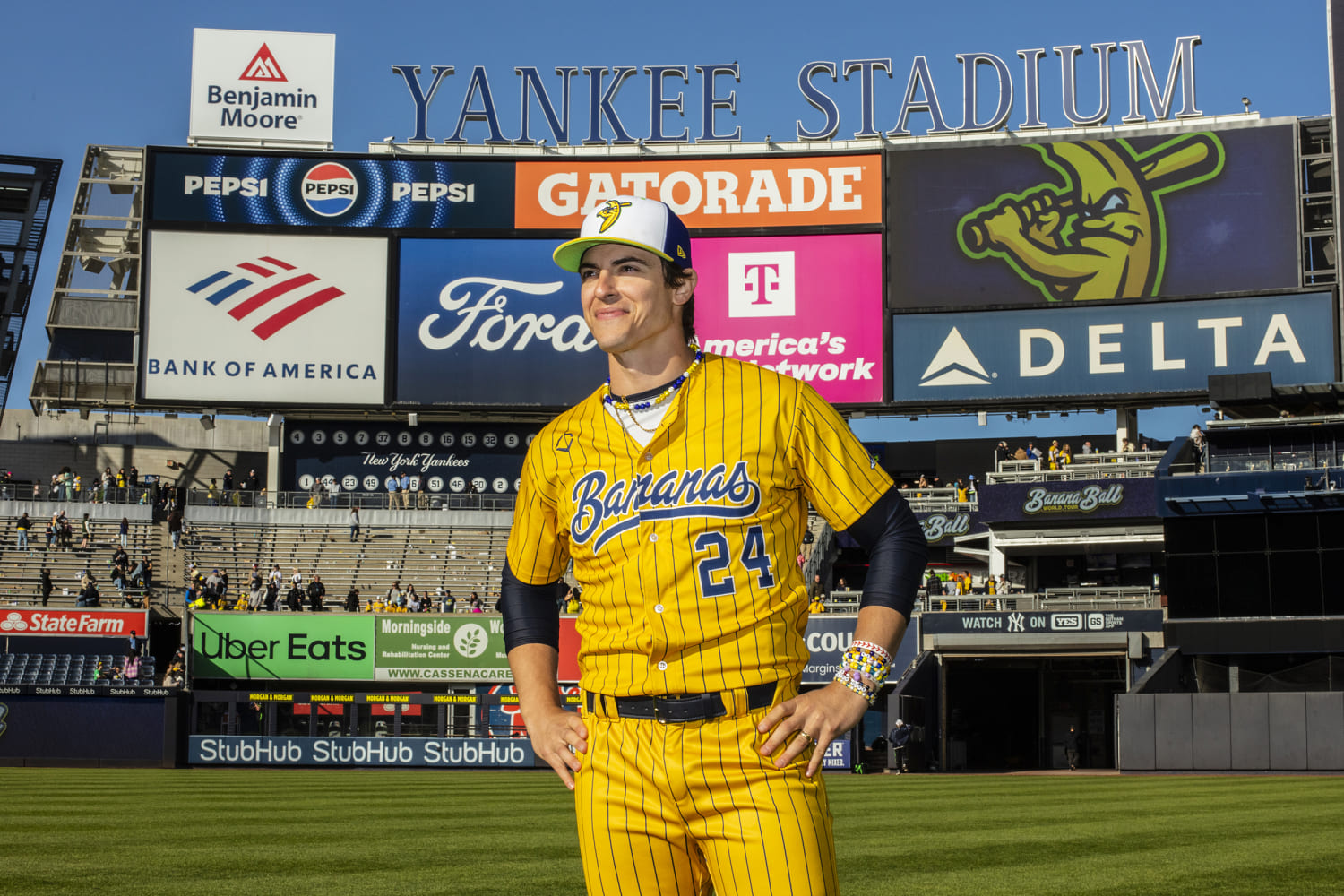
The air in the old ballpark smelled like stale beer, damp clay, and broken promises. It is a scent known intimately by anyone who has ever spent a decade chasing a white leather ball around the minor leagues, waiting for a phone call that never comes. For most players in the twilight of their twenties, the baseball diamond ceases to be a field of dreams. It becomes a factory floor. You clock in, you strike out, you adjust your batting gloves, and you watch the joy of your childhood evaporate under the harsh glare of commercial floodlights.
We have been conditioned to accept this version of the game. It is a cathedral of unwritten rules, solemn rituals, and three-hour marathons where nothing happens, very slowly. We sit in the stands, paying extortionate prices for lukewarm hot dogs, policing our own children to sit still because the traditionalists demand reverence.
Then came the yellow pants.
To understand why a sold-out stadium of sixteen thousand people is currently doing the Macarena while a pitcher throws a fastball on stilts, you have to understand the quiet tragedy of the second chance. Most athletic careers do not end with a press conference and a gold watch. They end on a Tuesday afternoon in a strip-mall parking lot, where a manager tells a thirty-year-old catcher that they are freeing up a roster spot for an eighteen-year-old from the Dominican Republic.
Jesse Cole looked at that structural heartbreak and saw an opportunity. Not just to build a business, but to stage a rescue mission for the soul of America’s pastime.
When the Savannah Bananas first took the field in Georgia, the local community laughed. The team name was ridiculous. The bright yellow uniforms looked like a neon mistake. The stadium was ancient, dating back to World War II, burdened by a history of failed franchises that had gone bankrupt trying to sell traditional baseball to a public that had grown profoundly bored. Cole and his wife, Emily, poured their life savings into the venture. At one point, their bank account dwindled to just twenty-nine dollars. They were sleeping on an air mattress, fueled entirely by the insane conviction that people did not hate baseball; they hated the boredom that had suffocated it.
The breakthrough came when they stopped treating baseball as a sport and started treating it as a Broadway show where the actors happen to be elite athletes.
Consider the anatomy of a standard strikeout. In the major leagues, it is a moment of public humiliation. The batter slinks back to the dugout, head bowed, snapping his bat over his knee in frustration. The crowd offers a polite, rhythmic clap. The game grinds to a halt while the next batter slowly adjusts his armor.
Now, look at Grayson Long. He is a real pitcher with a real 90-mile-per-hour fastball, but tonight, he is wearing a kilt. When he strikes out a hitter under the rules of "Banana Ball," he doesn’t just walk back to the mound. The entire infield immediately launches into a synchronized, choreographed TikTok dance to a Britney Spears track, while the stadium announcer screams through the PA system. The batter isn't angry; he's laughing. The fans aren't watching their phones; they are standing on their seats, spilling beer, screaming at the top of their lungs.
It looks like chaos. It looks like a circus. But beneath the slapstick comedy lies a brutal, unforgiving standard of athletic excellence.
You cannot play Banana Ball if you are just a clown. The rules are designed to accelerate the game to a breakneck pace. There are no walks; if a pitcher throws four balls, it becomes a "sprint," where the batter runs around the bases while every single defensive player on the field—including the outfielders—has to throw the ball around to every position before they can try to tag him out. If a fan catches a foul ball in the stands, the batter is out. There is a strict two-hour time limit. The clock counts down like a time bomb, forcing a frantic, breathless urgency onto a sport that used to pride itself on timelessness.
This environment requires a rare breed of human being. It demands athletes who possess major-league talent but lack major-league egos.
For decades, the traditional baseball pipeline has functioned as a meat grinder. It selects for conformity. Young men are taught to suppress their personalities, to look uniform, to speak in clichés about taking it one game at a time. If a player flips his bat after a home run, he is punished with a fastball to the ribs during his next plate appearance. The sport rewards the stoic, the mechanical, the invisible.
The Bananas do the exact opposite. They scout for the castaways. They look for the guys who were told they were too eccentric for the minor leagues, the pitchers who couldn’t stop talking on the mound, the infielders who practiced backflips during warmups.
Michael Deeb is a prime example. He was a bruising linebacker at Notre Dame, a man built like a brick wall, who transitioned to baseball but found himself stuck in the endless, anonymous purgatory of independent leagues. He was a phenomenal athlete looking for a stage, not a prison. In Savannah, he found a place where he could sprint from the dugout, rip his jersey open like Superman, and slide into second base on his stomach just to celebrate a single.
"I spent my whole life being told to calm down on the field," Deeb once remarked during a post-game interview, his eyes wide with the adrenaline of a man who had finally been allowed to breathe. "Here, they told me I wasn't being loud enough."
That is the invisible stake of this entire experiment. It is the realization that we have structured our modern entertainment around a false choice. We are told that we must choose between the purity of high-level competition and the cheap thrills of theatrical entertainment. The Bananas proved that this boundary is entirely artificial.
When you watch a Banana Ball game, you are watching elite athletes operating at the absolute peak of their physical capabilities while simultaneously performing a comedy routine. It is the athletic equivalent of playing a flawless Rachmaninoff piano concerto while riding a unicycle. If you drop the ball, the joke fails. If you miss the pitch, the show falls apart.
The business world callously refers to this as "disruption." They write case studies about how the Bananas sold out every single game, accumulated millions of social media followers, and built a ticket waiting list that rivals the Green Bay Packers. Corporate executives buy tickets just to sit in the stands and analyze the logistics of how the team handles customer service—every stadium employee, from the ticket rippers to the parking attendants, is trained to perform, dance, and high-five every single guest.
But calling it a business model misses the point entirely. It ignores the emotional alchemy that happens when you remove fear from a game.
Watch the kids in the front row. In a standard Major League stadium, children are often passive observers, buried in iPads by the fifth inning, distracted by the colossal video screens because the action on the grass below has slowed to a crawl. In Savannah, the children are part of the ecosystem. They are hunting for foul balls because they know their catch matters. They are making eye contact with the third baseman, who might just hand them a yellow rose mid-inning or pull them onto the field to help lead the crowd in a chant.
This is not a cynical marketing ploy. It is a fundamental rejection of the loneliness that defines modern public life. We live in an era of profound isolation, where our entertainment is curated by algorithms and consumed through individual glowing rectangles. The Bananas have created an antidote: a communal, unironic celebration of joy. It is an environment where it is impossible to be a cynical spectator because the sheer momentum of the happiness around you forces your defenses down.
The traditionalists still complain. They write angry columns about the desecration of the game, arguing that the ghost of Babe Ruth is weeping somewhere because a batter decided to use a flaming bat or a pitcher delivered a ball while doing a full split. They see it as a mockery.
They are wrong. The Bananas aren't mocking baseball; they are saving it from its own self-importance. They are remembering that the sport was invented as a game, a pastime meant to be played in sunlit fields by people who wanted to escape the grime of the industrial revolution for a few hours. Somewhere along the line, billions of dollars and corporate sponsorships turned it into a joyless grind.
The sun begins to dip below the grandstands at Grayson Stadium, casting long, dramatic shadows across the infield. The score is tied in the final inning. The two-hour clock is ticking down to its final seconds. The pressure is real, the sweat is pouring off the players' faces, and the crowd is leaning forward, completely captivated by the outcome.
A player stands at home plate. He has spent his life being told he wasn't quite good enough for the big leagues. He has known the sting of release forms and the quiet despair of empty stadium parking lots. But tonight, he is wearing a bright yellow uniform. Sixteen thousand people are chanting his name.
He winks at the dugout, performs a brief, effortless pirouette, and steps into the batter's box, completely alive.