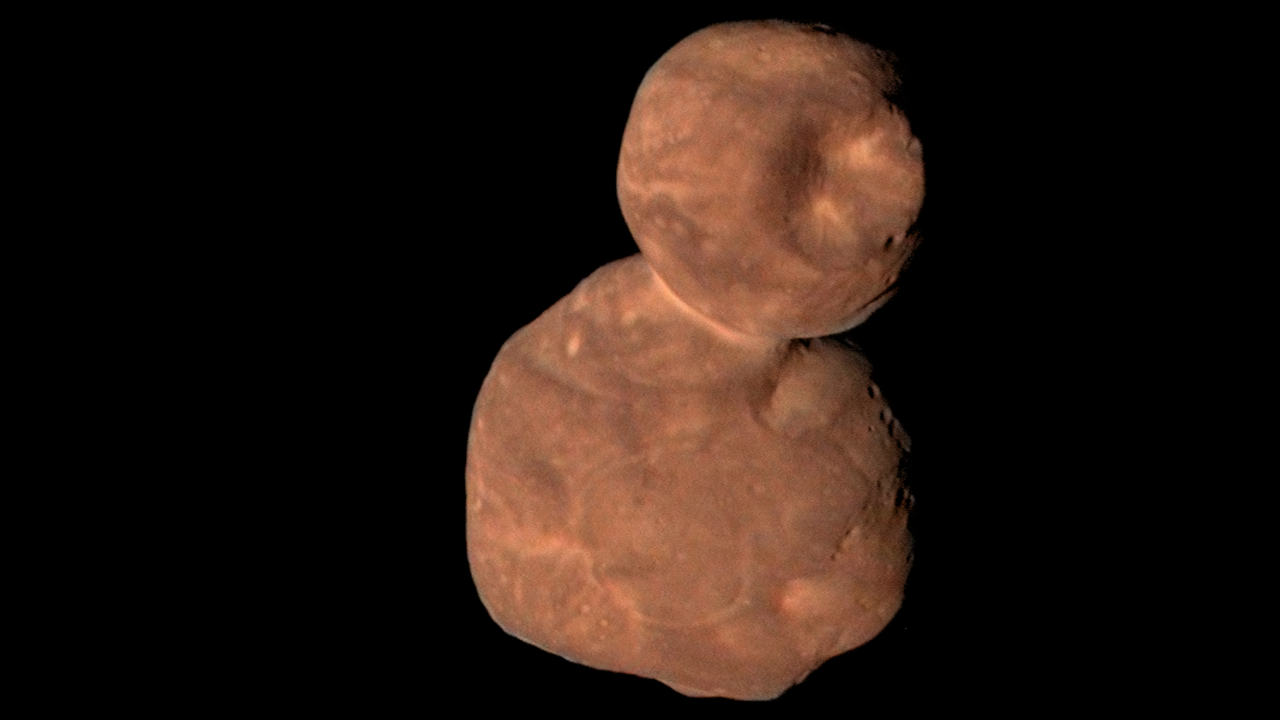
Everyone loves a neat story. NASA sends a probe billions of miles into the dark. The probe snaps a picture of a space peanut. The media screams that we have just photographed the building blocks of the planets.
It makes for great press releases. It fills documentaries with dramatic CGI music.
It is also fundamentally misleading.
When New Horizons zipped past Arrokoth in the Kuiper Belt back on New Year’s Day in 2019, the planetary science community rushed to label it a pristine time capsule. The lazy consensus went something like this: because Arrokoth sits far out in the deep freeze, untouched by the chaotic gravitational churn of the inner planets, it must look exactly today as it did four point six billion years ago. A static fossil. A pristine archive of solar system genesis.
I have spent decades watching researchers project their own desire for order onto chaotic data. Arrokoth is not a pristine time capsule. It is an survivor of a brutal, ongoing attrition war, shaped by thermal evolution, volatile migration, and surface physics that we are only beginning to comprehend. Treating a 33-kilometer-long dual-lobed contact binary as a literal snapshot of planetary birth is like looking at a single weathered brick in the ruins of Rome and assuming you understand the entire architectural blueprint of the Roman Empire.
Let us dismantle the mythology piece by piece.
The Contact Binary Fallacy
The defining visual of the Arrokoth encounter was its shape. Two distinct spheres lobes gently pressed together like a lumpy snowman. Planetary scientists immediately jumped on this. They called it a gentle accretion event. They argued that planetesimals formed in the primordial solar nebula by swirling together softly, touching at low velocities so they did not shatter.
It sounds poetic. It is also physically improbable.
When you model the actual dynamics of the early solar nebula, low-velocity collisions are rare exceptions, not the rule. The gas drag, the orbital shear, and the sheer turbulence of a collapsing disc mean that objects colliding at distances of 40 astronomical units are far more likely to experience catastrophic disruption or high-speed fragmentation.
What if Arrokoth did not form by a gentle merger at all? What if we are looking at the survivors of a catastrophic collisional cascade where two fragments happened to end up in a bound orbit, slowly spiraling inward due to gas drag until they kissed?
The data does not scream gentle accretion. It whispers survival against impossible odds. When you assume a gentle formation just because the final product looks smooth, you ignore the violent history required to clear the rest of the neighborhood.
The Myth of The Pristine Freezer
The second pillar of the Arrokoth consensus is thermal isolation. The argument goes that because sunlight is weak out there, nothing happens. The surface chemistry stays locked in ice, preserved like a woolly mammoth in permafrost.
This ignores radiogenic heating and cosmic ray bombardment.
Even four billion years out, elements like aluminum-26 and potassium-40 decay inside planetesimals. Over hundreds of millions of years, that internal heat source migrates outward. Volatiles like carbon monoxide, nitrogen, and methane ice do not just sit there. They sublimate, migrate through porous interiors, and redeposit on the surface.
Arrokoth is not a static object. It is a slow-motion thermodynamic engine.
When New Horizons measured the surface colors—deep red tholins, organic molecules created by cosmic ray processing—researchers treated it as primordial paint. But those tholins are continuously produced. Space weathering alters chemical bonds daily. The surface you saw in those blurry 2019 flyby frames is constantly being repaved by microscopic impacts and radiation-driven chemistry. Calling it a time capsule is like calling a forest fire a snapshot of a seed.
What We Actually Learned
Strip away the PR hype, and what did the flyby actually buy us?
We learned that planetesimals could grow larger than previously modeled before the violent clearing phases of planetary migration. We learned that contact binaries are common in the Kuiper Belt, which tells us something profound about how low-energy orbital dynamics operate in the extreme periphery.
That is valuable. That is hard science.
What is not science is extrapolating the formation history of the entire terrestrial world from one weirdly shaped rock at the edge of the solar system. Earth, Mars, and Venus formed in a radically different thermal and gravitational regime. They experienced giant impacts, runaway greenhouse states, core differentiation, and plate tectonics. Comparing Earth to Arrokoth is like comparing a nuclear submarine to a canoe because they both float on water.
The Danger of Narrative Physics
The problem with modern space exploration communication is the desperate need for a narrative arc. Funding depends on public enthusiasm. Public enthusiasm depends on simple, punchy stories.
So we get "The furthest world ever explored reveals the dawn of time."
The truth is messier. Science does not advance by finding a smoking gun that confirms your favorite hypothesis. It advances when your favorite hypothesis gets completely demolished by a weird little snowman rock that refuses to fit your models.
We sent a piano-sized probe four billion miles to look at a potato-shaped ice chunk, and instead of giving us answers, it should have made us realize how little we understand about how anything sticks together in the dark.
Stop looking at Arrokoth for where we came from. Look at it as a reminder of how much noise we invent to make the void feel familiar.