A rocket launch is usually an exercise in absolute, violent farewells. For seventy years, the fundamental physics of leaving Earth required a brutal mathematical trade-off: to thrust a few tons of human ambition into the stars, you had to burn millions of dollars of precision machinery and drop the hollowed-out carcass into the ocean, never to be seen again. It was the equivalent of flying a commercial airliner from New York to London and then crashing the Boeing 777 into the Atlantic because there was no way to bring it home.
For a long time, only one entity made bringing it home look normal. We watched the sleek, white cylinders of SpaceX glide backward out of the heavens, balancing on needles of blue flame, landing gently on concrete pads or floating barges. It felt like an American monopoly on the future.
Until today.
Off the coast of Hainan Province, the air was heavy with tropical humidity as a 63-meter-tall column of steel and titanium named the Long March 10B roared off its pad at the Wenchang commercial spaceport. It was a maiden flight. Historically, a maiden flight is a nervous gamble just to get the payload into orbit. But the real drama of this mission wasn't happening on the way up. It was happening on the way down.
Six minutes. That is all the time it took to rewrite the geopolitical balance of the upper atmosphere.
Consider the sequence of events. After pushing its payload toward low-Earth orbit, the massive first-stage booster separated. Instead of tumbling into a chaotic, fiery death spiral, the 760-ton vehicle did something profoundly unnatural. It turned around. Using a mixture of kerosene and liquid oxygen, its engines reignited in the thin air, fighting gravity, fighting momentum, biting into the atmosphere to slow itself from supersonic speeds.
But as the booster plunged toward a massive, 25,000-tonne vessel waiting in the South China Sea, observers noticed something missing. There were no landing legs.
When SpaceX engineered the Falcon 9, they equipped it with heavy, complex carbon-fiber legs that deploy at the final second. The Chinese engineers at the China Academy of Launch Vehicle Technology looked at those legs and saw a liability. Legs add weight. Weight reduces the amount of satellite cargo you can carry.
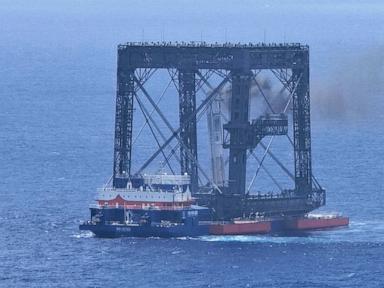
Instead, they built a giant net.
Imagine a high-wire acrobat falling from the ceiling of a stadium, but the acrobat is a 200-foot-tall, roaring metal tower weighing dozens of tons, and the net is a cross-shaped, high-strength buffered arresting system suspended on a ship fluctuating with the ocean waves. As the Long March 10B hovered over the deck, onboard mechanical hooks extended from its hull. With a deafening hiss of steam and mechanical tension, the rocket flew directly into the webbing. The net caught it.
It was the world’s first successful network-based recovery of an orbital-class launch vehicle.
To understand why this matters, you have to look past the spectacular video footage and examine the invisible, brutal economics of the modern space race. For nearly a decade, Western analysts watched China scale up its space program with a mixture of awe and complacency. The narrative was simple: China could build great traditional rockets, but they lacked the agile, iterative tech-culture required to master reusable rocketry. Last December, two private Chinese firms tried SpaceX-style leg landings. Both crashed in spectacular, explosive failures. The skeptics felt vindicated.
But failure in aerospace is just data with a high price tag.
The engineers didn't give up on reusability; they changed the paradigm. By shifting the landing gear from the rocket to the ship—by putting the "legs" on the ocean platform in the form of a massive net—China stripped structural weight from the vehicle itself. The Long March 10B can now haul 16 metric tons to orbit while remaining completely reusable. State officials have already announced plans to clean, refurbish, and refly this exact same booster before the end of the year.
This isn't just a technical milestone; it is a declaration of industrial parity. Stocks in Chinese aerospace firms locked at their daily limits within hours of the announcement. The American monopoly on affordable, high-frequency space access has vanished.
The true weight of this achievement lands not on the deck of that recovery ship, but in the boardroom discussions of every satellite telecommunications company on Earth. For years, SpaceX was the only game in town if you wanted cheap, reliable access to the stars. Now, a second infrastructure superpower has cracked the code.
As the sun sets over the Hainan launch site, the massive cross-shaped net holds the scorched, soot-stained cylinder of the Long March 10B. It looks exhausted, but intact. It is a quiet, heavy monument to a changing world. Space is no longer a destination we visit by throwing away our history; it is a road we are learning to build, use, and walk back down, over and over again.


