Step out of the high-speed rail terminal just south of Seoul, and the first thing that hits you isn't the cold wind. It is the vibration.
It is a low, structural hum that vibrates through the soles of your shoes before you even realize you are listening to it. For miles in every direction, the hills of Gyeonggi Province are being hollowed out. Earthmovers teeth into the red clay. Steel skeletons claw toward the gray sky. This is Yongin, a quiet region once known mostly for its theme park and sleeping-town suburbs. Today, it is the center of the world.
We talk about artificial intelligence as if it lives in the air. We speak of the "cloud" as if our digital thoughts float in some pristine, weightless atmosphere. But the cloud is an illusion. The cloud is a sprawling, humming, electricity-guzzling monument of concrete, copper, and ultra-pure silicon. Every time you ask an AI model to write a poem, analyze a medical scan, or generate an image, a microscopic surge of electrons must fire through a piece of glass no larger than a fingernail.
Right now, humanity is running out of those fingernails.
To fix this, South Korea's biggest technology giants are throwing $518 billion at a single patch of land. It is the largest single investment in industrial history. It is a financial bet so massive it stuns the imagination. To put five hundred and eighteen billion dollars in perspective: it is roughly the entire annual economic output of countries like Belgium or Sweden. All poured into one mega-cluster of chip factories.
But if you want to understand why this is happening, you have to look past the astronomical numbers. You have to look at the water.
The Microscopic Cleanroom
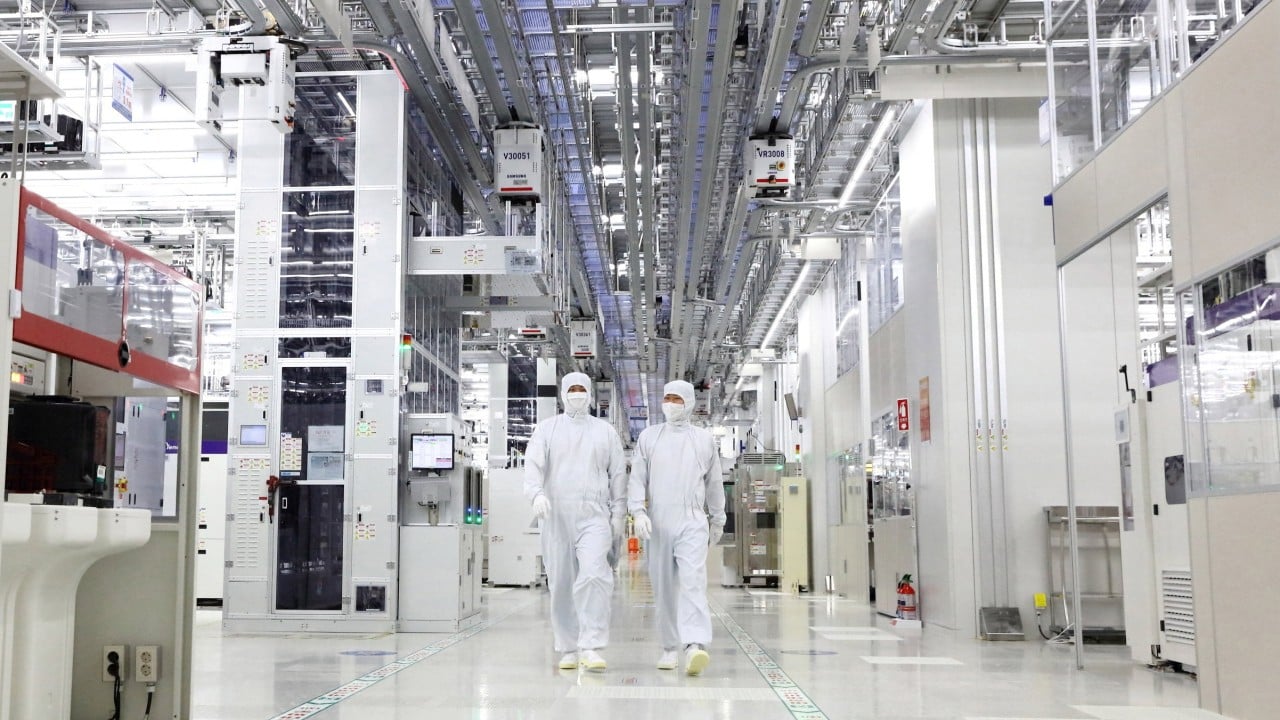
Consider a hypothetical engineer named Min-woo. He doesn't exist as a single person, but he represents the thousands of women and men who spend twelve hours a day walking through the surreal, yellow-lit cleanrooms of South Korean fabrication plants, or "fabs."
Min-woo wears a pristine white bunny suit. He breathes air that has been filtered so many times it feels entirely devoid of smell or moisture. In his world, a single speck of dust is a catastrophic asteroid. If a particle measuring just a few nanometers—thousands of times smaller than a grain of sand—lands on a silicon wafer during production, it can short-circuit an entire batch of microchips. Millions of dollars evaporate in an instant.
The machines Min-woo monitors are the most complex instruments ever built by human hands. They use extreme ultraviolet light to etch invisible rivers of circuitry onto silicon. It is a process of terrifying precision. It requires steadiness that defies the natural instability of the earth. If a heavy truck drives down a public road two miles away, the vibration can ruin the etching.
This is what $518 billion is actually buying. It is not just concrete and machinery. It is the forced containment of absolute purity on a planetary scale.
South Korea already dominates the market for memory chips—the digital scratchpads that computers use to hold data temporarily. But AI demands something deeper. AI models require High Bandwidth Memory, a specialized technology where individual chips are stacked vertically like high-rise apartments and connected by microscopic holes. It allows data to move at speeds that would have seemed mathematically impossible a decade ago.
Without these specific stacks of silicon, the most advanced AI software in the world becomes a Ferrari stuck in bumper-to-bumper traffic. The software is ready to sprint, but the hardware cannot feed it information fast enough. Samsung and SK Hynix, the two titans driving this half-trillion-dollar project, know that whoever controls this hardware pipeline controls the future of global computation.
The Ghostly Geography of Supply
It is easy to look at this sudden construction boom and see only corporate ambition. But look closer, and you see fear.
The global supply chain for advanced semiconductors is terrifyingly fragile. The world relies almost entirely on a handful of factories scattered across a few geographic flashpoints. A single geopolitical misstep, a major earthquake, or a prolonged drought could halt the production of advanced electronics globally. It would freeze everything from smartphone manufacturing to automotive assembly lines.
When you sit in a boardroom in Seoul, that fragility isn't an abstract academic theory. It is a structural threat.
The Yongin mega-cluster is an attempt to rewrite the geography of global power. By building a centralized mega-hub that integrates everything from raw material design to final chip packaging within a single domestic zone, South Korea is attempting to build a fortress. They are trying to ensure that no matter how chaotic the outside world becomes, the digital heart of the global economy keeps beating.
But the sheer scale of this project creates its own gravity. A chip fab of this size does not just exist in an environment; it alters it completely.
A single modern fab can consume millions of gallons of water every single day. The water must be treated until it is ultra-pure—stripped of every mineral, bacteria, and impurity until it is no longer even safe to drink because it would leach minerals directly out of your body. To supply the Yongin cluster, engineers are constructing massive pipelines to draw water from distant rivers, fundamentally shifting the hydrology of the region.
Then there is the power. The cluster will require gigawatts of electricity, enough to power entire small nations. It forces a difficult conversation about where that energy comes from in an era of tightening climate realities. The stakes are invisible until they suddenly manifest as a new transmission tower cutting across a rural valley, or a massive sub-station rising next to an ancient farming village.
The Weight of the Invisible
There is a strange disconnect at the heart of modern life. We live in a world that feels increasingly digital, weightless, and instantaneous. We swipe through video feeds, generate text, and store our lives in databases without ever thinking about the physical toll of those actions.
We forgot that the digital world is made of dirt.
It is made of quartz sand mined from specific quarries, melted down at extreme temperatures, refined into pure silicon ingots, sliced into impossibly thin wafers, and stamped with light. The Yongin project is a reminder of the sheer, brutal physical reality required to sustain our digital lives. It tells us that our collective hunger for smarter algorithms and faster responses has a direct, undeniable weight on the physical earth.
The hills around Yongin continue to vanish. The low hum in the ground will grow louder over the next decade as more factories come online, eventually aiming to house dozens of individual production lines by the late 2040s.
Years from now, a college student might sit in a library in Chicago or Tokyo, typing a prompt into a device to solve a complex medical problem or generate a piece of architecture. The response will arrive in seconds. That student will not think about Gyeonggi Province. They will not see the yellow light of the cleanroom, nor will they think of the rivers piped across miles of clay to wash a piece of glass.
They will simply witness the miracle. But the miracle is anchored to the earth by half a trillion dollars of steel, water, and human sweat, buried deep in the South Korean hills.