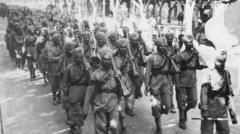
A heavy trunk sits in the corner of a brick home in Jalandhar. Inside, wrapped in aging muslin, lies a brass medal. It bears no name. For over a century, the family knew only a fragment of a story: a young man left the sugarcane fields, boarded a massive ship, and never returned.
History recorded the grand strategies of the Western Front. It charted the movements of divisions and the decisions of generals in Whitehall. But it somehow dropped the names of the men who actually held the line when the mud threatened to swallow everything.
Thousands of men from the Punjab region sailed into a freezing European winter to fight a war that was not theirs. They died in the trenches of Ypres and the dust of Gallipoli. When the conflict ended, their names vanished from the official ledgers of remembrance. They became a collective, anonymous statistic.
A quiet reckoning is finally overturning this silence. Through painstaking archival detective work, thousands of these forgotten Punjabi soldiers are being officially recognized for the very first time. Their identities are being restored to the global ledger of sacrifice.
The Geography of Silence
To understand how someone vanishes from history, look at how the records were kept.
Imagine a clerk sitting in a drafty office in 1919. He is sorting through thousands of handwritten field reports sent from the battlefields of East Africa, Mesopotamia, and France. The colonial administrative machine was built for scale, not for individual humanity.
British casualties were meticulously cataloged. Letters went home to grieving mothers in Yorkshire. Headstones were carved with precise initials and regiments.
For the soldiers of the British Indian Army, the process looked entirely different. Names were transcribed by clerks who did not speak Punjabi. A spelling mistake here, a misplaced village name there, and a person's existence began to blur.
Consider a hypothetical young sepoy named Choor Singh. In his village, his identity was tied to his family, his land, and his community. To the military bureaucracy, he was merely a number attached to the 15th Ludhiana Sikhs. If he died in a chaotic retreat near Neuve Chapelle, his death might only be recorded as a tally mark in a ledger tracking daily losses.
This was not necessarily a deliberate act of malice. It was the predictable result of a massive, indifferent imperial bureaucracy. The system valued the muscle and courage of the Punjab plains but lacked the administrative will to preserve the individual identities of the men who provided it.
The Long Journey from the Five Rivers
The men who left the Punjab were not professional mercenaries looking for adventure. They were farmers, sons of the soil, bound by deep traditions of honor and duty.
The transition was violent. They left an arid, sun-drenched plain where the rhythm of life was dictated by the harvest. Within weeks, they found themselves crammed into the dark holds of troopships, crossing oceans they had only ever heard of in stories.
They stepped off the boats in Marseille into a European winter that shocked their bones. The mud of Flanders was unlike anything they had encountered. It was a cold, clinging clay that filled the trenches and rusted their rifles.
They fought in cotton uniforms until woolens could be scraped together. They faced artillery barrages that turned the earth upside down, a terrifying industrial scale of warfare that no amount of traditional warrior training could prepare them for.
Letters sent back to the Punjab, heavily scrutinized by wartime censors, revealed the psychological toll. Soldiers wrote of a world where the sky rained fire and the ground dissolved beneath their feet. Yet, they stayed. They held vital sectors of the line during the critical early months of the war, buying precious time for the Allies.
Piecing the Fragments Together
Restoring these names is not a simple matter of opening an old book. It requires an extraordinary amount of historical detective work.
Researchers have spent years combing through disparate sources. They cross-reference chaotic medal index cards with regional village rosters. They translate heavily faded community records and compare them with colonial war diaries.
The difficulty lies in the gaps. A soldier might be listed on a memorial in Egypt under a heavily mangled variant of his name, while his pension records in Punjab show a completely different spelling.
Historians must act like forensic accountants. They track down the small clues—a service number, a father's name, a specific regiment—to prove that these separate records belong to one single human being.
This meticulous labor has revealed thousands of individuals who were completely omitted from official commemoration lists. These men did not have headstones. Their families never received definitive word of where they fell. They simply drifted out of living memory, leaving behind nothing but an empty space at the family table.
The Impact on the Living
This project is about much more than correcting historical typos. It changes how modern families understand their own lineage.
For generations, many families in Punjab and across the global diaspora lived with a vague, lingering ghost. They knew an ancestor had gone to the "Great War," but the details were completely lost. There was no grave to visit, no monument to read, no official acknowledgment that their sacrifice mattered to the world.
When a name is finally restored to an official memorial, the ripple effect is profound.
It provides an anchor. A family living in Birmingham or Vancouver can now point to a specific stone or an official database and see their great-grandfather’s name etched alongside his comrades. It validates the stories whispered by elders. It proves that their history did not begin with immigration in the 1960s, but was woven into the global narrative long before.
The Changing Shape of Remembrance
The way we remember war is shifting. For a long time, the dominant narrative of the First World War focused heavily on the Western experience—the poets of the trenches, the fields of northern France, the grief of European nations.
That view is incomplete. The conflict was truly global, and its resolution depended heavily on millions of non-European soldiers who volunteered to fight.
By adding thousands of Punjabi names back into the official record, the history of the war becomes more accurate. The monuments lose their homogeneity and begin to reflect the true diversity of the forces that stood in those trenches.
The work remains unfinished. Every year, researchers uncover more fragments, more forgotten ledgers, more names waiting to be reclaimed from the margins.
The brass medals hidden away in old trunks across Punjab are finally regaining their context. The silence is lifting. The men who stood in the freezing mud of Flanders, thousands of miles from the warm fields of their youth, are finally being called home by their proper names.