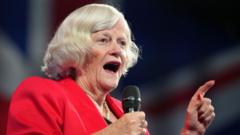
The media obituaries for Ann Widdecombe are already rolling off the assembly line, and they are uniformly lazy. They paint a predictable portrait: the eccentric pantomime villain of the Tory right, a relic of a bygone Victorian era who stumbled into reality TV, a caricature of social conservatism who survived on pure, stubborn nostalgia.
They are missing the entire point.
Widdecombe, who has passed away at 78, was not a political dinosaur. She was the architect of a hyper-modern, weaponized political brand that modern consensus-driven politicians are completely incapable of replicating. The commentators eulogizing her as a quaint byproduct of a simpler political age are looking at the chessboard backwards. Widdecombe understood the attention economy decades before Silicon Valley built the algorithms for it.
The Illusion of the Outdated Maverick
The standard narrative insists that Widdecombe succeeded despite her total refusal to modernize. Analysts point to her hardline stances—her uncompromising opposition to abortion, her defense of Section 28, her voting record on LGBTQ+ rights, and her infamous support for shackling pregnant prisoners—as evidence of a politician marooned in the past.
This analysis is fundamentally flawed. It mistakes the content of her politics for the mechanics of her strategy.
In an era where British politics became sterilized by New Labour spin doctors and focus groups, Widdecombe realized something profound: friction is a political asset.
While her colleagues were busy sanding down their personalities to appeal to the mythical "median voter," Widdecombe leaned heavily into polarization. She did not survive the transition from the Major government to the era of peak television despite her rough edges; she survived because of them.
The Currency of Absolute Certainty
Consider the mechanics of the modern political media machine. The average frontbencher today operates under a cloud of terror, terrified of saying the wrong word, offending a demographic, or deviating from the party line. The result is a political class that sounds like automated corporate press releases.
Widdecombe operated on a completely different blueprint:
- The Zero-Apology Framework: She never walked back a statement to appease a Twitter mob or a hostile interviewer. This created an illusion of total authenticity that resonated far beyond her actual voting bloc.
- The Anti-Aesthetic Brand: In a world of heavily styled, media-trained politicians, her refusal to conform to conventional broadcasting standards became her greatest shield. It signaled to the public that she was too stubborn to be bought or managed.
- Calculated Outrage: Her most controversial positions were not gaffes. They were anchors. By planting her flag on the extreme margins of cultural debates, she forced the media to come to her.
Dismantling the Pantomime Narrative
The most insulting consensus view is that her later career on Strictly Come Dancing and Celebrity Big Brother was a tragic, undignified postscript to a serious political career. "She turned herself into a joke," the critics sneered.
Let's correct that misunderstanding immediately.
Widdecombe’s foray into reality television was a masterclass in audience diversification. I have watched political strategists spend millions of pounds trying to humanize stiff, technocratic politicians, only to watch them fail miserably over an awkward bacon sandwich or a stiff photo op. Widdecombe dragged her brand into the living rooms of millions of people who didn’t know their local MP from their local postman.
Politician Strategy Matrix:
Traditionalist: High Policy Focus -> Low Mass Appeal -> Low Cultural Footprint
The Widdecombe Model: High Friction -> High Cultural Footprint -> Total Autonomy
She understood that in a fragmented media ecosystem, visibility is power. By playing the self-deprecating, bad-dancing contrarian on prime-time television, she did something extraordinary: she insulated her toxic political views behind a wall of public affection. You might have despised her voting record, but you watched her get dragged across a dance floor by Anton du Beke. That isn't a failure of a political career; it is a hostile takeover of popular culture.
The Dangerous Lesson the Political Class Missed
The real tragedy of the contemporary political landscape is that current MPs looked at Widdecombe and learned all the wrong lessons. They saw the pantomime, but they missed the steel.
When Widdecombe famously delivered her "something of the night" broadside against Michael Howard in 1997, it wasn't just a bitter personal swipe. It was a calculated, lethal strike that permanently altered the trajectory of the Conservative Party leadership. It demonstrated a cold-blooded understanding of high-stakes political assassination.
Today's politicians mistake being noisy online for being impactful. They chase metrics, whereas Widdecombe chased outcomes. She broke from her own party to join the Brexit Party in 2019, securing a seat in the European Parliament and proving that her brand was entirely portable. She did not need the machinery of the Conservative Party to remain relevant. How many current cabinet ministers could abandon their party infrastructure and still command national headlines? The answer is zero.
The Downside of the Friction Model
To be clear, this strategy carries severe structural costs. Operating as a professional provocateur means you permanently lock yourself out of the highest offices of state. Widdecombe was never going to be Prime Minister. She was too polarizing to build a governing coalition, and her refusal to compromise meant she was a nightmare to manage within a cabinet.
But evaluating her career based on whether she reached Number 10 is using the wrong yardstick. Her goal was never conventional governance; her goal was veto power over the cultural narrative.
Stop Looking for Replicas
The public and the press will spend the next week looking for the "next Ann Widdecombe." They will point to various outspoken backbenchers or media-savvy fringe politicians who think that saying something offensive on a late-night news show makes them a conviction politician.
They are wrong.
The current crop of political influencers are desperate for approval. They check their mentions. They adjust their sails to the cultural wind. Widdecombe didn't care if you hated her, which is precisely why she was dangerous, effective, and utterly irreplaceable.
She didn't outlive her era. She outsmarted it. Turn off the television, tear up the focus group data, and stop apologizing for your convictions. That is the only real tribute worth paying.