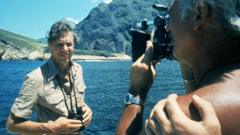
David Attenborough turns 100 today, a milestone that effectively canonizes him as the secular saint of the natural world. Most viewers seeking his work simply want a list of where to stream his greatest hits—the sweeping vistas of Planet Earth on BBC iPlayer, the deep-sea revelations of Blue Planet II, or his "witness statement" A Life on Our Planet on Netflix. But to treat his filmography as a mere collection of high-definition animal clips is to miss the radical shift in media and environmental politics he spearheaded. He didn't just narrate nature; he manufactured the way the modern world perceives it.
The primary way to access this century of work in 2026 is divided between three giants. The BBC iPlayer remains the repository for his "Life" series and the new Wild London, while Netflix holds his more urgent, late-career conservation manifestos. For those in North America, PBS and Discovery+ act as the primary gateways to his older, more academic expeditions.
The Architect of the Sledgehammer Documentary
In the late 1960s, while serving as Controller of BBC Two, Attenborough wasn't holding a camera. He was holding a ledger. He is the man who brought color television to the UK, choosing snooker and tennis as the Trojan horses for the new technology because their primary visual components—colored balls and yellow felt—demanded the upgrade. This executive ruthlessness eventually birthed the "sledgehammer" documentary.
Before Attenborough, nature docs were grainy, educational shorts. He envisioned 13-part epics with massive budgets that functioned like televised cathedrals. When he left his desk to film Life on Earth in 1979, he wasn't just a presenter; he was a pioneer testing the limits of 16mm film in the Rwandan rainforest. That series, viewed by an estimated 500 million people, established the "Attenborough Style"—the hushed, conspiratorial whisper that made the viewer feel like they were the only two people in the world watching a bird of paradise dance.
The Gorilla Incident and the Birth of Advocacy
The most famous sequence in television history almost never happened. In the Virunga Mountains, Attenborough’s encounter with mountain gorillas was intended to be a clinical observation of human speech evolution. Instead, a young gorilla named Pablo initiated physical contact.
This moment transformed the genre from "us looking at them" to "us being with them." It also marked the beginning of a slow, decades-long pivot. Critics often point out that for the first fifty years of his career, Attenborough rarely mentioned the destruction of the habitats he filmed. He was a master of the "Edenic myth," showing a world untouched by man.
The shift to the "witness statement" era seen in Our Planet (2019) was a calculated risk. He moved from being an observer to an activist, finally acknowledging that the pristine wilderness he’d spent a lifetime documenting was largely a fiction maintained by clever editing and long lenses.
Where to Stream the Definitive Collection
Streaming rights are a fragmented mess, but these are the essential pillars for anyone wanting to understand the man behind the voice.
- The Early Innovation: Life on Earth (1979) and The Living Planet (1984). These are harder to find but occasionally surface on BBC iPlayer or Criterion Channel. They show the raw, physical bravery of a younger Attenborough before he became a studio-bound icon.
- The Technical Zenith: Planet Earth I & II and Blue Planet II. Available on BBC iPlayer (UK) and Max or Discovery+ (US). These series utilized stabilized camera gimbals and drone technology that redefined the visual language of the 21st century.
- The Political Pivot: A Life on Our Planet and Breaking Boundaries. Found exclusively on Netflix. These are the "angry" films, where the grandfather of nature finally stops whispering and starts shouting about the climate collapse.
- The 2026 Milestone: Wild London. Streaming now on BBC iPlayer, this series finds a 100-year-old Attenborough looking at the foxes and stags of his own backyard, proving that the epic doesn't require a private jet.
The Cost of the Attenborough Legacy
There is a counter-argument to the universal praise. Some modern conservationists argue that the high-production "blue chip" style of Attenborough’s films created a false sense of security. By showing nature as beautiful and resilient in every episode, the industry may have delayed public panic over species loss.
However, the "Blue Planet Effect" is undeniable. A single sequence of a mother pilot whale carrying her dead calf, killed by plastic poisoning, did more to change UK legislation on single-use plastics than thirty years of scientific white papers. He realized late in life that data doesn't move people. Stories do.
His secret to longevity isn't a complex medical regimen. It is a simple, ten-minute habit of sitting still in a forest and waiting for the world to move. In a media landscape built on frantic cuts and loud opinions, his greatest contribution might simply be the gift of quiet observation.
Go to the woods. Sit down. Shut up. Wait ten minutes.


