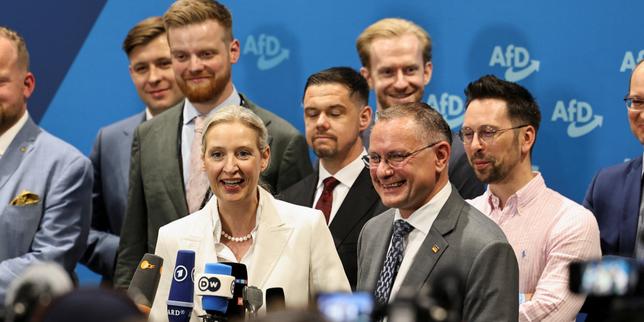
Mainstream political commentary loves a comforting narrative. The recent coverage of the Alternative for Germany (AfD) party congress is the perfect example. Journalists looked at the heated debates, the internal policy disputes, and the public disagreements, and immediately rushed to print the same lazy conclusion: the party is plagued by deep, destabilizing divisions despite a veneer of unity.
They are entirely misreading the mechanics of modern populist movements. For a different view, see: this related article.
What the establishment views as a fatal weakness is actually a calculated operational feature. The assumption that internal factionalism signals the imminent collapse or stagnation of a radical party relies on an outdated, twentieth-century model of political organization. In the current media ecosystem, structural friction is not a bug. It is an engine of growth.
The Flawed Premise of the Fragile Coalition
Commentators point to the friction between the party's programmatic moderates—who theoretically want to position the AfD for future governing coalitions—and the radical ethno-nationalist wing as evidence of a house divided. They argue that these two currents cannot coexist indefinitely without tearing the party apart. Further reporting regarding this has been published by Al Jazeera.
This analysis fundamentally misunderstands how political branding works in a polarized environment.
Political parties do not need ideological purity to win elections; they need attention and broad-spectrum grievance capture. The internal tension within the AfD allows it to play a double game that standard political parties cannot replicate.
- The Radical Wing secures the base, ensures high-energy volunteer mobilization, and maintains the party’s anti-establishment credentials.
- The Pragmatic Wing offers a landing pad for disgruntled mainstream voters who want to protest without feeling like they are voting for complete chaos.
Imagine a corporation running two distinct product lines: one premium and traditional, the other cheap and disruptive. A corporate analyst wouldn't look at those competing products and declare the company is about to go bankrupt due to "profound internal contradictions." They would recognize it as a market segmentation strategy. By presenting multiple faces to the German public, the AfD expands its total addressable market.
The Stabilizing Power of External Pressure
The establishment's favorite talking point is that the party will self-destruct once the threat of a formal ban by the Federal Office for the Protection of the Constitution (BfV) intensifies. The logic goes that moderate members will flee to avoid professional ruin, leaving only the extremists behind.
This is wishful thinking disguised as strategy.
Decades of political science research into radical parties across Europe show that external legal and social ostracization—often called the cordon sanitaire—acts as a powerful binding agent. When a group is collectively targeted by the state and media elites, internal ideological differences matter less than collective survival.
The pressure from Berlin does not fracture the party; it compresses it. It forces internal rivals to settle their differences or at least postpone their civil war because they know any real split would mean mutual assured destruction. The elite consensus that the AfD is too divided to govern actually insulates the party from having to prove it can govern, allowing it to remain a pure protest vehicle while building structural power in the regional parliaments.
Why the "People Also Ask" Assumptions are Wrong
If you look at what people are searching regarding German politics, the underlying assumptions are completely backwards.
Can the AfD survive without a single, unified leader?
The common belief is that a party needs a singular, charismatic figurehead to sustain momentum. Analysts point to the co-leadership structure and the constant jockeying for power between figures like Alice Weidel and Tino Chrupalla as a sign of instability.
The reality? A decentralized leadership structure is a defense mechanism. In an era where political figures can be instantly taken down by scandals, legal challenges, or media campaigns, having a hydra-headed leadership means the movement cannot be decapitated by removing one person. If one leader falters or faces legal jeopardy, the other wing steps up. The internal rivalry keeps both factions sharp, hungry, and constantly optimizing their messaging.
Will economic stability kill the party’s momentum?
The conventional wisdom says that if the German economy stabilizes, the populist wave will recede. This ignores the fact that the AfD's core driver is no longer just economic anxiety; it is structural distrust in state institutions, energy policy, and demographic shifts. You cannot buy off a voter base that believes the entire political apparatus is fundamentally illegitimate merely by adjusting interest rates or offering energy subsidies.
The Cost of the Contrarian Reality
Let’s be completely transparent about the downsides of this reality. This internal friction does create real operational inefficiencies. The party struggles to pass coherent, detailed legislative agendas in regional parliaments. Their personnel decisions are often messy, public, and embarrassing.
But judging a populist protest party by the standards of a bureaucratic, centrist machine like the CDU or SPD is a category error. They are not trying to be a well-oiled governing machine. They are trying to be a wrecking ball. And a wrecking ball does not need a sophisticated five-year policy plan; it just needs mass and velocity.
Stop looking for the cracks in the foundation as a sign that the building is about to fall. Those cracks are expansion joints, designed to let the structure flex under pressure without breaking. The mainstream media will keep writing obituary after obituary for the party after every tumultuous congress, completely blind to the fact that the chaos they are documenting is exactly what keeps the movement alive.