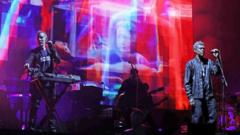
The sound check was loud enough to rattle the fillings in your teeth.
You stand shoulder-to-shoulder with strangers in a humid venue, the bass vibrating through the soles of your sneakers, waiting for a band that has spent four decades turning political friction into sonic poetry. Massive Attack has never done quiet. They operate in the shadows of trip-hop, layering melancholic strings over heavy, subterranean beats, forcing you to look at the ugly machinery of modern geopolitics while you dance.
Then, the lights don't go up. The speakers don't drop.
Instead, a bureaucratic edict drops from the ceiling.
Singapore said no.
It starts with a piece of paper. Or, more accurately, a notification delivered to the organizers by the Infocomm Media Development Authority of Singapore. The reason given is stark, stripped of any artistic nuance: a display involving Palestinian imagery during a scheduled performance breached local regulations regarding foreign politics and public safety. The band, known for their sharp visual commentary that often flashes across massive screens behind them—pairing statistics of civilian suffering with ambient noise—found themselves staring at a closed door.
Art has always been dangerous to governments because it refuses to stay inside the neat little boxes assigned to it.
Consider what happens next. A band sitting in a green room thousands of miles away has to decide whether to fold up their cables and catch the next flight out, or push back. Massive Attack chose the latter, issuing a direct response that cut through the polite corporate doublespeak usually deployed in international touring cancellations. They didn't apologize. They didn't shrug and accept the local zoning laws of global conscience. They pointed out the obvious contradiction of a state permitting trade, diplomacy, and cultural exchange with the world while drawing a hard, unyielding red line at visual solidarity with a besieged population.
Borders are strange things. They look solid on a map, inked in bold red or blue, but on the ground, they are porous, fragile lines enforced by men with clipboards.
I remember standing outside a venue in another city years ago, watching security guards confiscate handmade signs before the doors even opened. They weren't looking for weapons. They were looking for words. A piece of cardboard scrawled with a city name half a world away was treated like a lit match near a gasoline pump. Security personnel, young men and women wearing neon vests who probably just wanted to earn an hourly wage and maybe catch a glimpse of the headliner, suddenly found themselves cast as frontline censors in a global ideological war.
That is the absurdity of modern touring. You pack your guitar pedals, your synth modules, your emotional baggage, and your political convictions into a Pelican case, trusting that the ideas that survived a recording session in Bristol will survive customs in Southeast Asia.
They rarely do.
The Infocomm Media Development Authority operates under a strict mandate. Singapore maintains a delicate internal equilibrium, a multi-ethnic society carefully managed through rigorous laws designed to prevent religious and racial friction. To an administrator sitting in an air-conditioned office overlooking Marina Bay, a flashing graphic about Gaza isn't a plea for human empathy; it's a potential spark in a dry forest. They calculate risk in percentages and public order incidents.
The band calculates risk in moral currency.
These two worldviews cannot occupy the same room.
When Massive Attack responded to the ban, their statement was a masterclass in refusal. They argued that silencing imagery concerning an ongoing humanitarian catastrophe does not protect a public; it sanitizes their reality. It turns the venue into a sterile bubble where you can buy overpriced lager and sway to a trip-hop rhythm while ignoring the fact that the soundtrack of the century includes air raid sirens.
We have built a global culture that loves the aesthetics of rebellion without the inconvenience of actual consequence. Corporations love to slap a rainbow flag on their logos for thirty days, or fund a documentary about an abstract historical injustice that was resolved half a century ago. It is safe. It is profitable. It requires zero courage.
True dissent is messy. It arrives uninvited. It demands that you look at things happening right now, today, while your feet hurt and your favorite song is playing.
The band's catalog has always been obsessed with surveillance, control, and the invisible architectures of power. Tracks like "Angel" or "Unfinished Sympathy" aren't just catchy tunes to spin on a Friday night; they are sonic explorations of paranoia and emotional exhaustion. When you spend thirty years soundtracking the slow erosion of privacy and the mechanized cruelty of modern warfare, you don't simply turn off your brain when the tour manager hands you a censorship notice in Asia.
To understand why this ban matters beyond the ticket holders who missed a concert, look at how information travels now. A screen is never just a screen anymore. It is a portal. When a government bans a visual display at a concert, they aren't just regulating a stage production; they are attempting to sever the nervous system connecting a local audience to the broader planetary conversation. They are saying that the people in the seats are children who need to be protected from seeing the world as it actually is.
Silence is heavy.
Think about the silence in that Singapore venue when the cancellation was announced. Not the comfortable silence before a downbeat, but the heavy, suffocating quiet of an expectation unfulfilled. Fans who had saved up money, who had arranged babysitters, who had learned every lyric off vinyl records pressed decades ago, left into the humid night with nothing to hold onto except a refunded ticket stub and an unanswered question.
What are we allowed to care about? Who gets to draw the perimeter around our empathy?
Massive Attack’s response wasn't a PR stunt. It was an insistence on visibility. By pushing back against the ban, they dragged the conversation out of the damp basements of bureaucratic denial and thrust it back into the bright, harsh light of public scrutiny. They reminded everyone involved that art is not a luxury good you consume like a soft drink; it is the immune system of a culture.
The trucks keep rolling. The tour dates shift to cities with more permissive municipal codes or different political risk thresholds. The sound engineers pack up the mixing boards, coil the cables with practiced precision, and load them into crates that will fly across oceans.
Yet something remains behind in that venue in Singapore. A ghost of a show that never happened. A blank wall where a projection was supposed to cast a shadow.
And in that empty space, the question hangs in the air, louder than any bassline ever could be.