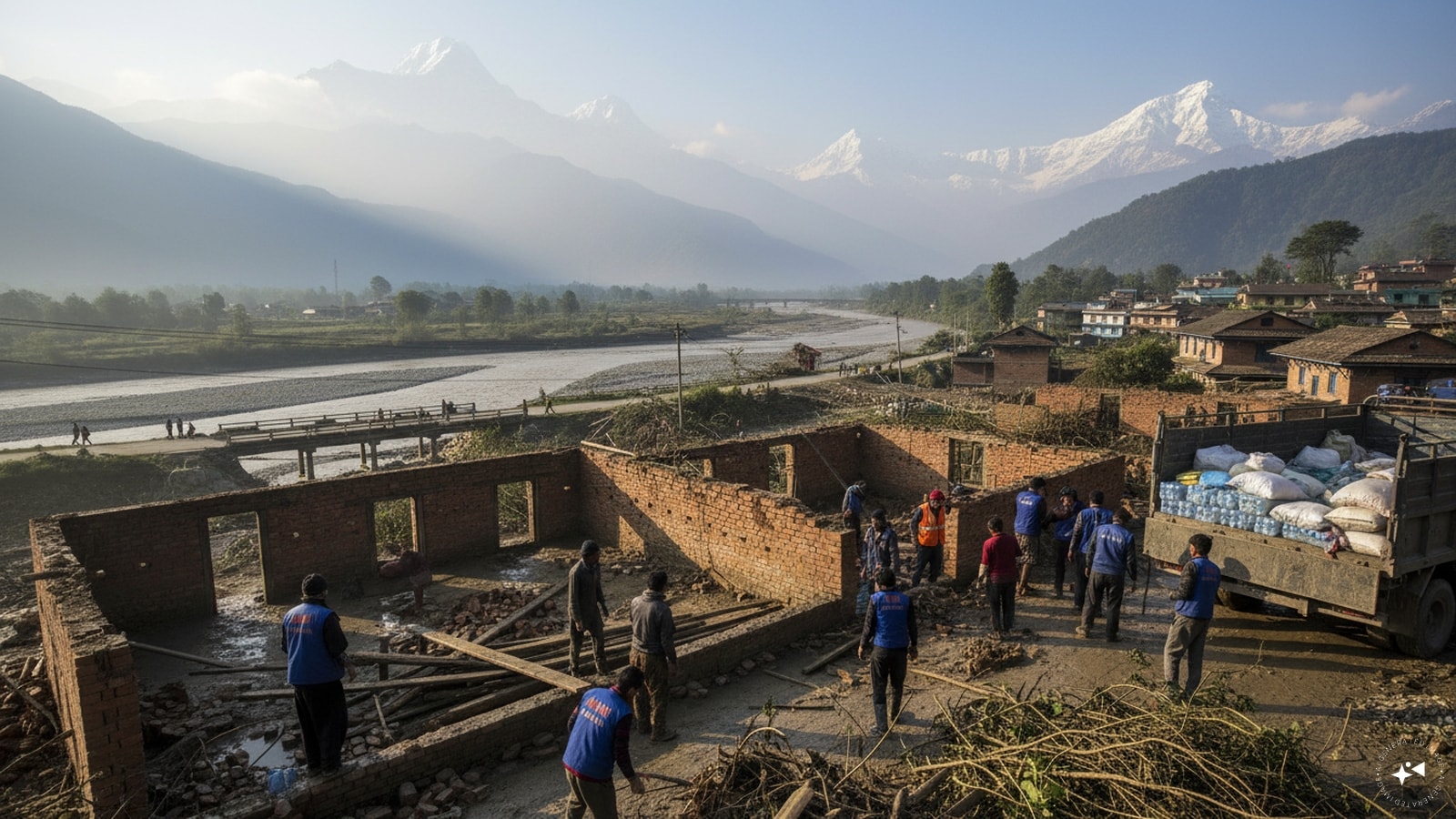
The rain in the mountains does not fall as water; it falls as weight. When a hillside saturated beyond its breaking point finally lets go, it carries with it centuries of stone, the roots of ancient pines, and the quiet lives of people who trusted the earth to stay put.
In Nepal, the monsoon is an old acquaintance, but lately, it has turned violent. It arrives with a roar that rattles corrugated iron roofs, turning dry riverbeds into churning rivers of slate-grey slurry. And then, just as quickly as it began, the sky clears. The sun burns down with an unforgiving, blinding heat on a landscape that has been rearranged overnight.
This is the exact moment the cameras leave.
Helicopters with spinning rotors that kick up dust and hope in equal measure lift off for the last time. Megaphones fall silent. The frantic scraping of bare hands against wet earth—searching for the distinctive blue of a jacket or the familiar corner of a doorway—stops. The search and rescue phase is officially over.
What remains is a quiet so heavy it feels physical.
Consider what happens next for a family standing where their living room used to be. There is no door to knock on. There is no address. There is only a flat, grey expanse of silt that smells of rot and wet stone. Officially, the government has transitioned its focus from rescue to rehabilitation. In the language of policy papers and press briefings, this is a logical progression. It is a shift from emergency response to long-term recovery.
Translation is required here, because cold policy language masks a raw human vulnerability.
Rehabilitation, in the wake of a devastating flood, does not mean handing out blueprints and bags of cement. It means staring down the barrel of an invisible crisis. How do you rebuild a livelihood when the topsoil that grew your rice is currently sitting three miles downstream, clogging a gorge? How do you send children back to school when the schoolhouse is now a tomb of mud?
To understand the scale of what Nepal faces now, you have to look beyond the casualty counts that flashed across international news screens for forty-eight hours. Those numbers are the scream; what follows is the long, exhausting silence.
Disaster relief operates on adrenaline. It is fueled by sirens, international aid packages, and the desperate, beautiful instinct of neighbors digging neighbors out of the ruins. But rehabilitation is bureaucratic, slow, and chronically underfunded. It is the art of stitching a shattered community back together using thread that keeps snapping.
Take, for instance, the logistics of displacement. Temporary shelters are erected, tarpaulins snap in the wind, and communal water points become breeding grounds for waterborne illness. The immediate threat of drowning gives way to the insidious, quieter threats of dysentery, infected wounds left untreated, and the deep, fracturing weight of psychological trauma.
A farmer named Ramesh, whose story echoes a thousand others across the valleys of Sindhupalchowk and beyond, sat on an overturned plastic crate last week, staring at a patch of ground where his orchard used to thrive. He wasn't crying. People who have survived Himalayan floods past the point of tears rarely cry. He was calculating. He was calculating the cost of a bag of fertilizer against the zero rupees sitting in his pocket.
"They tell us we will get support to rebuild," he said, gesturing vaguely toward the horizon where the river had carved a new, wider bed through his property. "But support doesn't bring back the trees that took twenty years to grow. You cannot eat a promise."
This is the paradox of post-flood rehabilitation. The state arrives with forms to fill out, damage assessments to verify, and relief quotas to distribute. Every single piece of paper is necessary. Every bureaucratic check is designed to ensure fairness in a country where resources are heartbreakingly scarce. Yet, to a man who lost his entire world in ten minutes, the endless waiting feels like a second disaster.
The geography of Nepal makes this a uniquely cruel puzzle. Nestled in the folds of the highest mountains on earth, infrastructure is fragile even on a good day. A single monsoon can sever arterial highways, collapse suspension bridges that serve as the only lifelines between isolated villages, and isolate communities for weeks. When the heavy machinery cannot reach the valley floor because the road has slid down the mountain, rehabilitation becomes an exercise in human endurance. Bags of rice are carried on backs. Tin sheets are hauled up steep mule tracks by men and women whose legs burn with fatigue.
We talk about climate resilience as if it were a technical upgrade, a matter of building higher walls or planting smarter crops. But true resilience is psychological before it is structural. It is the stubborn refusal of a community to pack up and leave their ancestral valleys for the crowded, unforgiving slums of Kathmandu. It is the elderly grandmother who sits outside her ruined home, sweeping away the fresh silt that trickles in with every afternoon shower, refusing to let the mountain win.
When the rescue teams pack up their gear and board the flights home, the real work begins. It is unglamorous work. It happens in dim administrative offices where officials debate compensation payouts, and on sun-baked riverbanks where calloused hands hoist timber into place.
The floodwaters recede. The news cycle moves on to the next earthquake, the next election, the next global tremor. But in the shadow of the peaks, the people of Nepal remain, picking up stones that do not belong to them, measuring out the distance between what was and what is left, and quietly refusing to let the story end in the mud.