Smoke smells different at six thousand feet.
It does not carry the familiar, greasy tang of a neighborhood house fire or the sharp, chemical bite of burning asphalt. High in the Bavarian Alps, where the air is thin enough to make your lungs ache after twenty paces, woodsmoke smells ancient. It smells like resin, damp limestone, and things that were never meant to burn.
For decades, I have walked the high trails above Berchtesgaden, watching the way tourists behave when they step out of the brass-lined elevator at the top of the Kehlstein. They come out into the blinding Alpine glare expecting to feel something monumental. Instead, they mostly look confused. They take a selfie in front of the red marble fireplace—a gift from Benito Mussolini—buy a postcard, and complain about the price of the bratwurst.
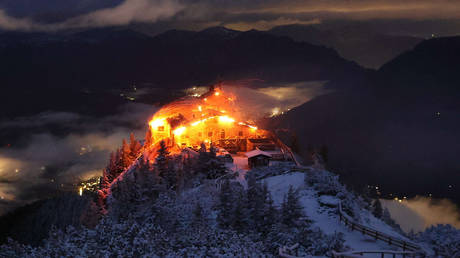
Now, picture that familiar gray stone structure, the Kehlsteinhaus, known to the world as Hitler’s Eagle’s Nest, caught in the orange grip of an inferno.
Wait. Stop right there. Let us separate the smoke from the spark before we go a single step further.
The headline making the rounds across the internet claims that a catastrophic fire has destroyed Hitler’s infamous mountain retreat. It is the kind of headline engineered to make your thumb stop scrolling, a neat little package of poetic justice delivered straight to your morning feed. Evil monument burns to the ground. History cleans up after itself.
Except, as anyone who has ever stood on the wind-scoured ridge of the Kehlstein knows, the truth is far messier, far weirder, and infinitely more revealing about who we are than a simple news alert could ever capture.
The Anatomy of a Rumor in the Alps
To understand why a story about fire destroying the Eagle’s Nest catches on so effortlessly, you first have to understand what actually happened—and what gets lost in translation between a Bavarian valley and a smartphone screen ten thousand miles away.
Over the years, fires have torn through the Obersalzberg, the sprawling mountain complex below the peak. Most famously, in April 1945, Allied Lancaster bombers rained thousands of tons of explosives onto the Berghof, Hitler’s actual residence further down the slope, turning his panoramic window and private living quarters into a smoldering crater. Days later, retreating SS troops torched what remained to keep it out of enemy hands. Decades later, smaller fires and structural emergencies have periodically threatened the historic buildings scattered across the Berchtesgaden basin, sparking frantic local headlines that inevitably mutate, through the telephone game of global aggregation, into a single, sensational claim: The Eagle’s Nest is gone.
Let us examine a hypothetical scenario to see how this happens in real time.
Imagine a night watchman—let us call him Lukas—making his rounds near the lower timberline of the Obersalzberg on a freezing Tuesday in November. The tourist season is dead. The yellow buses that ferry hundreds of thousands of visitors up the sheer, four-mile mountain road are parked in their winter garages. Lukas sees an orange glow flickering through the larch trees near one of the surviving auxiliary structures or the historic mountain lodges below the summit. He calls the Freiwillige Feuerwehr, the local volunteer fire brigade. Within twenty minutes, sirens are echoing off the sheer limestone face of the Watzmann mountain across the valley.
By dawn, local German news outlets run a straightforward, accurate report: a fire has damaged a historic building on the Obersalzberg, the site of Hitler’s former mountain compound.
By noon, an editor in London or New York—working fast, chasing clicks, blurry-eyed on their third cup of coffee—sees the words fire, Hitler, and mountain retreat. They conflate the Berghof, the auxiliary lodges, and the Kehlsteinhaus itself. They hit publish.
And just like that, in the collective imagination of the internet, the Eagle’s Nest burns down.
Why We Desperately Want the Stone to Burn
Why do we fall for it every single time?
Because stone is stubborn, and human beings hate unfinished stories.
I remember the first time I stood inside the great octagonal room of the Kehlsteinhaus. It was a Tuesday in late September, and a thick bank of fog had swallowed the mountain whole. You could not see the jagged peaks of Austria three miles away. You could not see the emerald ribbon of the Königssee far below. There was only the gray mist pressing against the glass and the heavy, oppressive silence of the granite walls.
I felt a deep, unsettling nausea that had nothing to do with the altitude.
You expect a place tied to the architecture of genocide to look sinister. You expect gargoyles, iron spikes, and dark, dripping corridors. Instead, the Eagle’s Nest looks like an upscale hunting lodge designed by someone with too much money and zero imagination. The timber ceilings are warm. The stonework is impeccable, fitted together by Italian masons who risked their lives hanging from ropes over sheer thousand-foot drops.
Martin Bormann, Hitler’s private secretary, poured an astronomical sum—roughly 30 million Reichsmarks, the equivalent of well over 150 million dollars today—into building this teahouse for Hitler’s fiftieth birthday. Thirteen months of frantic, round-the-clock labor. Men died blasting the 400-foot tunnel into the living rock just so the dictator could ride a brass elevator to the summit without catching a chill.
And here is the punchline that history left behind: Hitler hated it.
He was terrified of heights. He suffered from claustrophobia in the elevator. The thin mountain air gave him dizzy spells and headaches. Between its completion in 1938 and the end of the war, Adolf Hitler visited the Eagle’s Nest roughly fourteen times, often staying for less than an hour, nervously sipping weak tea while Bormann tried to impress visiting dignitaries with the view.
Think about that.
Twelve men died building a vanity project for a monster who couldn't even stand to be inside it.
When a monument has a backstory that absurd and that tragic, a fire feels like a mercy. A fire feels like punctuation at the end of a sentence that has dragged on for eighty years. If the Eagle’s Nest burns, we don't have to ask ourselves what we are supposed to do with it anymore.
The Heavy Burden of Keeping a Monster’s House
If you want to understand the invisible stakes behind every rumor of the Eagle’s Nest’s destruction, you have to talk to the people who live in its shadow.
For the residents of Berchtesgaden, the Kehlsteinhaus is not a symbol. It is a daily logistical, moral, and financial headache.
After World War II ended in 1945, the American military seized the mountain. Allied soldiers drank stolen champagne in the ruins of the Berghof, posed for photographs on the terrace of the Eagle’s Nest, and looted silver flatware as war trophies. When the Americans finally handed the territory back to the Bavarian state government in the early 1950s, German authorities faced an impossible choice.
They blew up the ruins of the Berghof with explosives in 1952, planting trees over the rubble so it could never become a shrine for neo-Nazis. They demolished the SS barracks. They erased the homes of Hermann Göring and Albert Speer from the mountainside.
Yet when the demolition crews reached the summit of the Kehlstein, they stopped.
Why? Because blowing up a solid granite fortress perched on a knife-edge ridge at 6,017 feet would have triggered massive rockslides, destroying the infrastructure below and scarring the Alpine peak forever. More importantly, the building itself had barely been used by Hitler. Unlike the Berghof, where the invasion of Poland and the Final Solution were actively plotted over coffee and pastries, the Eagle’s Nest was mostly a diplomatic waiting room.
So Bavaria kept it. They handed the management over to a charitable foundation, converted the interior into a mountain restaurant, and poured the proceeds into public welfare projects across the region.
It was a pragmatic, deeply German solution to an intractable problem: turn a monument to tyranny into a cash register for hospitals and schools.
Still, pragmatism does not erase the chill in the air.
The Ghosts in the Brass Elevator
Walk through the tunnel at the base of the summit today, and you will feel the temperature drop twenty degrees in ten steps. Water drips from the unlined granite ceiling. Your footsteps echo off the wet stone.
When you step into the elevator, the brass walls gleam just as they did in 1939. The green leather benches are pristine. An operator in a neat uniform presses a button, and for forty-one seconds, you rise silently through the heart of the mountain.
Every time I have taken that ride, I have watched the faces of the people standing next to me.
There is always a couple from the Midwest looking at their brochure. There is usually a group of teenagers from Munich, quiet and slightly uncomfortable, forced to confront a past their grandparents barely spoke about. And occasionally, you see someone whose eyes linger a little too long on the stonework, someone who came not to learn, but to worship.
That is the tightrope Bavaria walks every single day.
If you tear the building down, you get accused of erasing history—of paving over the crime scene so future generations can pretend it never happened. If you leave it standing, you risk turning the site of unspeakable evil into a theme park with good views and decent apple strudel.
This tension is precisely why the Documentation Center Obersalzberg—a stark, uncompromising museum built further down the mountain—was expanded in recent years. Its curators understood something vital: stone cannot speak for itself. If you leave a beautiful building on top of a breathtaking mountain without context, the beauty wins. The scenery seduces the visitor. You forget about the slave laborers who froze to death building the roads. You forget about the millions of lives extinguished by the men who once toasted their victories on that terrace.
What Actually Happens When History Catches Fire
Let us return to the image of the flames.
Suppose tomorrow morning, a lightning strike—or an electrical fault in the kitchen, or a careless cigarette tossed into the dry Alpine scrub—actually did engulf the Kehlsteinhaus. Suppose the timber roof collapsed, the red marble cracked in the intense heat, and the brass elevator warped into scrap metal.
What would we lose?
We would lose a piece of architectural engineering that defies the limits of 1930s construction. We would lose a tangible, physical anchor that forces visitors to confront the sheer scale of Nazi vanity—the willingness of a regime to move mountains just to flatter one man’s ego.
It is easy to read about totalitarianism in a textbook. Numbers blur together. Dates become trivia.
It is much harder to ignore totalitarianism when you are standing on a stone terrace bolted to a cliff face, staring down into a valley four thousand feet below, realizing that thousands of men were worked to exhaustion so a dictator could look at the clouds for forty-five minutes.
That physical shock is irreplaceable. You cannot replicate it with a virtual reality headset or a documentary film. You have to feel the wind whipping off the glacier. You have to touch the cold granite with your bare hand.
When a fire destroys a historic site—whether it is Notre-Dame in Paris, the National Museum of Brazil in Rio, or a disputed relic in the Bavarian Alps—we tend to grieve the objects. We mourn the wood, the glass, and the stone.
Yet the real casualty of any fire at a place like the Eagle’s Nest is not the building itself. It is our ability to verify the truth with our own eyes.
We live in an era where history is constantly being edited, softened, or rewritten to fit whatever narrative happens to be convenient this week. Conspiracy theories thrive in empty spaces. When the physical evidence disappears, the deniers move in. They claim it wasn't that bad. They claim it wasn't that big. They claim it never happened at all.
Standing on the Edge of the Ridge
I remember one particular afternoon on the Kehlstein, just before the last bus departed for the valley.
The crowds had thinned out. The souvenir shop was pulling down its metal shutters. A sudden autumn squall blew across the ridge, driving sleet sideways against the stone walls, and then, just as abruptly, the clouds parted.
The late afternoon sun broke through the gray ceiling like a spotlight, illuminating the entire Berchtesgaden valley in sharp, merciless clarity. You could see the white church steeples in the town below. You could see the winding scar of the mountain road clinging to the cliffside. You could see the exact spot in the forest where the Berghof used to stand, now completely swallowed by dark green pines.
I stood next to an older man from Vienna who had been leaning against the low stone parapet for nearly an hour without saying a word. His hands were tucked deep into the pockets of a worn wool coat.
"People come up here looking for monsters," he said quietly, his voice barely audible over the wind. "They want to see horns and claws."
He tapped the granite wall with his knuckles.
"All they find is rock. The monsters were never in the stone. They were in the people who thought they owned the sky."
He turned and walked back toward the tunnel, leaving me alone on the terrace as the shadows stretched across the valley floor.
Fire can melt brass. It can crack marble. It can reduce centuries of timber and labor to gray ash carried away on the mountain wind.
It cannot burn away a warning. And as long as that stone house clings to the edge of the Kehlstein, cold and stubborn against the Bavarian sky, it will keep asking the only question that actually matters: what are we willing to build, and who are we willing to destroy, just to feel like we are standing on top of the world?