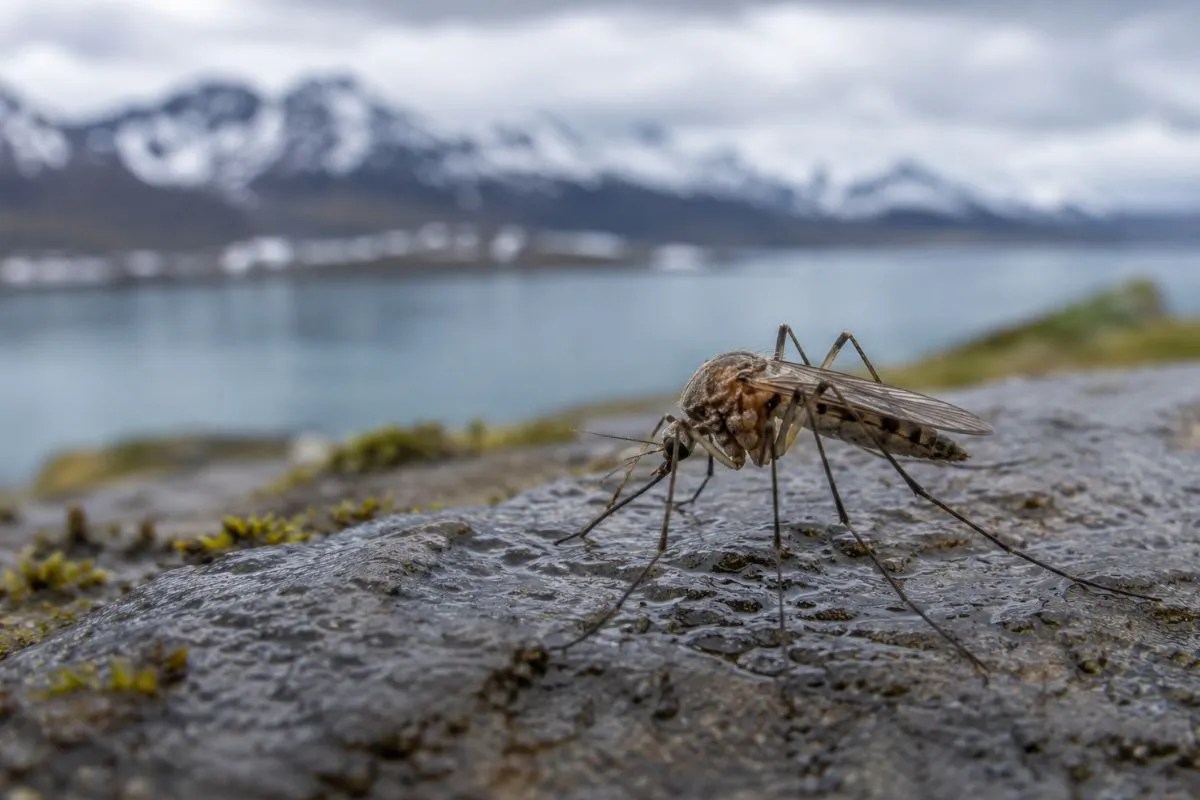
The headlines are screaming again. "Iceland Has Mosquitoes!" "The Arctic is Melting!" The narrative is so predictable it feels scripted. Journalists see a single insect in Reykjavik and suddenly the horsemen of the apocalypse are saddling up. They want you to believe that a few buzzing wings in the North Atlantic are the definitive proof of a planetary collapse.
They are wrong. Not because the climate isn't shifting—it clearly is—but because their obsession with "indicator species" like mosquitoes is a lazy proxy for actual ecological understanding. This isn't a story about a dying planet. It’s a story about biological inevitability, human hubris, and the desperate need for a better headline.
The Lazy Consensus of the Mosquito Metric
The standard argument goes like this: Iceland has been mosquito-free for centuries because its rapid freeze-thaw cycles kill larvae before they can hatch. Now, because of "Global Warming," the barriers are down, and the bloodsuckers are moving in.
This is a middle-school level simplification of a complex thermodynamic system. Iceland’s lack of mosquitoes was never a permanent geographical law; it was a quirk of isolation and specific thermal volatility. To suggest that their arrival is the "ultimate proof" of climate shift ignores the reality of global trade, accidental introduction, and the sheer adaptability of life.
Mosquitoes didn't just wait for a 1-degree shift to cross the ocean. They’ve been trying to get into Iceland since the first Viking longship landed. The fact that they might finally be establishing a foothold says less about the "death of the Arctic" and more about the relentless pressure of invasive biology in a globalized world.
The Thermodynamic Truth About the Arctic
The Arctic isn't "breaking." It’s transitioning.
In the climate alarmist's view, the ecosystem is a glass sculpture—beautiful, static, and once cracked, it’s ruined. This is a fundamental misunderstanding of how the Earth operates. Systems move from one state of equilibrium to another.
If you look at the $E_{balance}$ of the planet, the polar regions act as heat sinks. As the thermal gradient between the equator and the poles narrows, the "weather" as we know it changes. But change is not synonymous with failure. We are witnessing a shift in the $latent\ heat\ of\ fusion$ across massive ice sheets. Yes, ice melts when it gets warmer. This is not a "discovery." It is basic physics.
The real question isn't "Why is the ice melting?" but "Why are we surprised that ecosystems are reacting to it?" Life does not sit around and mourn the loss of permafrost. It colonizes. The mosquito in Iceland is a colonizer. It is the vanguard of a new ecological state. To mourn the "old" Arctic is to indulge in a sentimentalism that nature doesn't share.
The Myth of the "Fixed" Environment
We’ve spent the last fifty years convinced that the 1950s climate was the "correct" one. We’ve benchmarked every biological shift against a tiny slice of Holocene history. This is the ultimate insider fallacy.
I’ve seen billion-dollar ESG funds built on the premise that we can "freeze" the current state of the biosphere. It’s a fool's errand. Even if we hit net-zero tomorrow, the thermal inertia in the oceans ensures that Iceland will continue to warm, and the mosquitoes will keep coming.
The industry obsession with "preventing" change has blinded us to the necessity of managing it. We are so busy crying about a bug in a northern pond that we are failing to build the infrastructure required for a greener, wetter, and yes, buggier north.
Why the "Indicator Species" Argument is Flawed
- Correlation vs. Causation: Just because mosquitoes appear as temperatures rise doesn't mean temperature is the only variable. Changes in shipping routes, aircraft frequency, and even the type of jet fuel used (which affects local atmospheric particulates) play a role.
- Genetic Plasticity: Species evolve. We aren't dealing with the same mosquitoes that existed 200 years ago. We are dealing with organisms that have survived massive chemical onslaughts and urban expansion. They are tougher than your climate models give them credit for.
- The "Silent" Variables: What about the species that aren't moving? If the climate were truly "shifting beyond repair," we would see a uniform northward migration of all temperate species. We don't. We see a chaotic, patchy, and often contradictory movement of life.
The High Cost of Sentimental Science
The competitor's article wants you to feel a sense of dread. Dread is a great way to get clicks, but it's a terrible way to run a planet.
When we frame the arrival of a new species as a "disaster," we trigger a defensive, conservative response. We want to go back. But there is no back. The Arctic is becoming a different version of itself.
Imagine a scenario where the "greening" of the Arctic leads to a massive increase in carbon sequestration through new tundra growth. This isn't a pipe dream; it's a documented phenomenon. But you won't hear about it in the "Mosquito Apocalypse" articles because it complicates the narrative. It suggests that the Earth has feedback loops that we don't fully control or understand.
Stop Watching the Insects, Start Watching the Ice-Albedo
If you want to actually understand what’s happening in the North, stop looking at the bugs and start looking at the $albedo$.
The real engine of change isn't the presence of a mosquito; it's the ratio of reflected to absorbed sunlight.
$$\alpha = \frac{P_{reflected}}{P_{incident}}$$
As $\alpha$ decreases because of receding ice, the system absorbs more energy. This is a runaway feedback loop. It is a mechanical reality. Whether or not a mosquito survives a winter in Akureyri is a footnote to this massive energy transfer.
The media focuses on the mosquito because it's relatable. It bites you. It's annoying. It's "scary." But focusing on the mosquito is like focusing on the hood ornament of a car that’s driving off a cliff. It’s irrelevant to the physics of the crash.
The Insider’s Take: Adaptation Over Panic
I have worked with environmental risk assessors who spent years modeling the "return to baseline." It is a waste of human capital. The baseline is gone.
The real "game" now isn't stopping the mosquitoes; it's figuring out how to live in the world they are moving into. This means:
- Aggressive Genetic Monitoring: Not just for mosquitoes, but for the pathogens they carry.
- Infrastructure Decoupling: Building cities that don't rely on the "stability" of the permafrost.
- Ecological Realism: Accepting that some species will go extinct and others will thrive. This isn't "giving up"; it's recognizing that the biosphere is a dynamic process, not a museum exhibit.
The "lazy consensus" wants you to stay in a state of perpetual shock. Every new bird, every new bug, every new heatwave is treated as a fresh trauma. It’s exhausting and it leads to policy paralysis.
The Brutal Reality
The Arctic is changing faster than the rest of the world. This is not news. It has been the case for decades. The "mosquito entry" into Iceland is a symptom of a process that started long before you bought your first electric car.
The problem with the competitor’s article—and the entire genre of "climate panic" journalism—is that it infantilizes the reader. It presents a world where nature is a fragile victim.
Nature is not a victim. Nature is an opportunist.
The mosquitoes in Iceland aren't a sign that the world is ending. They are a sign that the world is moving on without our permission. They are the first settlers in a new northern frontier. While you're busy mourning the loss of a mosquito-free Iceland, the mosquitoes are busy figuring out how to thrive there.
Stop looking for "signs" of change and start accepting the reality of a state-shift. The Arctic isn't breaking; it's reformatting. If you can't handle a few mosquitoes in Reykjavik, you aren't ready for what comes next.
Build a better house. Buy a better net. The old Arctic is dead, and it's not coming back.
Quit whining about the bugs and start looking at the energy balance. That's where the real story is.