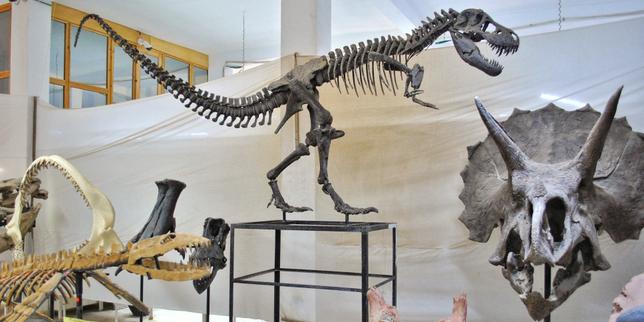
Morocco operates as the primary global node for the extraction and commercialization of prehistoric remains, a sector defined by a decentralized labor force and a centralized international export market. The Kingdom’s unique geological profile—specifically the Kem Kem Group and the phosphate basins near Khouribga—provides a high-density yield of Cretaceous and Devonian specimens. This natural endowment has birthed an informal but highly efficient industrial complex that bridges the gap between artisanal mining and high-net-worth private acquisitions.
The Structural Architecture of the Fossil Market
The Moroccan fossil economy functions through a three-tier vertical integration model.
- The Extraction Tier: Local populations in regions like Erfoud and Midelt engage in manual labor, often using rudimentary tools to navigate the "Red Beds" or the limestone layers of the Anti-Atlas. Their role is purely volumetric; they secure raw material without the specialized knowledge required for scientific preservation.
- The Preparation Tier: This is where value is exponentially added. Specialized workshops use pneumatic air scribes, chemical stabilizers, and micro-blasting to reveal the biological structures trapped within the matrix. The quality of this labor determines whether a specimen sells for $500 or $50,000.
- The Brokerage Tier: Intermediaries manage the logistics of export and the navigation of international customs. These actors possess the network to reach auction houses in Paris, New York, and London, converting Moroccan soil into a global luxury asset.
The Cost Function of Paleontological Extraction
The price of a Moroccan fossil is not a reflection of its scientific rarity alone, but a function of labor-intensive preparation and the risk of damage during transport.
Labor Intensity Variables
The preparation of a Spinosaurus aegyptiacus vertebra or a Zarafasaura skull requires hundreds of hours of painstaking manual work. Because the marginal cost of labor in Morocco is significantly lower than in Europe or North America, the country maintains a competitive moat that prevents other fossil-rich regions from dominating the market.
Authenticity and Restoration Ratios
A critical metric in this business is the "restoration percentage." In the high-volume market, it is common to see composite fossils—specimens where bones from multiple individuals of the same species are combined to create a "complete" skeleton. For instance, a mosasaur skeleton sold to a private collector may be 30% original bone and 70% plaster and resin. The market price correlates directly with the integrity of the specimen, though the lack of standardized certification creates a high degree of information asymmetry between sellers and buyers.
The Regulatory Friction and Scientific Opportunity Cost
Morocco’s Law No. 22-80, which governs the protection of national heritage, remains a point of significant friction. While the law theoretically restricts the export of items with high scientific or historical value, the definition of "scientific value" is sufficiently fluid to allow a massive volume of material to bypass strict scrutiny.
This regulatory ambiguity creates a bifurcation in the market. On one hand, the commercial trade provides a livelihood for thousands of families and funds the discovery of sites that academic paleontologists would otherwise never find due to budget constraints. On the other hand, the "unscientific" extraction methods often result in the loss of stratigraphic data—the context of the soil around the bone—which is often more valuable to researchers than the bone itself.
The Dynamics of Private vs. Public Acquisition
A significant shift in the last decade is the entry of "Investment-Grade Paleontology." High-net-worth individuals now view dinosaur fossils as an alternative asset class, similar to blue-chip art or rare violins. This has decoupled the price of fossils from their educational value. When a Moroccan Carcharodontosaurus skull is auctioned, the bidding is driven by aesthetic impact and rarity as a "prehistoric sculpture," rather than its contribution to the phylogenetic tree.
This commodification creates a "knowledge drain." When a unique specimen enters a private collection, it is effectively removed from the peer-review process. Unlike public museums, private owners are under no obligation to allow scientists to CT-scan or sample their acquisitions. This creates a bottleneck in the understanding of evolutionary biology, specifically regarding the transition of species during the Late Cretaceous period in North Africa.
Mapping the Export Logistics and Custom Arbitrage
The movement of fossils out of Morocco relies on a classification system that often labels specimens as "decorative stones" or "handicrafts." This linguistic maneuver allows for the mass transit of trilobites and orthoceras—which are legally permitted for export—to mask the movement of restricted vertebrate remains.
The primary transit hubs are:
- Casablanca and Tangier: Large-scale shipping containers destined for European distributors.
- Sainte-Marie-aux-Mines (France) and Tucson (USA): The two largest annual mineral and fossil trade shows where the majority of Moroccan wholesale transactions are finalized.
At these hubs, the Moroccan supply chain meets global demand. The Tucson Gem, Mineral & Fossil Showcase alone generates hundreds of millions of dollars in economic impact, with Moroccan vendors occupying a significant portion of the floor space. The revenue generated here rarely trickles back to the original diggers in the Tafilalt region in any meaningful way, as the value-add happens almost entirely at the brokerage and retail levels.
The Risk of Specimen Forgery
As prices rise, the incentive for sophisticated forgery increases. Moroccan artisans have become world-class at "fossil manufacturing." This involves casting real bone fragments in a matrix of crushed rock and glue to simulate a complete, rare discovery.
Detection Mechanisms
- UV Light Analysis: Used to detect the presence of modern glues and resins that fluoresce differently than fossilized bone.
- Solvent Testing: Applying acetone to the surface to see if artificial coloring or "matrix paste" dissolves.
- X-ray/CT Scanning: The only definitive way to see if the internal structure of the bone is consistent throughout the specimen or if it is a "frankenstein" of multiple animals.
The prevalence of these techniques has forced high-end auction houses to employ specialized consultants, further increasing the overhead costs of the trade and consolidating power among a few trusted international dealers.
The Evolution of the Kem Kem Group Economy
The Kem Kem Group in southeastern Morocco is essentially an undersea graveyard from 100 million years ago. It is unique because it represents a "predator-heavy" ecosystem. In most fossil beds, herbivores outnumber carnivores. In the Kem Kem, the opposite appears to be true, making the specimens extracted here—like those of the aquatic Spinosaurus—exceptionally desirable.
The economic reality is that without the commercial market, our understanding of the Kem Kem would be decades behind. The sheer volume of earth moved by commercial diggers provides a massive "sampling size" that academic grants could never fund. However, this creates a paradoxical relationship where the very market that discovers the science also destroys the context necessary to interpret it.
Strategic Transition Toward Sustainable Paleontology
The current model of "extract and export" is a depletion-based economy. To move toward a higher-value, sustainable framework, Morocco would need to internalize the "Experience Economy" of paleontology.
The Institutional Shift
Instead of exporting raw or semi-prepared specimens, the development of world-class museum facilities and "paleo-tourism" in the Tafilalt region would capture the higher-margin revenue currently lost to international auction houses. By keeping high-value specimens in-country and charging for access—both for tourism and for scientific research—the Kingdom could transform a finite mineral resource into a permanent intellectual and economic asset.
The Certification Protocol
Implementing a national database and a blockchain-based "Certificate of Origin" for every vertebrate fossil would collapse the counterfeit market and allow for a transparent tax structure. This would provide the state with the funds needed to employ local diggers as "field technicians" under scientific supervision, rather than as informal miners.
The path forward requires treating the fossil record not as a warehouse of stone to be liquidated, but as a strategic reserve of scientific data. The transition from a commodity-based export model to a service-based research and tourism model is the only way to resolve the tension between local economic survival and global heritage preservation. Those who control the preparation and the provenance will ultimately control the market; currently, that control sits in the hands of European and American middlemen. The strategic play is to move the center of that gravity back to the source.