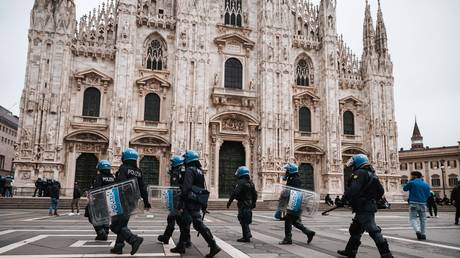
Deploying 500 soldiers into Milan after two days of violent clashes and storefront looting treats a structural economic and policing bottleneck as a perimeter defense problem. Standard wire reports treat the move as a straightforward escalation: riots broke out over the cost of living, luxury boutiques boarded up their windows, dozens or hundreds of officers were injured, and Rome sent troops while drafting tougher public-order penalties. That surface narrative misses the core operational tension. Soldiers can guard static landmarks and transit nodes, yet rioters operate as a decentralized, mobile crowd while public-order police face staffing constraints and soldiers operate with narrower public-order mandates and non-lethal equipment limits.
A rigorous breakdown of the Milan deployment requires separating verified operational facts from educated hypotheses. Known facts include the authorization of 500 additional soldiers to support thousands of police and security personnel in Milan, emergency closures or wooden boarding across high-profile luxury and retail storefronts around the Duomo and fashion district, expanded checks at railway stations and neighborhoods beyond the historic core, and political friction ahead of upcoming national elections over cost-of-living pressures, housing, fuel prices, and public-order legislation. Educated hypotheses involve how long deterrence holds before crowd tactics adapt, how much retail revenue loss stems from preventive closures versus actual property damage, and whether tougher penalties deter first-time or youth participants rather than merely shifting flashpoints across city districts.
The Cost Function of Urban Riot Deterrence
Every urban public-order response operates under a visible cost function where state resources, commercial activity, and political capital trade off against one another. When rioters smash storefronts and clash with police, the immediate cost appears as broken glass, stolen merchandise, and injured officers. The larger cost sits in preventive friction: luxury houses and retailers boarding windows, canceling foot traffic, and absorbing lost sales even on days when violence does not materialize.
A security deployment succeeds only when the marginal deterrence added by each uniformed post exceeds the economic and political drag imposed on the city by visible militarization.
In Milan, the cost function has four main variables that interact rather than add up linearly:
- Deployment density: Sending 500 soldiers adds visible presence, yet Milan spans dense avenues, arcades, transit hubs, and outer neighborhoods that a small reserve cannot saturate simultaneously.
- Equipment and mandate asymmetry: Conventional troops trained for static guard duty or territorial support do not automatically carry the same public-order tools or arrest authority as specialized police units, creating a gap between presence and crowd-control execution.
- Commercial shutdown drag: Boarding up storefronts in high-value retail corridors protects inventory while signaling acute instability to tourists, buyers, and investors.
- Political signaling cost: Tougher anti-riot laws and military deployments project firm state authority ahead of elections, yet heavy-handed optics risk hardening grievance narratives among peaceful demonstrators.
Traditional reporting stops at counting troops and boarded windows. Operational analysis asks what happens when a high-visibility cordon around central luxury streets pushes opportunistic looting two kilometers outward into less guarded commercial strips. Displacement does not erase the cost function; it redistributes it onto smaller merchants with weaker physical defenses.
Three Pillars of the Milan Unrest Mechanism
Standard coverage often lumps protesters, agitators, and looters into a single mass driven vaguely by "anger." Separating the unrest into three structural pillars clarifies why state pushback faces friction.
Economic Grievance as the Mobilization Fuel
Cost-of-living strain—elevated rents, transport and fuel expenses, stagnant real wages, and dim career prospects—supplies the broad social tinder across European cities. When housing and basic essentials squeeze younger cohorts and working households, political legitimacy weakens. Grievance alone rarely dictates where a crowd breaks glass, but it lowers the social threshold for turning out in large numbers when online calls to action circulate.
Opportunistic Looting Inside Mass Demonstrations
Large demonstrations create a classic collective-action shield. Peaceful marchers and political organizers generate crowd volume and media attention, while smaller, faster-moving subgroups exploit police distraction to breach storefronts, grab high-resale goods such as footwear, apparel, and luxury items, and scatter before containment lines form. Treating looting as pure political protest misreads the incentive structure; treating every demonstrator as a looter alienates peaceful citizens and complicates crowd sorting on the street.
Law Enforcement Bottlenecks and Legal Escalation
Police forces carry the frontline burden of containment, arrest processing, and investigation, often under chronic overtime and recruitment strain. Bringing in military personnel relieves static guarding duties around sensitive sites and transit choke points, freeing police units for mobile response. At the same time, introducing new statutory penalties and parental liability rules raises the legal stakes after the fact, though deterrence depends on perceived certainty of identification and arrest during chaotic street encounters.
Consider a practical street scenario during a Saturday demonstration in central Milan. A legal march gathers near a major plaza while smaller black-clad or masked groups probe side streets lined with high-end retail. If police units are tied down holding a static line at one square, fast-moving looters can hit two commercial lanes in minutes and vanish into subway entrances or adjacent blocks. Soldiers stationed at fixed points deter direct attacks on guarded positions, yet catching mobile actors requires rapid intelligence, perimeter coordination, and unobstructed arrest pathways.
Cause-and-Effect Chains Standard Reporting Misses
Competitor articles typically present events as a simple chain: unrest happens, government sends soldiers, order is defended. Four second-order loops complicate that sequence:
- The visibility-versus-displacement loop: Heavy visible guarding around flagship luxury boutiques raises the local risk of hitting prime targets, prompting agile groups to shift toward secondary shopping streets or transit corridors where guards are thinner.
- The closure-and-narrative loop: When major brands board up windows days ahead of a protest, the streetscape visually confirms disorder even before clashes start, feeding both online provocation and diplomatic or investor worry.
- The mandate-and-friction loop: Deploying soldiers without full riot-control tooling or clear urban policing overlap can create hesitation at the moment a crowd fractures, forcing police to bridge the tactical gap anyway.
- The grievance-and-polarization loop: Framing every street clash strictly as a security threat or hybrid subversion without addressing housing and cost-of-living pain can unify moderate protesters with radical fringes against the state.
Operational Playbook for Managing Escalation
Managing a repeat protest cycle requires sequenced execution across intelligence, field deployment, commercial coordination, and policy follow-through rather than a single troop announcement.
- Map target tiers and transit choke points before crowd arrival: Rank commercial corridors by vulnerability and resale value, pair rail and metro station checks with perimeter nodes, and keep a dedicated mobile police reserve unpinned from static posts.
- Define clear division of labor between troops and police: Assign soldiers to static site protection, station perimeters, and visible deterrence where their legal authority and equipment fit cleanly, reserving specialized law enforcement for active crowd dispersal and arrests.
- Coordinate staggered commercial risk controls: Establish clear communication channels with retail associations and municipal officials so shuttering or boarding happens where risk warrants it, avoiding indiscriminate multi-day commercial paralysis across safe blocks.
- Isolate violent actors through rapid identification and targeted enforcement: Use video, transit monitoring, and swift booking pipelines to separate felony property crimes and assaults from peaceful assembly, preserving legal clarity and public credibility.
- Pair near-term order with measurable cost-of-living relief: Treat troop deployment strictly as a temporary containment bridge while advancing concrete housing, wage, or commuter cost measures that shrink the recruitable crowd over coming months.
Limitations and Strategic Risks
No security or legislative measure eliminates urban unrest on its own. Military deployments carry civil-military sensitivities in democratic European capitals, can overstretch defense personnel if prolonged across multiple cities, and do nothing to lower rent or fuel bills. Tougher criminal penalties and parental liability laws may deter some offenders or help prosecutors build cases, yet heavy statutes can also spark legal pushback, court backlogs, or accusations of overreach if applied unevenly. Conversely, relying purely on restraint without rapid containment invites repeat looting that erodes public trust in municipal governance.
The decisive strategic move for policymakers and security planners is to treat the 500-soldier deployment as a time-boxed containment bridge, not a permanent operating model: pair disciplined, clearly bounded police-military coordination on high-risk weekends with rapid post-incident prosecution of looters and tangible economic relief on housing and living costs before the next protest cycle compounds political strain.