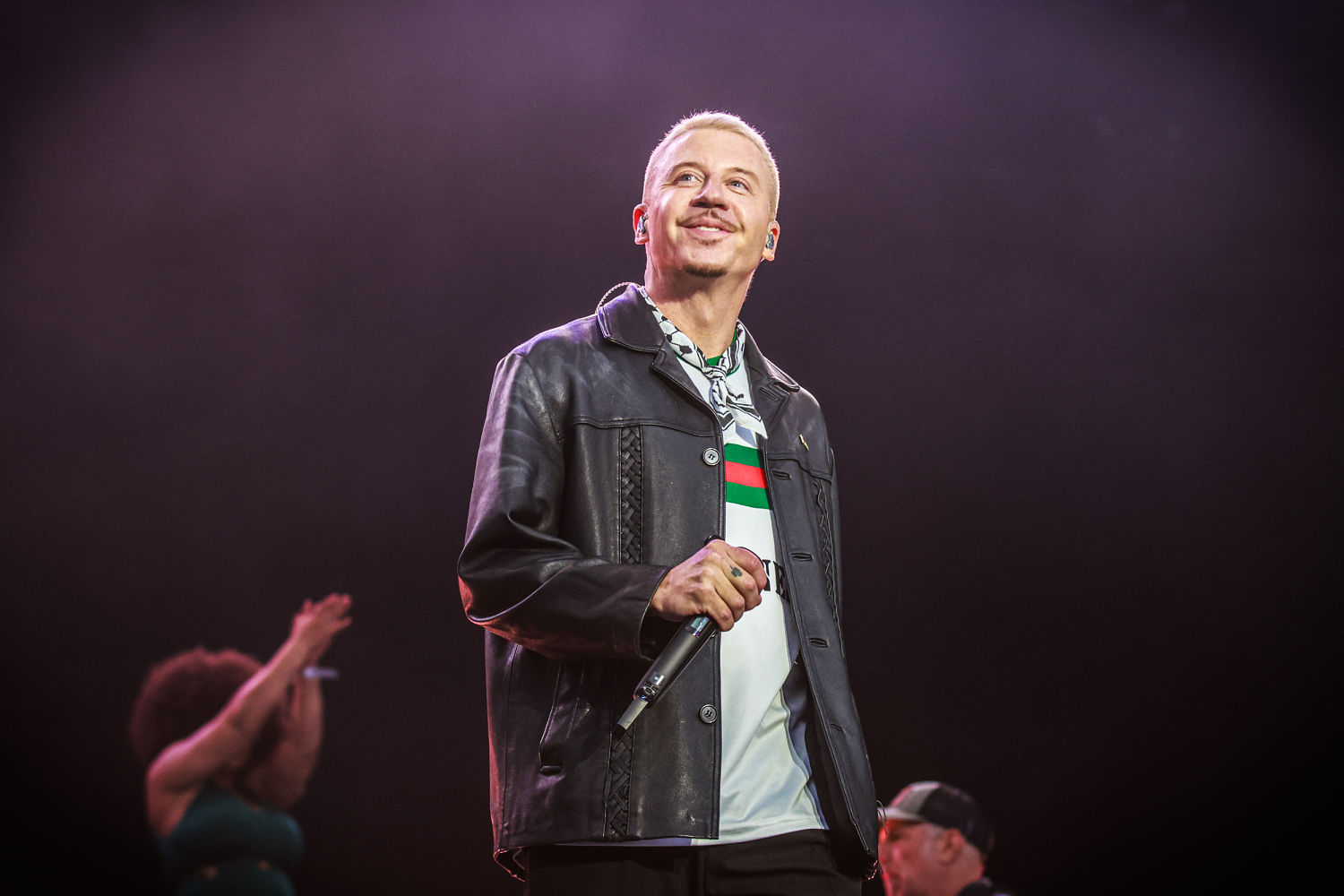
There are arenas where music is meant to be an escape. You step through the concrete tunnels, shedding the noise of rent, traffic, and fractured news cycles, trading them for three minutes of bass that vibrates against your sternum and lyrics you memorized in your bedroom. The lights dip. The crowd surges into a single, breathing organism. For a brief span of hours, the outside world is supposed to stay outside.
Then there are nights when the outside world refuses to wait at the doors.
Benjamin Haggerty knows those nights well. Better known to millions as Macklemore, the Seattle-born rapper built a career not by retreating into the frictionless luxury of modern pop stardom, but by dragging his own flaws, political anxieties, and cultural contradictions directly into the spotlight. He has spent years navigating the strange tightrope of commercial success and moral discomfort. But standing on stage in recent months, the charts and the platinum plaques have begun to feel like background noise against a much louder, more urgent drumbeat.
When an artist with a global platform decides to turn an international concert tour into a deliberate act of public witness, the air in the room changes. It is no longer just about the hook, the beat, or the nostalgia of a mid-2010s radio hit. It is about a microphone being used not to entertain, but to interrupt.
Consider what happens when a crowd of thousands stops dancing and starts listening to something that cannot be neatly resolved in a three-minute track.
For decades, the standard playbook for mainstream musicians faced with geopolitical catastrophe has been remarkably consistent: smile, wave, release a vague statement about peace, and keep the merchandise stands open. Controversy is bad for ticket sales. Neutrality is safe. Corporate sponsorships do not look kindly on artists who disrupt the quarterly revenue projections with moral imperatives. To speak out on a partitioned, burning world is to invite a storm of backlash, tour cancellations, and industry blacklisting.
Yet, a tectonic shift is underway in how artists perceive their own utility. When Macklemore announced his upcoming tour dates centered around the explicit banner of a Free Palestine tour—directing proceeds to humanitarian relief and using his physical presence to amplify a cause that governments and media conglomerates often sanitize or ignore—he broke the unwritten contract of pop music compliance.
He did not invent this lineage, of course. From Harry Belafonte singing civil rights anthems to Sinead O'Connor tearing up a photograph on live television, popular culture has always possessed a volatile fringe of performers who realized that a stadium full of screaming fans is an amplifier of conscience. But doing so in the hyper-fragmented, algorithmically policed attention economy of the current decade carries a different weight. Every lyric, every interview snippet, and every ticket sold is instantly fed into a meat grinder of digital outrage, corporate risk management, and intense ideological warfare.
Why take the risk?
To understand that, you have to look past the marquee lights and into the quiet rooms where artists grapple with the surreal nature of their own existence. Imagine sitting backstage in a European arena, scrolling through high-definition footage of devastation thousands of miles away—rubble that used to be a bakery, children holding scraps of notebooks in dusty hospital wards—and then walking out onto a hydraulic lift to perform a lighthearted party track. The cognitive dissonance is staggering. For many modern creators, the traditional insulation of wealth and fame has begun to feel less like a shield and more like a cage.
Macklemore’s recent musical interventions, including his track "Hinds Hall," served as a bellwether for this internal reckoning. Named after the administration building occupied by student protesters at Columbia University, the song was an unfiltered dispatch of rage, solidarity, and frustration with institutional hypocrisy. He didn't drop it through a traditional major-label PR rollout designed to maximize streaming revenue; he released it independently, pledging all profits to the United Nations Relief and Works Agency (UNRWA).
When an artist bypasses the boardroom calculus to speak directly to an audience about human suffering, it disrupts the entire ecosystem of celebrity culture. It forces fans to confront a difficult question: Can you truly separate the art from the atrocity happening outside the concert hall?
The tour announcement is the logical extension of that impulse. It transforms a transient digital protest into a physical, moving infrastructure of solidarity. Concert venues are rented. Tickets are printed. Sound checks are run. But instead of the usual machinery of consumerist escapism, these spaces are consciously repurposed as town halls for global empathy.
Critics, naturally, rush to dismantle these efforts. They label them performative, naive, or politically inconvenient. They argue that a rapper from the Pacific Northwest has no business wading into centuries-old geopolitical conflicts. They point to the inevitable contradictions of a wealthy entertainer engaging in political activism while benefiting from the very capitalist structures they critique.
These are fair observations, up to a point. No human being is a monolith of purity, and the music industry is an empire built on exploitation. But dismissing an artist's public stance purely because they are imperfect misses the entire mechanism of cultural momentum. Change has never been driven by spotless icons; it is pushed forward by flawed individuals who decide that their discomfort matters less than the suffering of others.
When a public figure with millions of followers uses their reach to redirect millions of eyes toward a humanitarian crisis, the calculus of public awareness shifts. It breaks through the numbing fatigue of the 24-hour news cycle. It reaches teenagers in suburban towns who might never open a foreign policy journal, but who will listen to a thirty-second clip of their favorite artist talking about human rights on TikTok.
We live in an era characterized by a profound sense of powerlessness. People feel trapped inside economic systems they cannot control, voting for political options that feel hollow, and watching distant human tragedies unfold on glass screens in the palms of their hands with a sickening sense of inevitability. In that environment, the sight of someone standing on a massive stage—possessing everything the world tells us we should want—and willingly risking it all to say this is wrong acts as a strange kind of psychological defibrillator.
It reminds us that speech still has a cost, and therefore, it still has value.
The lights will go down in these arenas. The bass will rattle the floorboards. The crowds will raise their hands in unison, unified not just by a catchy rhythm, but by a shared acknowledgment of a breaking world. And somewhere in the dark, beneath the glare of the spotlights, the old illusion that art can remain neutral will quietly dissolve into the night.


