The announcement by New York City Mayor Zohran Mamdani of a $50 World Cup ticket lottery represents a textbook municipal intervention into an aggressively pricing global marketplace. By securing 1,000 tickets across seven matches at MetLife Stadium and subsidizing transit, the administration seeks to insulate a fraction of the local working class from market forces. While framed as a victory for civic accessibility, the initiative operates on a scale so statistically marginal that it serves primarily as a rhetorical critique of mega-event extraction rather than a structural solution to urban exclusion.
To evaluate the mechanical reality of this policy, one must look past the political theater and dissect the friction between localized command-and-control distribution and globalized, dynamic demand pricing. Meanwhile, you can find similar events here: The Anatomy of Execution Why New York Distanced Cleveland in Game Five.
The Friction Function of Price Versus Allocation
The primary tension of the 2026 FIFA World Cup ticketing ecosystem is driven by dynamic pricing, a mechanism designed to extract the maximum consumer surplus by adjusting ticket costs in real-time based on velocity and demand. Within this framework, secondary market floor prices for group-stage matches at MetLife Stadium sit at approximately $553, while the high-demand final commands thousands.
The municipal intervention attempts to establish a parallel, artificial economy. By fixing the ticket price at $50 for 1,000 select inventory units, the city creates a massive arbitrage gap. The market value of the asset and its state-mandated price diverge by an order of magnitude. To understand the bigger picture, check out the detailed article by Sky Sports.
[Market Price: ~$553] <--- Arbitrage Gap ---> [Subsidized Price: $50]
To prevent this value from being immediately captured by commercial scalpers, the city must implement highly restrictive operational barriers. This dynamic can be expressed as an inverse relationship: when a state actor artificially suppresses price, it must exponentially increase administrative friction to maintain the intended distribution.
The city’s anti-arbitrage framework relies on three distinct operational chokepoints:
- Identity and Financial Verification: Winners face arbitrary audit vectors requiring proof of residency through official identification, lease agreements, utility bills, or pay stubs.
- Non-Transferability Protocols: Digital ticketing infrastructure is bypassed or restricted; tickets are tied explicitly to the verified lottery winner's identity.
- Physical Custody Chains: In a deliberate move to eliminate secondary market listing windows, physical tickets are withheld until the day of the match, distributed in person only at the municipal bus terminal immediately prior to boarding.
This logistical friction functions as a non-monetary tax. The working-class resident pays $50 in capital but incurs a heavy cost in temporal investment, administrative compliance, and rigid scheduling.
The Lottery Geometry: Supply Compression and Mathematical Improbability
The political rhetoric surrounding the program positions it as an engine of broad working-class inclusion. However, a structural analysis of the supply-and-demand metrics reveals a stark mathematical bottleneck.
New York City possesses a population exceeding 8 million residents. The lottery allows up to 50,000 entries per day over a six-day window, creating a theoretical pool of hundreds of thousands of applicants. Across the seven eligible matches—comprising five group-stage fixtures and two early knockout rounds—the total inventory is capped at 1,000 tickets, or roughly 150 tickets per match.
Evaluating this inventory against MetLife Stadium's 82,000-seat capacity illustrates the marginal nature of the intervention:
$$Inventory\ Share = \frac{150}{82,000} \approx 0.18%$$
Per match, the municipal allocation accounts for less than one-fifth of one percent of the stadium seats. Assuming a conservative total pool of 200,000 unique applicants competing for the 500 winning slots (given that each winner can purchase up to two tickets), individual probability of selection scales downward toward $0.25%$.
This is not systemic access; it is an institutional raffle. The framework does not scale because it does not alter the underlying economics of the event. It merely reallocates a rounding error of total stadium inventory to serve as a high-visibility proof of concept for municipal socialism.
Transit Subsidization and Infrastructure Arbitrage
A critical but frequently overlooked component of the Mamdani initiative is the integration of free round-trip bus transit. Mega-event pricing strategies extend far beyond the gate admission; they encompass the entire transit corridor. In the lead-up to the tournament, transit costs within the Tri-State area became highly volatile. New Jersey Transit initially projected special event rail return fares from Penn Station to MetLife Stadium at $150—a massive surge from the standard $13 commuter fare—before public pushback forced a recalibration to $105. Parallel charter bus operations stabilized at roughly $80 for a round trip.
By absorbing the transit cost, the city eliminates a regressive logistics tax that would otherwise neutralize the ticket subsidy. For a working-class fan, an un-subsidized $50 ticket paired with a $105 train fare yields a total cost of $155, radically altering the affordability equation for a low-income household.
The city’s deployment of dedicated bus transport from a centralized municipal terminal bypasses regional rail premiums. This represents an effective deployment of logistical infrastructure to shield citizens from surge-priced regional transit networks. However, because this benefit is bound exclusively to the 1,000 lottery winners, it functions as an isolated sanctuary rather than a broad regulatory cap on transit gouging during the tournament.
The Host Committee Mechanism and Municipal Leverage Constraints
A critical structural detail of the program is its institutional origin. The $50 tickets do not emerge from concessions granted by FIFA via its centralized ticketing operations. Instead, they are drawn from inventory allocations held by the New York/New Jersey Host Committee.
This distinction illuminates the structural limitations of municipal leverage against global sporting monopolies. During the campaign cycle, the administration pressured FIFA to mandate a 15% flat inventory reservation for local residents and to abandon dynamic pricing entirely. FIFA systematically ignored these demands. The governing body maintains a strict revenue-maximization mandate, relying on host committees to manage localized political fallout.
Because host committees are reliant on municipal cooperation for policing, sanitation, permitting, and public space usage, they possess a finite pool of localized assets—including VIP allocations, sponsor tickets, and internal inventory—that can be bargained away. The 1,000 tickets secured by the city represent the maximum concession extractable through local horse-trading, rather than a fundamental shift in FIFA's corporate ticketing policy. The global soccer governance model remains completely insulated from local democratic pressure; it merely permits local politicians to repurpose a micro-fraction of host-committee inventory to mitigate domestic dissent.
The Atmospheric Value of De-Commoditizing the Stands
While the economic scale of the intervention is small, its implications for stadium atmosphere and fan topography are real. In modern sports analytics, a direct correlation exists between hyper-commoditized ticket distribution and the sanitization of stadium atmosphere. When tickets are distributed exclusively via maximum-bid algorithms and corporate hospitality tranches, the demographic of the stadium shifts toward corporate clients and affluent tourists.
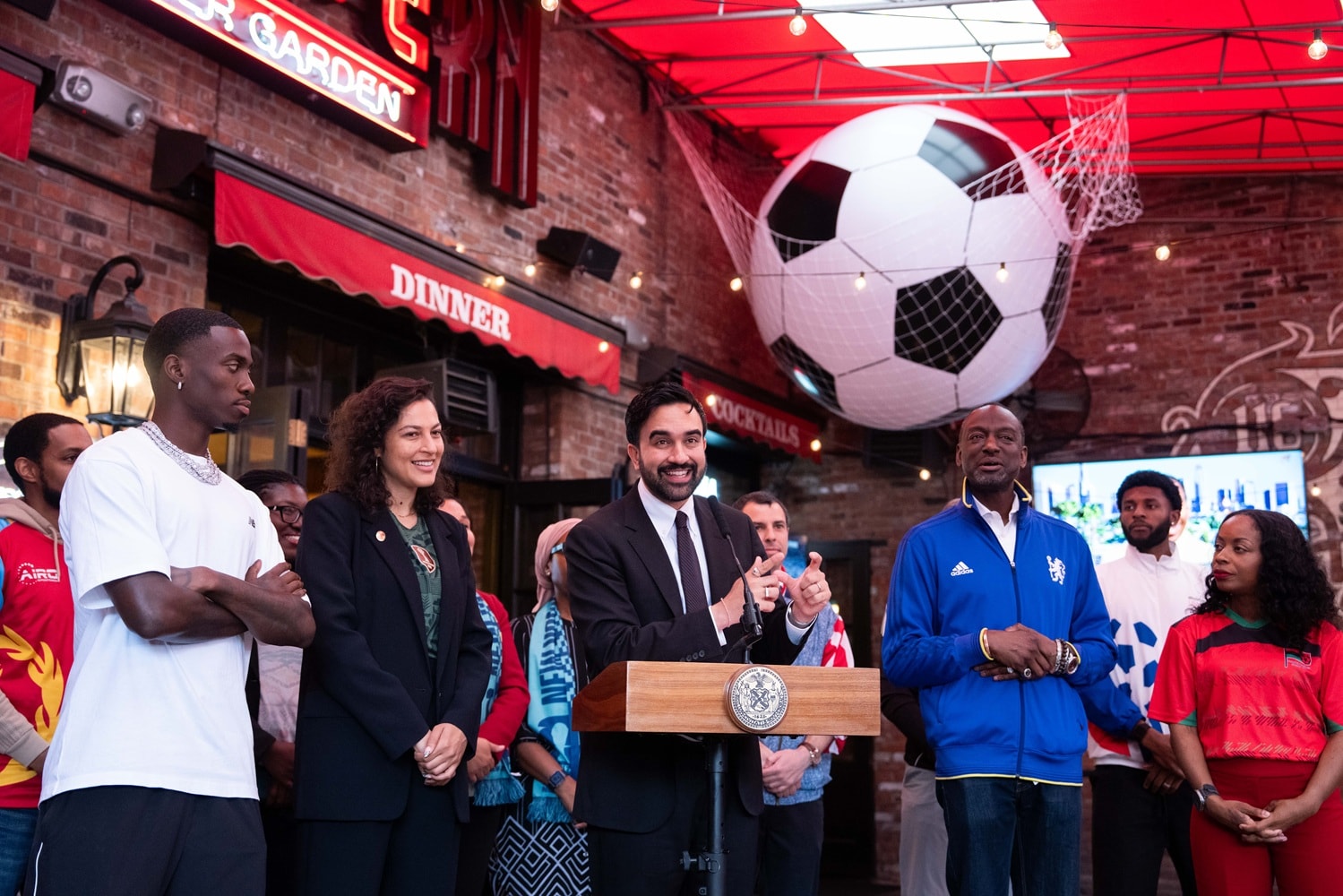
This creates an atmospheric bottleneck. The most passionate fan bases are frequently concentrated within working-class immigrant communities—exemplified by the selection of Harlem’s Little Senegal as the location for the mayor's announcement. By carving out a non-market enclave within the upper tier of MetLife Stadium, the city injects a highly concentrated group of dedicated local supporters into an otherwise commercialized corporate bowl.
The strategic limitation is spatial segregation. By clustering these 150 subsidized fans per game inside the upper bowl, the intervention establishes a socio-economic stratification within the stadium itself. The lower and mid-tier bowls remain the exclusive domain of international capital and corporate sponsors, while civic equity is confined to the literal periphery of the venue.
Strategic Operational Playbook
For municipal leaders seeking to replicate or scale this framework in future mega-events, relying on nominal host-committee inventory hand-outs is a losing strategy. To achieve systemic equity, cities must deploy their regulatory and infrastructural leverage long before the ticketing phase begins.
Municipalities should establish a strict three-part operational playbook during the initial venue bidding phase:
- Infrastructural Permitting Linkage: Cities must condition the use of public parks, fan zones, and municipal transit expansions on a legally binding, fixed-price ticket tier. This tier must represent a minimum of 5% of total stadium inventory, managed directly by the city's housing or human resources administration to guarantee local, income-verified distribution.
- Surge Fencing on Public Transit: Local transit authorities must institute absolute price ceilings on public rail and bus corridors serving the venue. Elevating commuter fares by 800% for event days undercuts the regional economy and functions as an unhedged tax on transit workers.
- Taxation on Secondary Arbitrage: Implement a localized municipal luxury tax on all secondary market ticket transactions occurring within city limits that exceed 150% of face value. The revenue generated from this tax should automatically flow into a dedicated fund to finance free public viewings, municipal youth sports infrastructure, and public transit subsidies for the duration of the event.