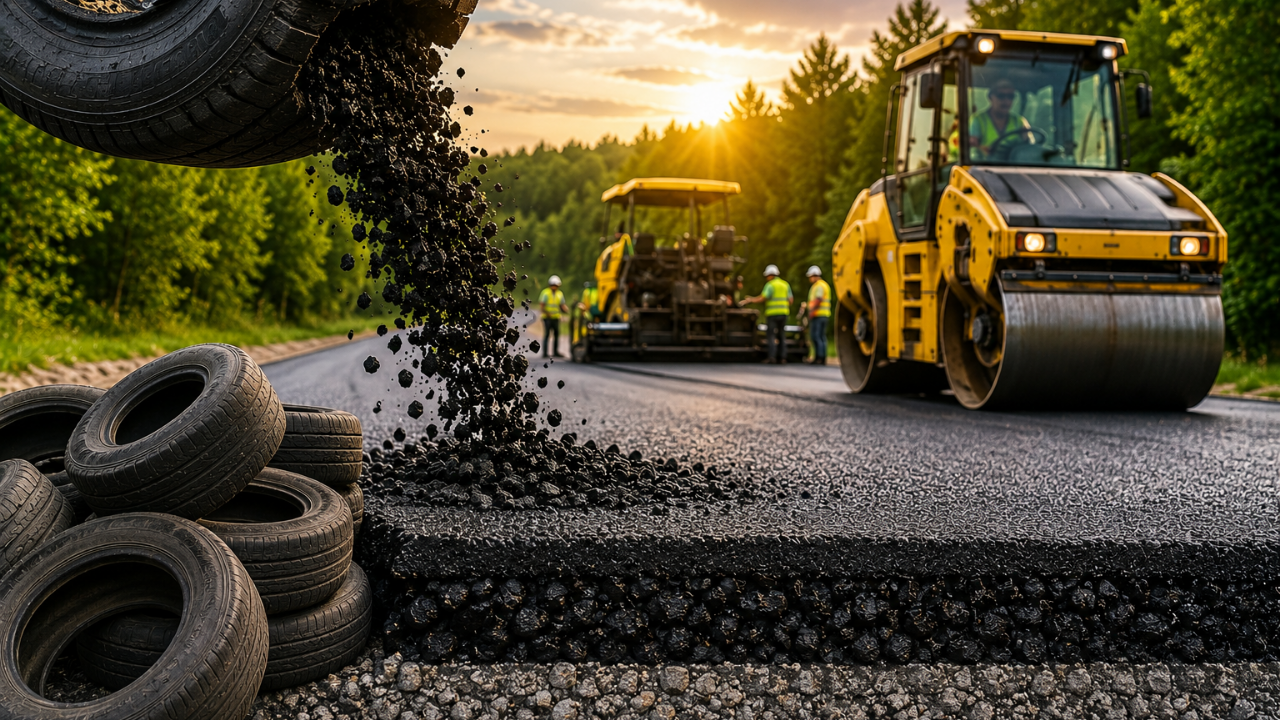
What happens to millions of old vehicle tires when they are completely worn out? Most people don't think about it, but they usually pile up in landfills or create massive disposal nightmares. Michigan decided to tackle this problem head-on by burying old rubber right under our daily commutes.
On a 0.8-mile stretch of Ellsworth Road in Pittsfield Township, workers laid down a special mix of asphalt containing more than 7,000 recycled scrap tires. It wasn't just a quirky environmental stunt. In June 2026, that exact project earned the National Asphalt Pavement Association's Quality in Construction Award in the Green Category.
Let's look at how this works, why civil engineers are paying close attention, and what it means for local infrastructure.
The Problem With Traditional Pavements
Asphalt takes a massive beating. Between heavy freight trucks, freezing winter freeze-thaw cycles, and blistering summer heat, standard roads crack, rut, and crumble within years. Fixing them costs local governments millions of dollars annually.
Meanwhile, scrap tires pile up by the millions. Discarded tires trap rainwater, attract mosquitoes, and pose severe fire hazards if they catch flame. Traditional disposal options offer limited utility. Throwing them away is a waste of a remarkably resilient material.
Rubber doesn't give up easily. It is flexible, tough, and engineered to withstand intense friction. Engineers figured out that if rubber can handle thousands of miles of high-speed friction on asphalt, it might just handle life inside the asphalt itself.
How Ellsworth Road Changed the Equation
The Washtenaw County Road Commission partnered with Michigan Technological University and the Michigan Department of Environment, Great Lakes, and Energy (EGLE) to test a better approach. They didn't just dump whole tires into the dirt. That would ruin the structural integrity of the road.
Instead, specialized processors shredded the scrap tires, stripped out the steel belts, and ground the remaining rubber down into fine crumb rubber and granules. Contractors like Cadillac Asphalt mixed this clean tire powder directly into the hot-mix asphalt.
The project spanned roughly 0.8 miles of Ellsworth Road between the I-94 bridge and Carpenter Road. Crucially, the project team used traditional asphalt on an adjacent section of the exact same road. This created a real-world control group. Engineers can now directly compare how the rubber-modified pavement holds up against standard mix under the exact same daily traffic load of nearly 20,000 vehicles.
The Real Benefits of Rubberized Asphalt
Why bother modifying hot-mix asphalt with ground rubber at all? Honestly, the performance data speaks for itself.
- Crack resistance: Rubber flexes. When heavy trucks roll over the surface, the asphalt absorbs the stress and bounces back instead of fracturing.
- Rutting reduction: Summer heat causes standard asphalt to soften and rut under heavy tires. Rubber raises the melting threshold and maintains structural stiffness.
- Waste diversion: Tossing thousands of tires into a single road project clears out localized stockpiles and keeps useful polymers out of landfills.
It isn't a silver bullet for every single road budget constraint. Rubberized hot-mix asphalt can carry a slightly higher upfront material cost than conventional mixes. Yet, when you factor in extended pavement life cycles and fewer emergency pothole patches over a ten-year span, the math starts to look entirely different.
Moving Past the Gimmick Phase
For years, green infrastructure projects faced skepticism because they felt more like public relations stunts than engineering breakthroughs. Programs funded by EGLE grants across Michigan are changing that narrative. By coupling local road commissions with university researchers who monitor rut depth, air voids, and tensile strength, these projects provide hard data.
The national recognition from the National Asphalt Pavement Association proves that rubber-modified asphalt has graduated from a backyard science experiment to a legitimate engineering standard.
If you drive through Pittsfield Township today, the road looks normal. You won't bounce around, and your car won't smell like burning rubber. That is the point. Good infrastructure technology should blend into the background while quietly solving complex municipal problems beneath your tires. Check local municipal updates if your county is exploring grant-funded sustainable paving alternatives, and advocate for durable, recycled materials the next time your local roads get scheduled for an overhaul.