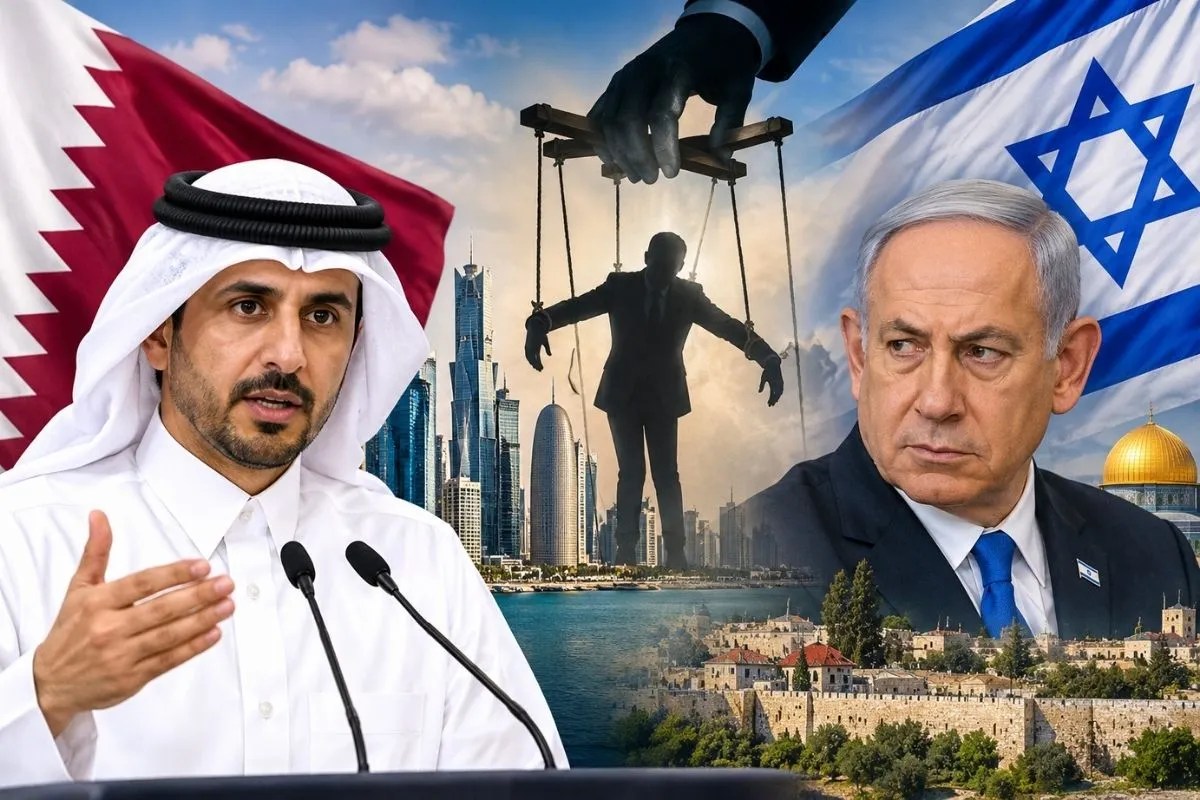
Silence in a diplomatic room has a weight you can feel behind your eyes. It is not the quiet of a library or an empty house. It is the taut, humming stillness of people holding their breath while calculating what another person’s anger might cost them tomorrow.
I have sat in enough waiting rooms outside high-level negotiations to know the smell of stale espresso and fresh ink on promises nobody quite trusts. You watch aides adjust their cuffs, phones face down on glass tables, everyone pretending that a single poorly chosen adjective will not set an entire region back by six months. That is the air Qatar is breathing right now as it pushes back against accusations from Israeli leaders, rejecting the suggestion that Doha is somehow to blame for stalled progress and accusing those same leaders of turning Qatar into a scapegoat to mask their own political and strategic failures. You might also find this related story useful: The Real Reason Spain's High Speed Rail Network Is Failing.
Read the headline and it sounds like just another volley in an endless war of words. Two capitals trading barbs. Another press release. Another round of outrage on cable news.
Except words in diplomacy are rarely just noise. They are load-bearing walls. When you start knocking them down to distract from cracks in your own foundation, the ceiling comes in on everyone. As discussed in detailed coverage by NPR, the implications are notable.
To see why this clash matters beyond the usual back-and-forth, we have to step back from the podiums and look at what happens when the person holding the middle ground is accused of rigging the game.
The Architecture of a Scapegoat
Blame is a remarkably tidy tool. When domestic pressure mounts, when hostage negotiations drag on without a breakthrough, when military objectives collide with political survival, pointing outward is faster than looking inward.
Politicians have relied on that reflex for centuries. Look at almost any prolonged crisis in modern history—from mid-twentieth-century border disputes to tense Cold War standoffs—and you will see a familiar pattern. Whenever an internal coalition frays or a promised timeline slips, leaders often search for an external culprit who is both visible enough to blame and inconvenient enough to argue with.
Qatar fits that profile with frustrating precision for its critics. Small in geography, outsized in reach, Doha has spent years positioning itself as a go-between in conflicts that bigger, louder powers could not—or would not—touch. It hosts offices, maintains backchannels, talks to actors that Western capitals refuse to seat at the front table, and absorbs the resentment that inevitably comes with being the messenger.
Being the messenger is a thankless job. Nobody thanks the mail carrier when the bill arrives.
To make this dynamic concrete, let us use a hypothetical scenario—not because the real diplomacy is fictional, but because an everyday parallel makes the mechanics unmistakable. Picture a neighborhood feud between two families who have not spoken in years, and a mutual acquaintance who agrees to pass notes back and forth so the dispute does not spill into the street. Every time negotiations stall, one side tells the whole block that the go-between is dragging their feet on purpose. Soon, neighbors stop asking what the two families actually want and start arguing about whether the go-between has ulterior motives.
That is the trap Qatar is pushing back against. When Qatari officials push back hard against Israeli leadership, they are not merely defending their reputation in a vacuum. They are fighting a narrative shift—one that tries to recast a mediator as an obstacle so domestic audiences focus on the go-between rather than on unresolved decisions at home.
And honestly? Watching this unfold makes you wonder how any third party survives the process with its credibility intact. Diplomacy is messy, opaque, and often deeply frustrating for people waiting on answers. When you are on the outside looking in, it can feel impossible to know who is genuinely trying to close a deal and who is stalling for leverage. That uncertainty is real. Admitting that the fog is thick is the only honest way to walk through it.
What Happens Inside the Room
Most people picture diplomacy as dramatic handshakes under bright lights. The reality is far more tedious—and far more fragile.
It happens in windowless rooms where drafts change by a single word between midnight and four in the morning. One side insists on phrasing that guarantees immediate security; the other demands language that protects long-term political standing. A negotiator spends hours testing whether a compromise on timing can unlock movement on access, only to watch the entire sequence freeze because a statement made thousands of miles away altered the mood in the room.
In those moments, trust is not a feeling. It is currency.
Once a mediator is publicly branded as untrustworthy or complicit, that currency loses value fast. Even if private channels stay open, the public accusation changes the calculus for everyone watching. A hardliner at home points to the criticism as proof that talking was a mistake. A skeptical public grows more cynical about every rumor of progress.
Qatar’s counter-push is a direct response to that erosion. By calling out what Doha characterizes as an attempt to shift blame for failure, Qatari leaders are drawing a line: we will not quietly absorb responsibility for deadlocks created elsewhere.
Consider what happens next if that line holds—or if it snaps.
If Doha’s pushback forces a sharper focus on the actual sticking points of the negotiation, then the noise clears a little, even if the temperature rises. Hard questions get asked about positions, demands, and political incentives rather than personalities and motives.
If, instead, the accusation sticks and widens, the cost spreads far beyond two capitals. Mediation depends on being acceptable enough—or at least useful enough—to multiple sides at once. The moment a mediator is treated as a partisan villain by one key player, the entire bridge starts to sway.
The Invisible Stakes for Ordinary Lives
High diplomacy can feel terribly distant when you are making coffee in your kitchen or checking the news on a crowded train. Treaties, communiqués, and ministerial rebukes sound like chess moves played by people whose names you barely remember how to spell.
Yet every delay in a negotiation carries a human price tag that never shows up in a press briefing.
For families waiting for loved ones, another stalled week is not an abstract diplomatic setback. It is another seven days of unanswered questions, sleepless nights, and fragile hope stretched thin. For civilians living under the shadow of ongoing conflict, another breakdown in talks can mean another round of fear, displacement, or scarcity.
That is why scapegoating in crisis politics is so dangerous. It turns urgent human stakes into theater.
Let us use a metaphor here to see how easily that happens. Imagine a surgeon in an operating room who turns to the staff and blames the thermometer for a patient’s fever, while refusing to address the infection underneath. Smashing the glass might make the surgeon feel decisive for ten seconds. It does nothing to bring the fever down.
When political leaders blame an external mediator for their own inability to deliver results, they are smashing the thermometer. It creates motion without healing. It gives supporters someone to shout at while leaving the core impasse untouched.
Qatar’s sharp rebuttal cuts right at that theater. By framing the criticism as a deflection from Israeli leaders’ own failures, Doha is stripping away the polite diplomatic euphemisms and naming the political game being played in plain sight.
Does that mean Qatar’s hands are spotless or its motives purely altruistic? No serious observer of Middle Eastern statecraft believes any nation acts without strategic interests. Qatar has built influence, soft power, and regional relevance through its role as a hub and interlocutor. Calling out a scapegoat narrative does not erase statecraft; it simply exposes a different layer of it.
Why Credibility Is Harder to Rebuild Than Destroy
There is an old truism in human relationships that applies doubly to international crises: trust arrives on foot and leaves on horseback.
You can spend a decade cultivating quiet access with rival factions, building a reputation for discretion, and hosting talks that everyone else avoids. It takes only a few high-volume accusations—repeated often enough in speeches and media briefings—to plant doubt in millions of minds.
Once doubt takes root, even helpful moves look suspect. If a mediator proposes a new framework, critics ask what angle they are playing. If talks pause, critics claim the mediator engineered the stall. Everything gets filtered through suspicion.
That is why this moment is a turning point for how international mediation is judged. If publics and governments start treating every go-between as a convenient scapegoat whenever talks hit a wall, the world loses one of its few non-military pressure valves.
Think about that for a second. When traditional alliances are strained and public anger is running high, backchannels and mediators are often the last thin thread keeping a crisis from spiraling completely out of control. Cut that thread just because it is tangled, and you do not untie the knot. You just lose control of what is hanging from it.
Qatar is betting that pushing back loudly is better than bleeding credibility quietly. In diplomatic terms, that is a gamble. Outspokenness can rally allies and sharpen your case, but it can also harden resentment among adversaries who already view your role with suspicion.
Still, silence has its own risks. Stay quiet while someone paints you as the villain of the story, and by the time you speak up, half the room has already memorized the script.
Reading Between the Diplomatic Lines
When you follow a story like this, the easiest mistake is picking a team before understanding the incentives.
Ask yourself what each side gains from the public fight. When Israeli leaders criticize Qatar’s role or posture, they are speaking not just to Doha, but to domestic voters, coalition partners, and allies watching how firm they appear amid intense pressure. When Qatar fires back that it is being made a scapegoat to hide those leaders’ failures, Doha is speaking to regional partners, international backers, and anyone who sees the blame game for what it is.
Both sides are managing audiences. Both are protecting leverage.
What gets lost in the crossfire is clarity—the plain, unvarnished truth about what is actually blocking a resolution and who is willing to pay the political cost to move past it.
History is merciless toward leaders who confuse blame with strategy. Loud accusations feel powerful in the moment. They fill headlines. They give crowds a target. Yet months or years later, when historians look back at why a crisis dragged on or why a deal slipped away, nobody cares much about the cleverest insult traded at a podium. They look at who made hard choices and who looked for someone else to hold the bag.
A single spark can turn dry brush into a blaze. A single honest compromise can cool a room that has been boiling for weeks.
Between those two possibilities stands a fragile table, a stack of disputed drafts, and people who cannot afford another week of noise disguised as progress.


