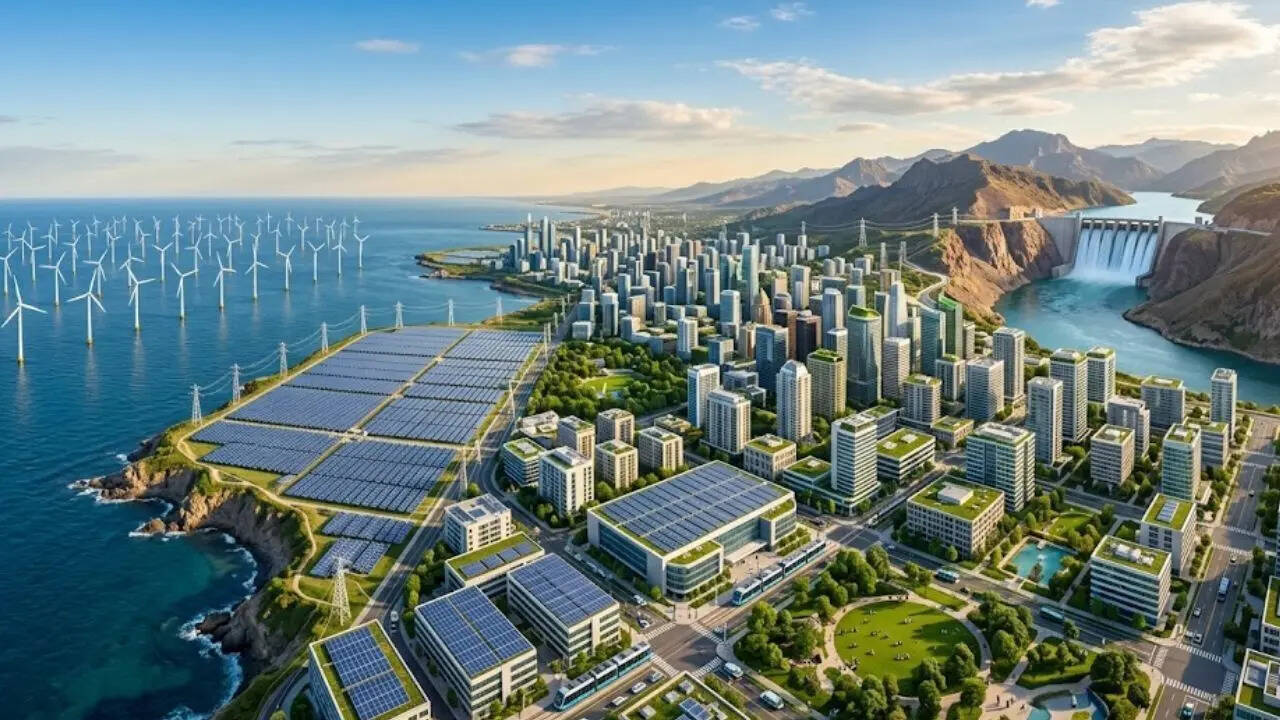
The claim that a city is powered entirely by renewable energy requires a rigorous audit of the distinction between physical electron flow and contractual accounting. In the United States, several municipalities have crossed the threshold of 100% renewable electricity procurement, but the operational reality involves a complex interplay of geography, legacy infrastructure, and Renewable Energy Credits (RECs). Reaching this milestone is not a matter of simply installing solar panels; it is an exercise in managing grid intermittency and securing long-term Power Purchase Agreements (PPAs) that decouple a city’s fiscal energy footprint from fossil fuel volatility.
The Triad of Municipal Energy Transitions
Decarbonizing a city’s power supply rests on three structural pillars. If any pillar is weak, the claim of "100% renewable" becomes a marketing label rather than a technical reality.
- Resource Proximity: The presence of high-density energy sources like large-scale hydroelectric dams or geothermal vents within a manageable transmission radius.
- Regulatory Autonomy: The ability of a municipal utility to bypass investor-owned utility (IOU) mandates and dictate its own procurement mix.
- Storage and Balancing: The capacity to manage the "duck curve"—the gap between peak solar production and peak evening demand—without falling back on natural gas peaker plants.
Cities that have achieved this status typically utilize a dominant, "always-on" renewable source, primarily hydroelectricity, which provides the base-load stability that wind and solar cannot yet guarantee without massive battery arrays.
Case Study Analysis Geographic Advantage and Infrastructure
The success of early adopters in the U.S. serves as a blueprint for the structural requirements of a green grid.
Aspen, Colorado: The Hydro-Wind Hybrid
Aspen reached its goal by leveraging a diverse portfolio. The city’s energy mix is roughly 53% wind, 46% hydroelectricity, and a small remainder from solar and landfill gas.
- The Logic: Hydro provides the foundation. Because water flow is controllable, it acts as a mechanical battery, allowing the city to absorb the variability of wind power.
- The Constraint: Small-scale hydro is subject to seasonal runoff variations. Drought conditions in the West present a long-term risk to this model, forcing cities to over-index on wind and solar to compensate for potential hydro shortfalls.
Burlington, Vermont: The Biomass Factor
Burlington became the first city in the U.S. to source 100% of its electricity from renewables. Their strategy involves a mix of wind, hydro, and biomass.
- The Logic: The McNeil Generating Station, a wood-burning biomass plant, provides a steady base load. Unlike wind and solar, biomass can be ramped up or down based on demand.
- The Constraint: Biomass remains a point of contention regarding carbon neutrality. While technically renewable because trees can be replanted, the immediate carbon output at the stack is higher than coal. Burlington’s model relies on sustainable forestry practices to justify the carbon-neutral designation.
Georgetown, Texas: Economic Arbitrage
Georgetown’s shift was driven by price stability rather than environmental policy. As a municipally owned utility in the heart of wind-rich Texas, they secured long-term contracts for wind and solar that were cheaper than traditional coal or gas options.
- The Logic: By locking in 20-year fixed rates, the city hedged against the fluctuating costs of fossil fuels.
- The Constraint: Market volatility in the ERCOT (Electric Reliability Council of Texas) grid can still affect the city's financial standing if their production exceeds local demand during periods of low market pricing.
The Mathematics of the 100% Threshold
To understand how a city like Greensburg, Kansas, or Kodiak Island, Alaska, functions, one must examine the $E_{total}$ equation. The goal is to ensure that:
$$E_{generation} \ge E_{consumption}$$
On an annual basis, this is easy to achieve. However, on a second-by-second basis, it is nearly impossible without storage. Most "100% renewable" cities operate on a Net Metering or REC-based system. They export excess solar energy during the day and import grid power (which may be coal or gas-fired) at night. They then retire RECs to offset the carbon footprint of that imported power.
The transition from contractual 100% to physical 100% requires a fundamental shift in how we value energy.
The Storage Bottleneck
For a city to be physically carbon-free, it must solve the storage duration problem.
- Short-term (0-4 hours): Lithium-ion batteries manage solar drops during the evening ramp.
- Medium-term (4-24 hours): Pumped hydro or flow batteries handle multi-day cloud cover or low-wind periods.
- Long-term (Seasonal): Green hydrogen or thermal storage addresses the drop in solar output during winter months.
Kodiak Island, Alaska, solves this via a combination of wind and hydro, using a massive fly-wheel system to stabilize the grid against sudden drops in wind speed. This mechanical solution prevents the need for diesel backup generators during minor fluctuations.
The Cost Function of Decarbonization
The primary barrier to replication is the capital expenditure (CAPEX) required for grid modernization. While the levelized cost of energy (LCOE) for solar and wind is now lower than fossil fuels in most regions, the integration costs—upgrading transmission lines and installing smart meters—create a high entry barrier.
Small municipalities have an advantage:
- Lower Peak Demand: Easier to satisfy with localized microgrids.
- Agile Governance: Fewer stakeholders to align compared to a metropolis like New York or Chicago.
- Community Buy-in: High visibility of local projects (e.g., Greensburg’s wind turbines) increases public support for rate adjustments.
Structural Hurdles in the "Last Mile"
The final 10% of decarbonization is the most expensive. This is known as the "Law of Diminishing Returns in Grid Reliability." As a city approaches a purely renewable mix, the cost of maintaining grid stability increases exponentially because the backup systems must be just as large as the primary systems.
To overcome this, cities are looking toward:
- Demand Response: Incentivizing residents to shift heavy appliance use to peak production hours.
- Inter-regional Transmission: Building high-voltage DC (HVDC) lines to move wind energy from the Great Plains to urban centers on the coasts.
- Distributed Energy Resources (DERs): Turning every home with a battery and solar panels into a micro-power plant.
Strategic Path for Municipal Planners
The move to a carbon-free grid is a multi-decade infrastructure project. The most successful cities followed a specific sequence:
- Audit and Efficiency: Reducing the total load through building retrofits before adding new generation capacity.
- Portfolio Diversification: Avoiding over-reliance on a single weather-dependent source.
- Utility Ownership: Transitioning to a municipal utility model to regain control over the sourcing mix.
Cities that fail to address the storage and balancing requirements will find their "100% renewable" status is a fiscal construct that disappears the moment the sun sets or the wind dies down. The objective for the next wave of cities is to move beyond RECs and toward real-time carbon-free energy (CFE), where every kilowatt consumed is matched by a kilowatt produced from a carbon-free source at the same hour and on the same grid.
The transition hinges on the deployment of long-duration energy storage (LDES). Without it, the grid remains tethered to the very fossil fuel assets it seeks to replace, using them as a silent, uncredited backup. The cities mentioned here are not at the finish line; they are the testing grounds for the grid-scale technologies that will eventually determine the feasibility of national decarbonization.