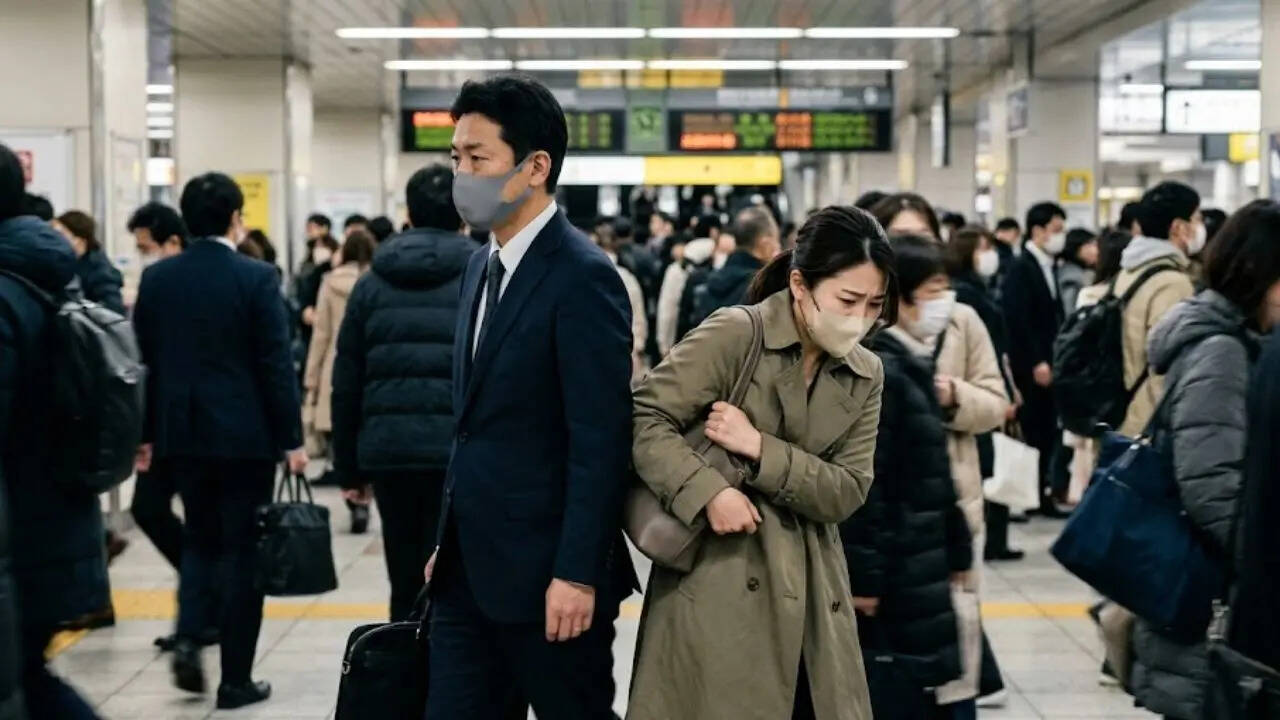
The phenomenon known as Butsukari Otoko—deliberate collision men—represents a specific failure in the social contract of high-density urban transit. While often dismissed as a symptom of generalized stress or overcrowding, a structural analysis reveals a targeted, asymmetrical power dynamic designed to reclaim perceived status through physical intimidation. In the context of Tokyo’s transit infrastructure, which facilitates over 40 million passenger journeys daily, these incidents are not random statistical noise; they are intentional kinetic interventions targeting specific demographics.
Understanding this behavior requires moving beyond emotional narratives and examining the intersection of spatial economics, social hierarchy, and the anonymity of the crowd.
The Kinematics of the Intentional Collision
To define the Butsukari Otoko action, one must distinguish it from the accidental contact inherent in a megacity. A standard accidental collision involves mutual attempts at avoidance, often resulting in a deceleration or a pivoting of the shoulders to minimize impact surface area.
The intentional collision operates on an inverted physics model:
- Vector Persistence: The aggressor maintains a rigid, linear trajectory, refusing to adjust for oncoming foot traffic.
- Impact Loading: Instead of absorbing force, the aggressor leans into the contact, often leading with the shoulder to maximize the transfer of kinetic energy to the target.
- Target Selection Bias: Analysis of reported incidents shows a near-total skew toward women, the elderly, or individuals carrying bags—targets perceived as less likely to retaliate physically or legally.
This behavior functions as a "kinetic micro-aggression" where the aggressor utilizes the physical environment as a weapon. By choosing high-traffic bottlenecks (staircases, ticket gates, or narrow platform segments), the aggressor ensures that the impact is forceful enough to cause distress but fast enough to allow for a quick escape into the mass of the crowd.
The Three Pillars of Aggressor Psychology
The motivation behind deliberate bumping is rarely about reaching a destination faster. It is a manifestation of displaced frustration and a desire for control within a rigid societal structure. We can categorize the drivers into three distinct psychological pillars.
1. Status Reclamation Theory
In a society where professional or social status may be stagnating, the aggressor seeks "micro-victories" to reaffirm their dominance. By forcing another person to yield or causing them physical shock, the aggressor experiences a brief, visceral sense of power. The choice of target is critical here; the aggressor avoids individuals who appear high-status or physically imposing, focusing instead on those they deem "safe" to victimize.
2. The Anonymity Shield
The density of Tokyo’s transit system provides a low-risk environment for antisocial behavior. The "Bystander Effect" is amplified in Japan by a cultural emphasis on wa (harmony) and the avoidance of public confrontation. An aggressor knows that the victim is unlikely to shout or chase them, and the crowd will likely prioritize their own commute over intervening in a momentary scuffle.
3. Spatial Entitlement
There is a documented psychological phenomenon where certain individuals feel an inherent right to a "clear path." When the physical reality of a crowded station contradicts this internal expectation, the resulting cognitive dissonance triggers an aggressive response. The Butsukari Otoko views the presence of others in "his" path as an active provocation.
The Economic and Social Cost Function
The impact of Butsukari Otoko extends beyond individual bruises. It imposes a measurable tax on the efficiency and safety of the transit network.
- The Vigilance Tax: Victims and potential targets must expend significant mental energy scanning crowds for potential threats. This hyper-vigilance leads to increased cortisol levels and long-term transit anxiety, effectively reducing the quality of life for a significant portion of the commuting population.
- Flow Disruption: While the aggressor seeks a clear path, the aftermath of a collision often creates a "ripple effect" in foot traffic. A victim stumbling or dropping items creates a bottleneck, slowing down the throughput of the station.
- Institutional Erosion: If transit authorities and police are perceived as unable or unwilling to address these incidents, it erodes trust in the safety of public infrastructure.
The difficulty in quantifying these costs lies in the under-reporting of incidents. Because the contact is often brief and physical damage is minor compared to violent assault, many victims rationalize the event as a "one-off" or an accident, even when the intentionality is clear.
Defensive Architecture and Surveillance Gaps
The design of Tokyo’s major hubs, such as Shinjuku or Shibuya, contributes to the problem. These stations are marvels of engineering, but they were designed for maximum throughput, not necessarily for the prevention of subtle harassment.
The Bottleneck Problem
Current station layouts often funnel massive volumes of people through narrow "choke points." These areas are the primary operating theaters for Butsukari Otoko. The high density allows them to claim "plausible deniability"—they can argue they were simply pushed by the crowd behind them.
CCTV Limitations
While Japanese stations are heavily monitored, traditional CCTV is often poorly positioned to capture the specific mechanics of a shoulder-check. Cameras are typically mounted high for broad coverage, missing the low-level physical interactions occurring at shoulder or waist height. Furthermore, the sheer volume of people makes real-time monitoring nearly impossible without sophisticated AI-driven behavioral analysis.
Strategic Countermeasures and Systemic Evolution
Addressing targeted harassment in crowds requires a multi-faceted approach that moves beyond simple policing. It requires a shift in how transit spaces are managed and how social norms are enforced.
Behavioral Analysis Integration
The next evolution in station security is the deployment of computer vision systems capable of identifying "atypical movement patterns." A person who consistently moves against the flow of traffic or who maintains a rigid posture in high-density areas can be flagged for observation. This is not about facial recognition, but about gait and trajectory analysis.
The "Shield" Methodology for Commuters
In the absence of systemic intervention, frequent commuters have developed tactical responses.
- Angular Deflection: Walking at a slight angle to the crowd flow rather than a direct head-on path reduces the impact surface.
- The Lead Shoulder: Keeping a bag or a lead shoulder slightly forward creates a buffer zone, making it harder for an aggressor to land a clean hit.
- Visual Engagement: Maintaining a firm, forward-looking gaze—rather than looking down at a smartphone—signals situational awareness. Aggressors typically look for "soft" targets who are distracted.
Legal and Social Recalibration
For a significant shift to occur, the legal definition of assault must be applied more rigorously to these "minor" physical contacts. Recent years have seen a slight uptick in arrests, but the burden of proof remains high. A "zero-tolerance" public awareness campaign, backed by visible transit police presence during peak hours, is necessary to dismantle the Anonymity Shield.
The persistence of the Butsukari Otoko is a reminder that urban design is never neutral. Every corridor, stairway, and gate is a site of social negotiation. When that negotiation fails due to the aggression of a few, the mobility of the many is compromised. The solution lies in a combination of smarter surveillance, defensive spatial design, and a collective refusal to allow the crowd to serve as a mask for harassment.
Stations must be re-envisioned as active environments where the safety of the individual is prioritized over the raw throughput of the mass. This requires moving toward a transit model that recognizes physical harassment as a systemic disruption rather than a personal inconvenience. To mitigate the risk, commuters should prioritize situational awareness at peak nodes, while policy must pivot toward behavioral-based surveillance to identify repeat offenders before they can disappear into the crowd.