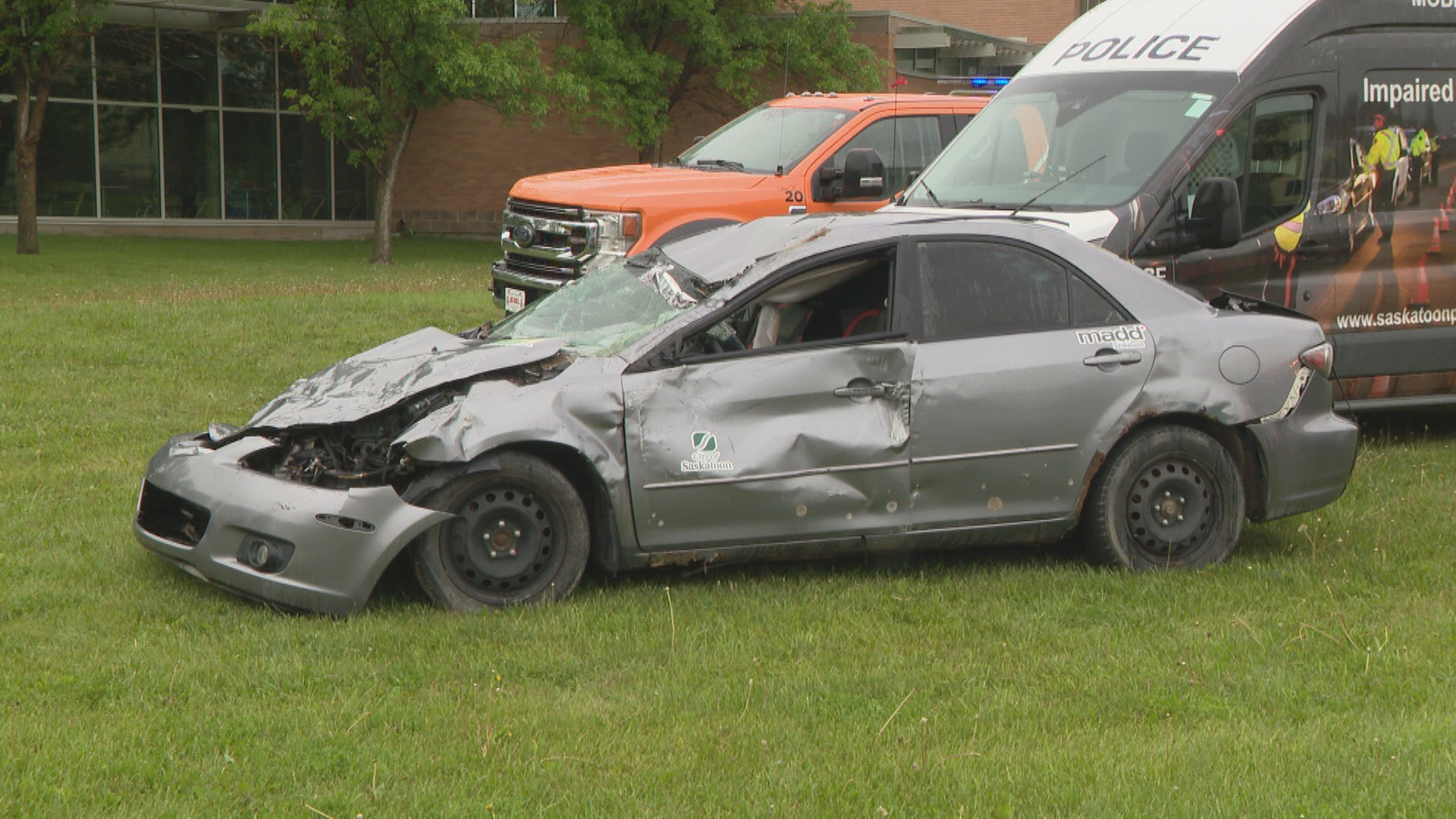
Public safety initiatives routinely rely on high-impact visual trauma to alter civilian behavior. The deployment of the "Crashed Car Campaign" by Mothers Against Drunk Driving (MADD) in Saskatoon serves as a classic case study in shock-based deterrence: placing a severely compromised vehicle at high-visibility intersections to force drivers to calculate the physical risks of operating under the influence. While these tactile installations evoke strong emotional responses, their operational efficacy as permanent behavioral correctors remains heavily constrained by cognitive biases and systemic bottlenecks.
To move beyond the limitations of standard awareness campaigns, we must deconstruct the variables governing impaired driving, map the limitations of shock metrics, and evaluate the structural alternatives required to achieve a sustained reduction in road fatalities.
The Behavioral Economics of Impaired Driving
The decision to operate a vehicle while impaired by alcohol or cannabis can be modeled through a classic rational choice framework, where an individual weighs perceived utility against perceived cost. The fundamental breakdown in public safety occurs because the target demographic consistently miscalculates both sides of this equation.
We can define the Risk Cost Function ($C$) as:
$$C = P_a \cdot P_c \cdot L$$
Where:
- $P_a$ is the perceived probability of law enforcement apprehension.
- $P_c$ is the perceived probability of a catastrophic collision given apprehension or ongoing transit.
- $L$ is the perceived magnitude of the legal, financial, or physical loss.
Shock campaigns like the crashed car installation attempt to artificially inflate $P_c$ and $L$ by presenting a visceral, worst-case outcome. The structural failure of this strategy lies in two distinct cognitive bottlenecks:
1. Optimism Bias and Distance Friction
Drivers do not view the crashed car as a reflection of their own trajectory; instead, they categorize the vehicle as the product of an statistical outlier or an incompetent actor. The message shifts from "This will happen to me" to "This happened to someone who lacked my driving capability."
2. Temporal Decay of Stimuli
The deterrence effect of a physical installation is highly localized and time-dependent. While a driver may experience a brief spike in caution immediately upon passing the intersection of Nelson Road and Attridge Drive, the psychological impact decays rapidly as time and distance increase. By the time the individual is in a high-risk environment—such as leaving a licensed establishment hours later—the cognitive salience of the visual stimulus has dropped to near zero.
Measuring Deterrence: The Failure of Latent Metrics
The success of public safety campaigns is frequently mismeasured through qualitative sentiment rather than quantitative risk reduction. When observers note that an installation makes people "think twice," they are relying on latent metrics—unverifiable internal cognitive states that do not reliably correlate with behavioral changes.
A rigorous analytical approach requires tracking manifest metrics. In Saskatchewan, the operational data exposes a stark divergence between public awareness and driver behavior:
- Systemic Recidivism: Despite years of iterative public safety campaigns, RCMP Traffic Services recorded 33 drug- or alcohol-related fatalities within the province in 2025.
- The Saturation Index: Since 2020, approximately 1,000 road signs have been installed across Saskatoon indicating where a criminally impaired driver was apprehended. Rather than acting as a absolute deterrent, the sheer volume of signs can introduce habituation, where drivers become desensitized to the warning infrastructure.
- Resource Exhaustion: Municipal police data indicates that during high-density checkpoints, law enforcement teams routinely exhaust their operational capacity due to the volume of concurrent apprehensions, forcing the premature termination of active screening.
This capacity ceiling proves that the immediate constraint on impaired driving reduction is not a lack of public awareness, but an enforcement bottleneck. Awareness campaigns do not alter the supply of offenders if the perceived probability of apprehension ($P_a$) remains low due to visible constraints on police resources.
Structural Substitution Over Moral Persuasion
To permanently alter the equilibrium of road safety, structural interventions must supersede moral persuasion. Relying on an individual's sobriety-compromised judgment to choose responsibility is an unstable risk-mitigation framework. True risk reduction is achieved by removing human choice from the safety equation.
[Impairment Detected] ---> [HALT Law Technology] ---> [Ignition Interlock / Vehicle Disabling] ---> Zero Mobility Risk
[Impairment Detected] ---> [Moral / Shock Campaign] ---> [Unregulated Human Choice] ---> Variable / High Mobility Risk
Passive Technological Interventions
The long-term solution shifts liability from the operator to the vehicle architecture itself. The legislative push toward frameworks similar to the United States' 2021 HALT Act (Honoring Abbas Family Legacy to Terminate Drunk Driving) represents a paradigm pivot. By mandating passive, non-intrusive alcohol and drug detection technologies as standard factory equipment, the vehicle becomes an active gatekeeper. If the system detects biometrics or sensor data indicating impairment, the ignition sequence is aborted or the vehicle transitions to a restricted safety mode. This eliminates reliance on the driver's volatile risk calculation.
Micro-Transit Infrastructure and Point-of-Sale Access
A secondary structural lever involves reducing the friction of safe transit alternatives at the exact moment of consumption. The probability of an individual driving impaired increases when the economic or temporal cost of alternative transportation is high. Municipalities that integrate subsidized micro-transit, ride-share geofencing around entertainment districts, and mandatory commercial vehicle coordination at point-of-sale locations see structural shifts in compliance that shock campaigns cannot replicate.
The Strategic Path Forward
Public safety organizations must reallocate capital from purely visual, temporary installations toward high-yield systemic interventions. The utility of the crashed car display is not entirely void; it serves as an effective fundraising and political lobbying tool to maintain organizational visibility. As a mechanism for direct behavioral modification on public roads, however, its return on investment is fundamentally capped by human psychology.
Municipalities and advocacy groups looking to optimize road safety assets should prioritize the following sequential playbook:
- Shift funding from static roadside displays into localized, high-frequency tactical checkpoint operations to directly maximize the perceived probability of apprehension ($P_a$).
- Lobby for accelerated regulatory timelines on passive biometric vehicle immobilization systems, transforming public safety from an educational campaign into an engineering constraint.
- Establish data-sharing pipelines between municipal police forces and ride-sharing networks to dynamically deploy transit subsidies to zones experiencing high rates of checkpoint closures due to processing overcapacity.


